How to Calculate Costs and Returns for Field Management Software
Learn how to calculate ROI for field management software by weighing licensing, setup, and training costs against trackable labor and operational gains.
by Guillermo Sánchez
|
Knowing how to calculate ROI for field management software starts with comparing its total cost with the financial value it delivers. Include software, implementation, and training costs, then measure gains against a clear baseline.
A useful business case reflects real field workflows, not best-case assumptions. This guide shows how to estimate costs, identify measurable returns, and assess the investment over a defined period. Clear figures give decision-makers a practical way to judge whether the software fits their operations.
Key Takeaways
- Separate recurring software expenses from implementation and training to see the full cost of adoption.
- Estimate returns using operational improvements your team can track, not assumptions about best-case performance.
- Set a consistent evaluation period and include relevant overhead and taxes in the business case.
- Use clear project data to connect investment decisions with the realities of field operations.
Software licensing, implementation, and training costs
Measure labor savings by comparing baseline hours for dispatch, paperwork, and project closeout with hours after rollout. Value saved time using labor costs, but distinguish estimated labor value from actual cash savings. Compare mileage and vehicle expenses before and after implementation, counting only reductions supported by project records.
-
List Software and Implementation Costs
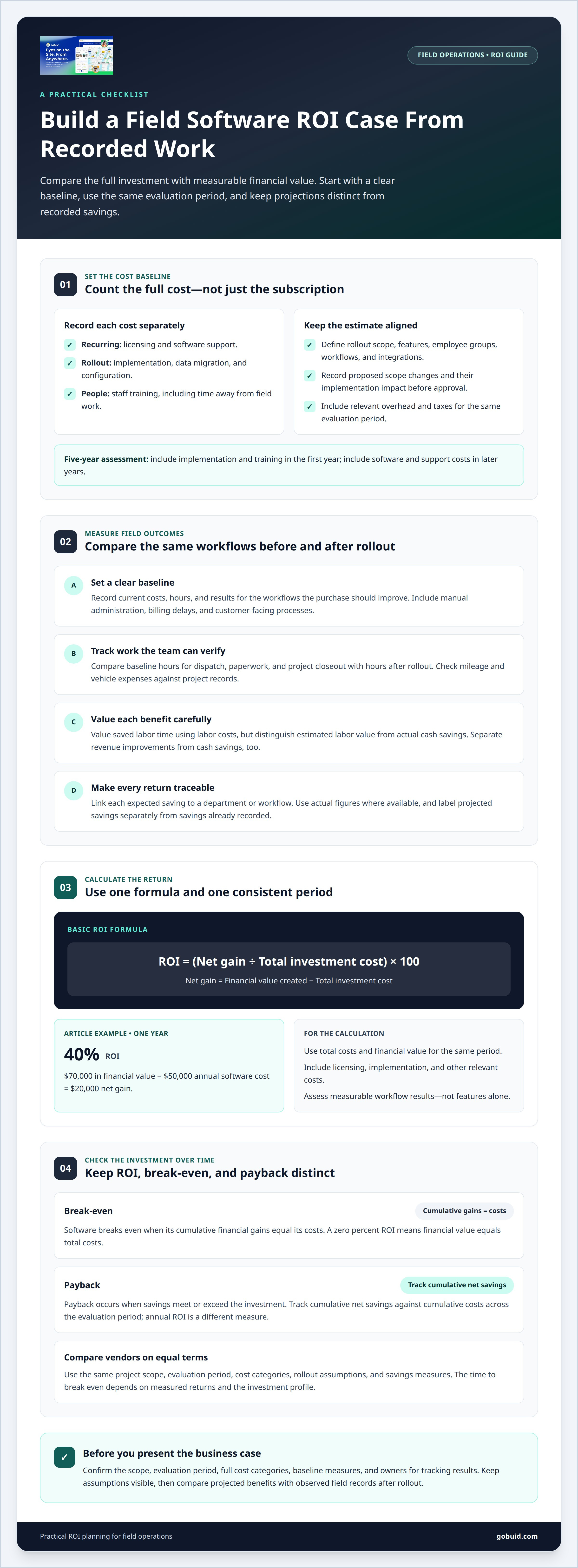
Record licensing, implementation, data migration, configuration, and staff training as separate costs. Note which features and employee groups each expense covers, including training time away from field work. For teams evaluating tailored business applications or custom integrations, development partners like sydeso.com can help outline upfront engineering and ongoing management budgets. For a five-year assessment, include implementation and training in the first year, then software and support costs in later years. Define the rollout scope early so added integrations or workflows do not quietly inflate the estimate.
-
Estimate Annual Software Costs
Convert a monthly subscription into an annual figure by multiplying the monthly fee by 12 months. Keep one-time setup costs separate from recurring licensing and support. Treat this as an example, not a quote for your project.
- Estimate returns alongside costs. Compare current labor hours, travel, and vehicle expenses with post-rollout metrics, and link each expected saving to a department or workflow. For example, fewer hours spent assembling reports can create a measurable labor benefit. Use actual figures where available, and clearly separate projected savings from savings already recorded.
- Control scope creep with a written list of required features, data to migrate, and training needs. Record each proposed change and its effect on implementation effort before approving it. This keeps the cost estimate aligned with the work the team needs and makes ROI easier to assess.
How do you calculate ROI on software?
Compare vendors against the same project scope, evaluation period, total-cost categories, and savings measures. Software reaches break-even when cumulative financial gains equal its costs. The time required depends on measured returns and the investment profile.
-
Apply the Basic ROI Formula
To understand how to calculate ROI for field management software, subtract total investment cost from the financial value created to find net gain. Divide net gain by total investment cost, then multiply by 100. For example, $70,000 in value minus a $50,000 annual software cost equals a $20,000 net gain, producing 40% ROI for that year. Include licensing, implementation, and other relevant costs in the same period.
-
Evaluate the Investment
Apply the formula to the full project, not just the subscription. Use consistent figures for software costs, implementation, and savings, and distinguish cash savings from estimated labor value. A zero percent ROI means the investment breaks even: its financial value equals its total costs. For project management software, assess the workflows it affects and count measurable results, not features, as returns.
-
Estimate Time to Payback
Track cumulative net savings against cumulative costs across the evaluation period. Payback occurs once the savings meet or exceed the investment; don’t treat annual ROI as the same measure. For decision-makers, compare vendors using identical assumptions about rollout, use, and expected gains. A field project data view can help keep performance measures connected to recorded work, rather than relying on broad estimates.
Building a business case for field service software
Build the case around a defined period, measurable savings, and outcomes that matter to field teams and customers.
- Choose the workflows the purchase should improve, then record their current costs and results. Include manual administration, billing delays, and customer-facing processes. Separate cash savings from revenue improvements so decision-makers can see where each projected return comes from. A clear baseline makes later comparisons more useful.
- Map each expected benefit to a practical metric. In a fictional Bill’s Bikes example, avoiding late fees saves $200 monthly, while accurate invoices save $250 monthly. On-time invoices and digital payment options add an estimated $250 monthly in revenue. Together, these changes connect customer experience to trackable business outcomes—an effect also emphasized by trade platforms like Trade-Hive, where verified feedback and consistent service standards help contractors sustain customer trust and revenue.
- Include all relevant costs for the same evaluation period, including overhead and taxes. Software pricing can vary with business size, user needs, and selected features, so assess the expected scope rather than assuming one price fits every company. Make assumptions visible and show how adoption or workflow changes could affect the estimate.
- Present the decision in plain terms: ROI is the financial return compared with the investment. Bill’s Bikes estimates $1,200 in monthly savings from its upgrade, including a $500 monthly saving from eliminating a payroll processing fee. Compare projected benefits with total costs, then explain which metrics will show whether results are positive after rollout. Organize project information to make those decisions easier to support.
GoBuid: Equipment Management
GoBuid’s Equipment Management can support ROI planning when equipment workflows are part of the investment case. Use Equipment Management alongside project measures to keep the evaluation focused on work your team needs to manage.
For a broader operational picture, GoBuid’s customised forms and Manpower Tracking can help structure project information, while one-click report generation can make it easier to compile. Keep the business case grounded in measurable outcomes, such as reduced manual reporting effort or clearer project records. These tools are especially relevant when your ROI assessment covers workforce, reporting, or equipment workflows.
Contact GoBuid to discuss how these tools fit your field management needs.
Turn ROI into a practical next step
Turn an estimate into a working decision by assigning owners to the metrics and reviewing them against project records. Calculating ROI for field management software is more useful when the same measures continue after rollout, allowing projections to be compared with observed workflows rather than left in a proposal.
GoBuid’s Digital Site Diary, Customised forms, and one-click report generation can help organize field information for that review. Keep the process practical: define who records the data, when the team reviews it, and what operational change would justify adjusting the plan. Then use those findings to guide the next improvement, not just the next software decision. Discuss your needs with GoBuid. With clear records and regular review, your team can move forward with stronger visibility and a business case grounded in fieldwork.
Frequently Asked Questions
What Is Return on Investment?
Return on investment (ROI) expresses the financial gain or loss from an investment relative to its cost. A positive result means measured gains exceed costs during the period assessed; a negative result means costs are higher. For field software, assess direct savings and revenue effects separately so decision-makers can see what drives the result.
How Often Should You Measure ROI?
Review ROI every 3 months, then complete a full reassessment every 12 months. Quarterly reviews can reveal whether teams are using the software as planned and whether workflow measures are changing. The annual reassessment gives decision-makers a broader view of costs and outcomes, including changes in project needs, adoption, or operating priorities.
How do you calculate ROI over a period?
Set the start and end points, then include gains and costs recorded within that same period. For a multi-year view, add relevant implementation, subscription, support, and training costs for each period, alongside financial benefits. Keep cash savings distinct from estimated time value, and use the same accounting approach throughout. This makes comparisons between periods more consistent.
What Is the Standard ROI Formula?
The standard formula is net gain divided by investment cost, multiplied by 100. Find net gain by subtracting investment cost from the value created. For example, if gains equal costs, net gain is zero and ROI is zero percent. Use matching cost and benefit periods, or the percentage can misrepresent the project’s financial performance.
What Longer-Term Outcomes Affect ROI?
Long-term ROI can change as field teams adopt new workflows, project volume shifts, and administrative processes improve or remain manual. Consider whether the software supports consistent records across projects, helps teams identify recurring delays, or changes how quickly information reaches decision-makers. Review these outcomes alongside financial measures, and avoid counting the same improvement as both cost savings and added revenue.