Is WhatsApp Still Enough for Managing Construction Projects?
Explore whether construction companies should move away from WhatsApp and how digital construction management software can improve project tracking, communication, compliance and reporting management.
by Michael Camarador
|
Buying construction management software is usually not the hardest part.
Getting people on site to actually use it is.
I’ve seen this firsthand when helping construction teams onboard new software. Management may be ready to digitalise, but site supervisors and workers often have a different question:
“Why change something that already works?”
For many contractors, that “something” is WhatsApp.
It is familiar, fast and already on everyone’s phone. A worker can send a photo, update a supervisor or ask a question without training or learning a new system.
So when small and medium-sized contractors look for construction management software, the question should not simply be “Which software has the most features?”
It should be:
“Which software will my team actually use every day?”
Should Construction Companies Move Away From WhatsApp?
Not necessarily completely.
WhatsApp is still useful for quick communication. There is no reason to force every conversation, message or informal update into a construction management platform.
The problem starts when WhatsApp becomes the system of record for a project.
A project can have multiple group chats for different sites, subcontractors and teams. Over time, important information gets buried.
A photo from an inspection might be hundreds of messages above. A supervisor may need to scroll through conversations to find an instruction from two weeks ago. Management may have to ask the site team to resend documents or photos when preparing a report or responding to an audit.
WhatsApp is excellent for communication.
It is not designed to manage structured construction workflows.
This is where moving certain processes into digital construction software can make a significant difference.
Instead of using WhatsApp for everything, contractors can use it for communication while using software for activities that require structure, accountability and evidence.
For example:
- Safety inspections
- Daily site reports
- Incident reporting
- Equipment records
- Manpower attendance
- Permits and approvals
- Task and issue tracking
- Quality checks
- Project documentation
The goal isn't to make your workers stop using WhatsApp.
It is to stop WhatsApp from becoming your project management system.
What Features Should Small Contractors Actually Look For?
Small contractors don't necessarily need every feature offered by an enterprise construction platform.
In fact, having too many features can make adoption harder.
For smaller teams and first-time software users, I would prioritise features that solve everyday site problems.
1. Mobile Access
Construction teams work in the field, not behind a desk.
Supervisors should be able to complete forms, upload photos, check tasks and submit reports directly from their phones.
If workers have to return to an office or use a complicated desktop system just to submit an update, adoption becomes much harder.
2. Digital Forms and Reporting
Paper forms and spreadsheets can work for a small number of projects, but they become difficult to manage as the company grows.
Digital forms allow teams to standardise inspections, checklists, daily reports and other recurring processes.
More importantly, information can be captured at the point where the work happens.
3. Safety and Compliance
Safety documentation is an important part of construction operations in Singapore.
Software can help organise inspections, incidents, permits, checklists and supporting records so that information is easier to retrieve when needed.
For contractors, the value isn't just having a digital form.
It is having a reliable record of what was done, when it was done and who completed it.
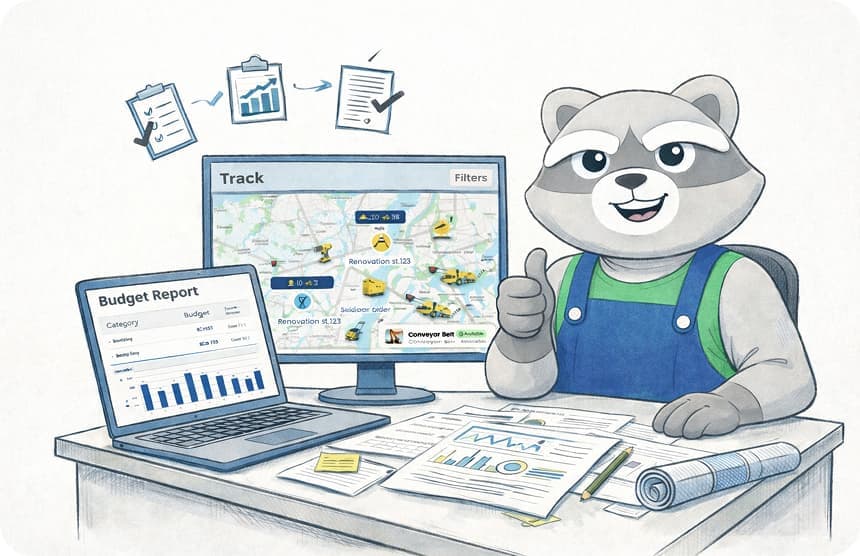
4. Manpower and Equipment Tracking
When a contractor is managing multiple sites, knowing who is working where and what equipment is being used can become increasingly difficult.
Digital tracking provides management with a clearer view of manpower and equipment across projects without relying entirely on messages or manually updated spreadsheets.
5. Tasks and Issues
A message saying “Please fix this” is easy to send.
Knowing whether the issue was actually resolved is another matter.
Construction software can turn issues into trackable tasks, with assigned responsibilities, updates and records of completion.
6. Dashboards and Real-Time Updates
Management shouldn't need to call every site supervisor to understand what's happening.
A central dashboard can provide visibility into project activity, outstanding issues, manpower, equipment and submitted records.
This is particularly useful when one company is managing several projects at the same time.
7. Evidence Management
Construction generates a lot of evidence: photos, inspections, approvals, reports and supporting documents.
The value of digitalisation is not simply storing these files.
It is being able to organise and retrieve the right evidence when you need it.
For example, GoBuid allows teams to create one-click bundled evidence, making it easier to bring relevant records together for reporting, compliance or project documentation.
How Is Construction Software Different From General Project Management Software?
A general project management platform may be useful for managing tasks, deadlines and team communication.
Construction has another layer of complexity.
Work happens across physical sites, often involving supervisors, workers, subcontractors, safety personnel, equipment and compliance requirements.
That means construction software needs to support field execution, not just office-based project planning.
For example, a construction team may need to record a site inspection, attach photos, assign a corrective action and maintain the resulting evidence.
A general task management tool may help with the task.
A construction-focused platform should help manage the workflow around it.
This distinction is important for SMEs because the right tool should fit the way their teams already work.
Do You Need Software That Integrates With BIM, ERP or Accounting?
Integration can be valuable, especially as a contractor becomes more digitally mature.
Larger companies may need connections between estimating, BIM, accounting, ERP, procurement and project management systems.
But for a smaller contractor adopting software for the first time, I wouldn't make integrations the starting point.
First, look at the workflows that are currently creating the most manual work. Ask these questions to yourself:
- Are your teams still using paper forms?
- Are daily reports being sent through WhatsApp?
- Are managers chasing photos and documents?
- Are spreadsheets being used to track manpower or equipment?
If these basic processes aren't structured yet, adding complex integrations may simply create more complexity.
Digitalise the core workflow first. Integrate deeper systems as the business grows.
Cloud-Based and Mobile-First Software Matters
For construction teams, accessibility is critical.
A cloud-based system means information can be accessed by authorised users across different locations, rather than being tied to one computer or office.
The software also needs to be easy for the people actually using it.
A site supervisor should not need extensive training to submit a report. A worker shouldn't have to navigate through complicated menus just to complete a checklist.
This is why simplicity matters so much for SMEs.
The closer a digital workflow feels to the simplicity of sending a WhatsApp update, the easier it is for teams to adopt.
More Features Don't Always Mean Better Software
One of the biggest mistakes I see contractors make is comparing software based purely on feature count.
A platform might have dozens of modules, advanced configuration and extensive integrations.
But if the site team finds it difficult to use, those features don't create much value.
For a small or medium-sized contractor, a leaner system that covers the essential workflows can sometimes be more effective.
Start with the processes your team performs every day. Then expand as your needs grow.
The objective isn't to digitalise everything on day one.
It is to make the important work easier to capture, manage and find.
The Real Benefit of Moving Beyond WhatsApp
Instead of scrolling through multiple WhatsApp groups to understand what happened, management can see the information in one place.
And instead of spending hours compiling evidence at the end of a project or before an audit, teams can build that evidence as the work happens.
That's ultimately what good construction software should do.
Do the work once. Capture the evidence once. Use the record when you need it.
For SMEs considering their first construction management platform, don't start by looking for the software with the longest feature list.
Start by looking at your team's current workflow.
Find the processes that are repetitive, difficult to track or constantly buried in WhatsApp messages and spreadsheets.
Then choose a system that makes those processes easier without making your site teams' jobs harder.
Because the best construction management software isn't necessarily the one with the most features.
It's the one your team will actually use.
Considering software? Read our blog on Choosing the Best Construction Management Software eEspecially for Singapore's Growing SME Contractors 2026