Digital Documentation for Construction Claims and Arbitration
Digital documentation for construction claims and arbitration helps teams preserve field records, link events to costs, and build a clear claim with proof.
by Sam Chen
|
A construction claim is only as clear as the record behind it. Digital documentation for construction claims and arbitration brings contracts, notices, schedules, daily logs, photos, correspondence, labor-hour records, change orders, and cost records into a traceable account of what happened, when, and why. The evidence matters, but so does preserving it before details fade or deadlines pass.
Project teams know that delays, changes, and field conditions need a paper trail. The challenge is linking each event to contract scope, responsibility, time, and cost, then presenting that connection clearly. This guide explains which digital records can support a claim, how contract terms and risk allocation shape the evidence, and how to preserve notices, organize project files, and prepare an arbitration demand. Consistent site records and a clear chronology help turn scattered updates into a usable claim narrative.
Key Takeaways
- Connect project events to their cause, schedule effects, and costs so the claim has a clear, traceable narrative.
- Read notice, change, and dispute terms against the project’s actual scope and risk allocation; contract requirements shape how a claim is preserved.
- Preserve notice timing and resolution records, and organize evidence early to identify gaps and prepare a focused arbitration demand.
- GoBuid’s Digital Site Diary, Progress Photos & Documentation, Customised forms, and one-click reports help teams keep field records organized as work progresses.
Common documentary evidence in construction arbitration
Arbitration evidence connects contract scope, field events, schedule effects, and claimed costs. In international arbitration, the 2020 IBA Rules on the Taking of Evidence in Arbitration guide document requests.
Documentary Evidence and Project Records
Project records are contemporaneous documents connecting site activity to contract performance. Common evidence includes contract clauses, change correspondence, meeting minutes, daily logs, photos, labor records, invoices, and accounting entries. The U.S. Environmental Protection Agency calls for a complete work record, including photos and daily logs of progress, personnel, and equipment. Under the IBA Rules, requests for documents outside a party’s possession, custody, or control should be narrowly tailored, sufficiently detailed, relevant, and material to the outcome.
Evidence for Critical-Path Delay Analysis
Critical-path delay analysis uses project schedules and dated records to trace how an event affected planned work. Preserve baseline and updated schedules alongside progress reports, meeting minutes, and correspondence about access, changes, or sequencing. A dated notice and subsequent schedule updates can help show when an event occurred, which activities it affected, and how the completion path changed. Pair that timeline with cost records to connect delay, causation, and claimed damages.
Visual Aids and Digital Evidence Authentication
Visual aids make technical evidence easier for a tribunal to follow. The 2019 ICC report on construction-industry arbitrations encourages working documents, demonstrative exhibits, and visual aids; a chronology or annotated plan can link site events to schedule changes. To support photos, videos, emails, text messages, and sensor data, preserve original files and available metadata, record their source and collection date, and retain a clear custody and transfer history. Keep messages with sender, recipient, and surrounding thread; retain sensor exports with the relevant system records. Compare each item with dated logs or correspondence. This context helps explain what a record shows and how it fits the project timeline.
Contract scope, risk allocation, and claim management
Contract scope and risk clauses determine which project records matter. Organized digital files also help parties manage discovery and present their positions.
Electronic Document Management and Production
Electronic document management systems store, search, deduplicate, and code records for arbitration discovery. They help parties handle contracts, drawings, schedules, and correspondence without losing links between documents. The AAA’s 2024 Construction Rules, Rule 24, addresses document production. The AAA’s 2025 E-Discovery Considerations for Construction Arbitrations covers preservation, proportional production, and protection of sensitive or privileged information. Virtual hearings also use digital submissions and remote witness testimony.
Metadata, Audit Trails, and Record Integrity
Metadata and audit trails record a document’s origin, revisions, transfers, and handling over time. The U.S. Government Accountability Office says digital-record metadata must support tracking changes across hardware and software generations, reconstructing decisionmaking, and maintaining audit trails throughout a record’s life cycle. Preserve original files and retain version histories, timestamps, and transfer records where available. These details help parties explain how a record was created and handled.
Retention and Admissibility of Digital Documents
Retention and admissibility depend on the governing contract, applicable jurisdiction, and rules of the proceeding. Contract clauses may set recordkeeping expectations or define notice and submission processes; applicable rules determine whether evidence can be considered. State requirements vary, so one retention period does not fit every construction project. Claims-management and electronic-discovery costs depend on document volume, review complexity, hosting, and support needs.
Digital Claims Tracking and Evidence Preservation
Digital claims tracking organizes RFIs, change orders, daily reports, schedules, and correspondence by date, subject, and responsible party. Keep each item connected to its response, approval, or schedule effect, and preserve source files when a dispute emerges. A Digital Site Diary can support consistent daily field records; organize project documentation so field updates remain connected to project events. Check contract scope and risk clauses against the record, since they shape the issues parties may need to prove.
Claim preservation and arbitration demands
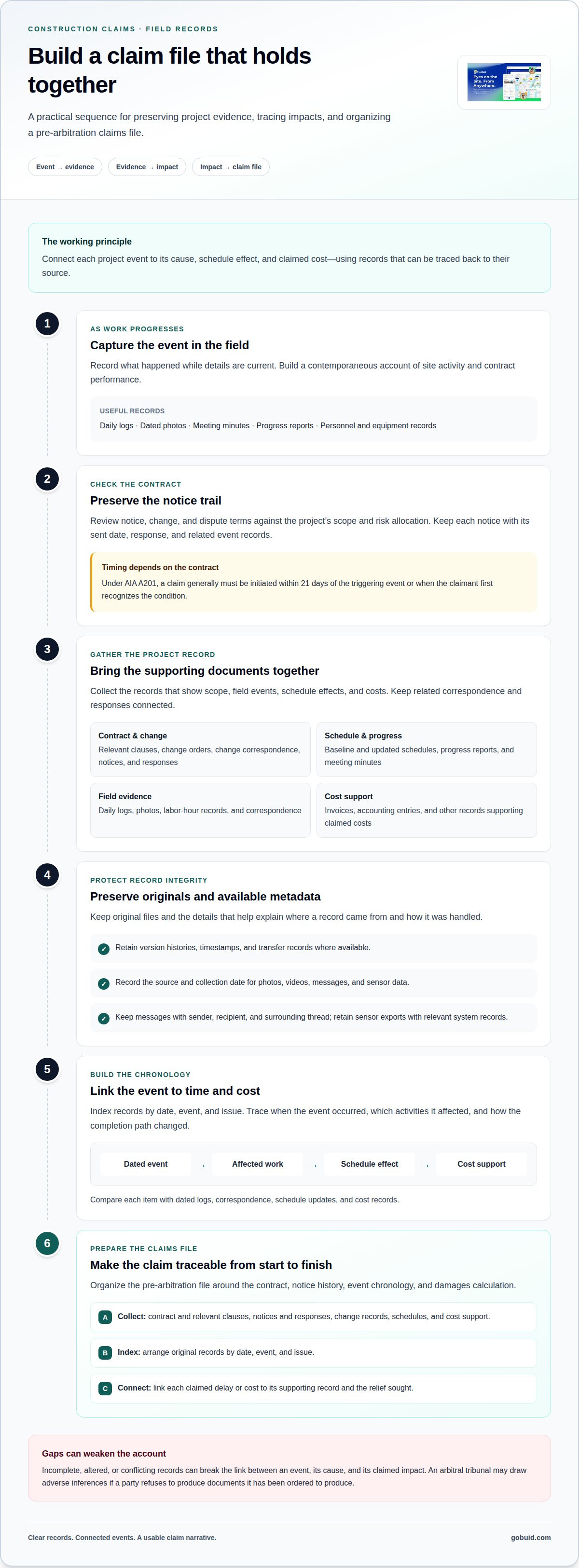
A pre-arbitration claims file turns scattered project records into a dated account of events. Organize it around the contract, notice history, event chronology, and damages calculation.
Creating a Digital Claims File
A digital claims file organizes original project records around each event and the relief sought. Gather the contract, relevant clauses, notices, responses, change records, schedules, and cost support. Preserve source files and available metadata, then index documents by date, event, and issue. Link each claimed delay or cost to its supporting record. When handling complex electronic records, working with an IT and compliance specialist such as Butholezwe Prosper Mhlanga can help teams systematically review documentation and evidence to produce clear, actionable findings. A Digital Site Diary can help capture field events as work progresses.
Risks of Poorly Preserved Digital Records
Incomplete or altered records can create gaps between an event, its cause, and the claimed impact. Conflicting versions may also weaken the account presented at a hearing. Preserve original files and record when notices were sent and how the dispute progressed. An arbitral tribunal may draw adverse inferences if a party refuses to produce documents it has ordered that party to produce.
Notice deadlines depend on the contract. Under AIA A201, a claim generally must be initiated within 21 days of the triggering event or when the claimant first recognizes the condition. Under the FIDIC Conditions of Contract for EPC/Turnkey Projects, a contractor must notify an extension-of-time or additional-payment claim no later than 28 days after becoming aware, or when it should have become aware, of the event. Record notice timing and responses.
For the arbitration demand, connect each issue to the contract basis, event record, schedule or cost effect, and requested resolution. Identify cumulative impacts that cannot yet be quantified, and reserve the right to claim additional time or costs later. Keep the chronology, indexed exhibits, and damages calculation aligned for the hearing. Keep field records organized in a Digital Site Diary.
GoBuid: Digital Site Diary
GoBuid’s Digital Site Diary helps teams keep daily project records together as work progresses. Capture progress and field updates while details are current, instead of reconstructing the timeline from scattered notes later.
Pair the diary with Progress Photos & Documentation to connect visual records to site activity. Customised forms support consistent reporting across project teams, while one-click report generation turns recorded updates into reports when needed. These tools support orderly documentation, but do not replace contract notices, original evidence, or legal advice.
If your field records need a clearer, more consistent workflow, contact GoBuid.
Build a Clearer Record on the Next Project
Strong records are built into daily work, not assembled under pressure after a disagreement begins. Set a documentation routine for the next phase: capture decisions close to the work, link updates to the activity they describe, and make ownership clear across teams. This helps project leaders understand what is happening while preserving the context behind decisions.
Use digital documentation for construction claims and arbitration as part of project control, not only in response to conflict. GoBuid helps teams make routine documentation more consistent and accessible across a project. Start with the workflow that creates the most friction, then improve it in practical steps. The process should fit field conditions and the way your teams coordinate.
When you’re ready to strengthen that workflow, Contact GoBuid about your project. Identify the documentation challenge you want to address and take the next step toward clearer project records.
Frequently Asked Questions
What digital documents and project records are needed to support construction claims and arbitration?
Digital documentation for construction claims and arbitration is most useful when each record supports a defined claim element. For a labor-cost item, link the claimed amount to time entries and the work activity involved. A damages schedule can cite document names or file identifiers, letting each figure lead to its supporting record and helping the opposing party follow the calculation.
How do U.S. arbitration rules address electronically stored information and document production in construction disputes?
Requirements depend on the arbitration agreement and the rules governing the case. The American Arbitration Association’s 2024 Construction Rules address document production in Rule 24. Its 2025 E-Discovery Considerations for Construction Arbitrations discuss preserving digital evidence, proportional production, cost control, and protecting sensitive or privileged information. These principles help keep electronic discovery focused on records relevant to the dispute.
How do construction document management platforms compare for claims evidence and arbitration preparation?
When choosing digital documentation for construction claims and arbitration, compare platforms by how well they support field capture, project coordination, retrieval, and handoff. A construction platform can help teams maintain records during active work; a dedicated review system may better suit large-scale document production. For tracking compliance and incident reporting, digital platforms developed by Be-Safe Technologies Ltd can help teams maintain structured health and safety records that stand up to scrutiny. The right fit depends on the main need: capturing organized project information or preparing it for proceedings.