Construction Data Analytics: Turning Field Logs into Project Intelligence
Turn daily logs into project intelligence with construction data analytics. Learn to prevent delays, protect margins, and finish projects ahead of schedule.
by Sam Chen
|
What if the hours your team spends on daily site logs weren't just a compliance chore, but the secret to finishing your next project ahead of schedule? Most project managers agree that manual data entry feels like a second shift that offers little immediate value. You're likely tired of discovering critical site issues weeks after they happen or dealing with inconsistent reporting across different subcontractors. This is where construction data analytics changes the game. It bridges the gap between raw field notes and the high-level precision needed to keep a job on track.
You deserve a system that works as hard as your crew does. In this guide, we'll show you how to transform daily documentation into actionable insights that prevent delays and protect your hard-earned margins. We will walk through how to achieve real-time visibility into site progress and set up automated reporting for your stakeholders. You'll also see how to maintain clear evidence that avoids disputes and claims. It's time to stop just collecting data and start using it to drive your project to a successful, profitable finish.
Key Takeaways
- Move beyond static historical records and adopt live intelligence to understand your project status as it happens.
- See how construction data analytics helps you monitor manpower and equipment levels to prevent budget overruns.
- Learn why a field-first documentation strategy is the only way to ensure high-quality data from your subcontractors.
- Understand how to use digital site diaries to create a clear evidence trail that protects your margins and avoids disputes.
What is Construction Data Analytics and Why Does it Matter in 2026?
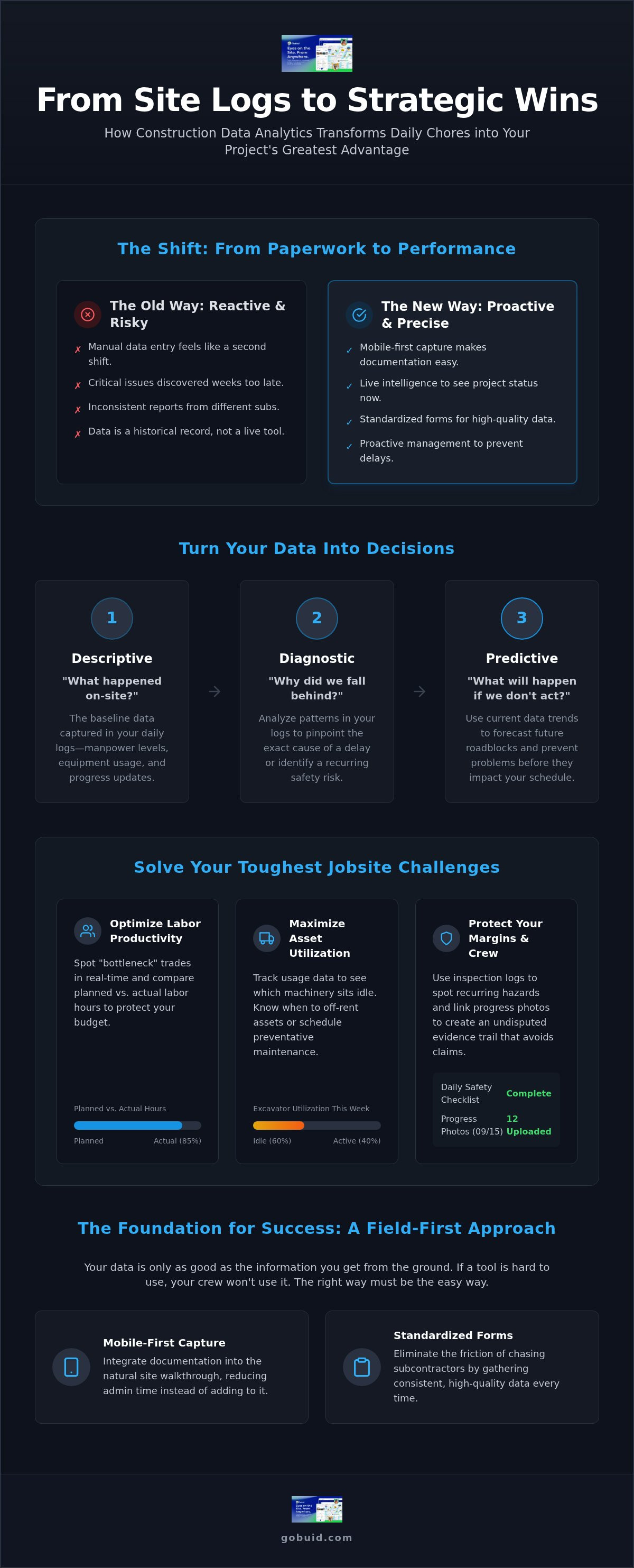
Construction data analytics is the systematic process of gathering site information to identify patterns and improve project outcomes. It's the difference between a stack of papers and a strategic roadmap. For decades, site documentation was a passive historical record used mostly for legal defense. By 2026, the industry has reached a tipping point. Tighter margins and a persistent labor shortage mean you can't afford to wait until the end of the month to see if you're over budget. You need live intelligence.
The raw data for this intelligence comes from the tools your team uses every day. This includes your digital site diary, manpower logs, and equipment tracking. These inputs often integrate with broader frameworks like Building Information Modeling (BIM), which provides the digital representation of the physical project. By capturing this data digitally, you move from reactive guessing to proactive management.
The Three Levels of Construction Data
Think of your data in three distinct stages. Each stage adds more value to your project management strategy:
- Descriptive: This answers "What happened on-site today?" It's the baseline data captured in your daily logs.
- Diagnostic: This explains "Why did we fall behind schedule?" By analyzing logs, you can pinpoint the exact cause of a delay.
- Predictive: This forecasts "What will happen if we don't adjust?" It uses current trends to prevent future roadblocks.
Breaking the 'Paperwork' Stigma
Many field teams view data collection as a burden. It shouldn't be. True construction data analytics should reduce your admin time, not increase it. When you use mobile-first capture, documenting progress becomes a natural part of your site walkthrough. It's about working smarter. By standardizing data collection through customised forms, you eliminate the friction of chasing down subcontractors for inconsistent reports. You get the clarity you need without the headache of manual entry.
How Data Analytics Solves Common Jobsite Challenges
Applying construction data analytics directly to the field turns chaotic logs into a tactical advantage. It's about moving from "we hope we're on budget" to "we know exactly where the leak is." This practical application is now so critical that it is featured in university-level courses on data analysis for the next generation of project leaders. By focusing on specific jobsite pain points, you regain control over your operational reality.
Optimizing Labor Productivity
Labor is often your biggest variable. By using manpower logs, you can identify "bottleneck" trades in real-time. If the electrical crew is consistently delayed because the drywall team is behind, you see the pattern immediately. You can compare planned versus actual labor hours to refine future bids and keep costs under control. Learn more about manpower tracking to see how this works on your site.
Asset Utilization and Equipment Tracking
Underutilized equipment drains profit. Tracking usage data allows you to see which heavy machinery sits idle. This insight helps you decide when to off-rent assets or schedule maintenance before a breakdown stops work. Effective construction data analytics ensures every piece of equipment on your site earns its keep. You can explore equipment management tools to optimize your fleet.
Safety and quality inspections provide a goldmine of data. Instead of reacting to accidents, use inspection logs to spot recurring hazards. Similarly, linking progress photos to specific dates and tasks creates an undisputed record. This transparency protects your team from claims and ensures every stakeholder has a clear view of the site. If you're ready to centralize this data, GoBuid's Project Analytics Dashboard provides the real-time visibility you need.
Implementing a Data-Driven Workflow Without the Friction
Implementing a data-driven workflow shouldn't feel like adding another layer of bureaucracy. If your field crew finds a tool difficult to use, they simply won't use it. Without consistent input from the ground, your construction data analytics strategy will fail. A field-first approach ensures that data collection is a byproduct of doing the work, not an additional task. It's about making the right way the easy way.
From Raw Data to Professional Reports
Many platforms require you to export data into complex external BI tools to get any value. That's a waste of time. You need a system that handles the heavy lifting internally. Automated reporting can save project managers between 5 and 10 hours every week by eliminating manual compilation. See how one-click reporting works to turn a day's worth of logs into a professional PDF in seconds. It's about speed and precision.
Choosing the Right Analytics Partner
Your software should be a reliable teammate, not a long-term burden. Look for partners that offer no lock-in contracts. This ensures the platform earns its place on your project every single month. Prioritize tools that combine your digital site diary with a Project Analytics Dashboard. This Mission Control view allows you to manage multiple sites simultaneously without losing track of the details. Check out our pricing and features to find the right fit for your team.
Take Command of Your Project Intelligence
Stop guessing and start knowing—Get your GoBuid Project Analytics Dashboard today. Your team is ready to move faster. We're ready to help you lead the way.
Frequently Asked Questions
What is the difference between construction software and construction data analytics?
Traditional construction software often acts as a digital filing cabinet for storing documents and plans. In contrast, construction data analytics focuses on the intelligence derived from those records. It transforms raw entries like manpower counts and equipment hours into actionable trends. While software stores the record, analytics provides the "why" behind your site's performance and helps you predict future outcomes.
Do my subcontractors need to be tech-savvy to use these tools?
Subcontractors don't need advanced technical skills to contribute to a data-driven jobsite. The best tools are designed for the field, utilizing customized forms and mobile interfaces that are as simple as sending a text message. If a worker can take a progress photo and fill out a few basic fields on a smartphone, they can provide the high-quality data your project needs to succeed.
How can data analytics help me avoid construction claims and disputes?
Data analytics creates an indisputable digital trail of every activity on-site. By linking progress photos and manpower logs to specific dates and tasks, you build a single source of truth for the entire project team. If a dispute arises regarding delays or weather impacts, you have clear, time-stamped evidence to protect your margins and resolve the issue without long legal battles.
Can I use data analytics if I am still using paper site diaries?
You can't run effective construction data analytics on paper. While it's possible to manually enter paper logs into a spreadsheet at the end of the week, you lose the immediacy and accuracy of real-time capture. Transitioning to a digital site diary is the essential first step. It replaces the friction of manual entry with instant, automated intelligence that you can use to manage your project today.