Preventing Construction Project Delays: A 2026 Strategy for Contractors
Learn the 2026 strategy for preventing construction project delays. This guide shows contractors how to use digital tools to automate reporting and stay on b...
by Sheldon Huang
|
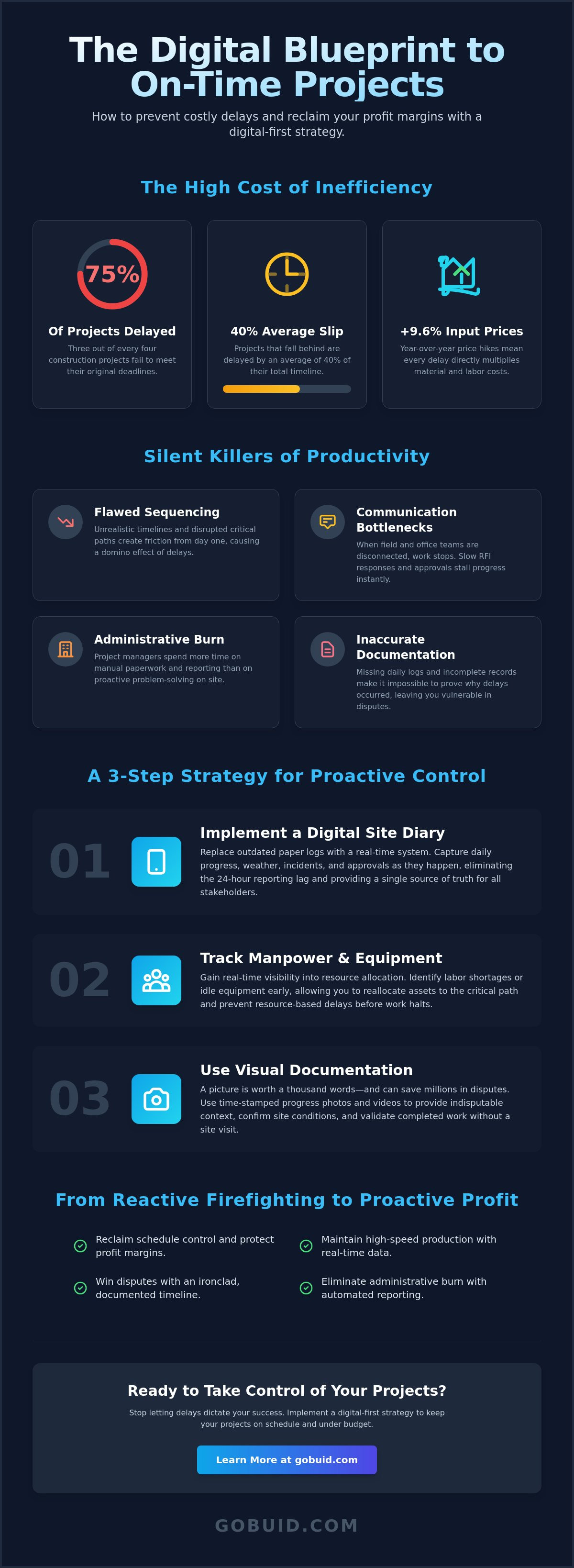
An estimated 75% of all construction projects currently experience delays, with timelines slipping by an average of 40%. In a 2026 market where input prices have climbed 9.6% year-over-year, these setbacks are no longer just a nuisance. They're a direct threat to your firm’s survival. You’re likely feeling the administrative burn of manual reporting while struggling with a lack of real-time visibility into your manpower. It’s nearly impossible to win disputes over delay causes when your records are incomplete or late. Preventing construction project delays requires moving past outdated paper trails and embracing a digital-first operational strategy.
You know that more paperwork isn't the answer, but better data is. This guide provides a direct path to reclaiming your schedule and your profit margins. Discover how to identify early warning signs and implement digital systems that keep your projects on schedule and under budget. We’ll show you how to automate daily documentation, deploy digital site diaries, and use real-time analytics to maintain total transparency across every square foot of your project.
Key Takeaways
- Identify hidden bottlenecks in sequencing and communication that derail the critical path.
- Deploy a Digital Site Diary to capture field data in real-time and eliminate reporting gaps.
- Master a proactive strategy for preventing construction project delays by tracking manpower and equipment usage.
- Eliminate administrative burn by using one-click reporting to generate professional updates instantly.
- Maintain high-speed production by automating safety and quality inspections with customized digital forms.
Table of Contents
Identifying the Root Causes of Construction Project Delays
Construction schedules often fail before the first shovel hits the dirt. Unrealistic timelines and flawed sequencing disrupt the critical path, creating friction that compounds over time. When your baseline is built on guesswork rather than historical field data, you lose the ability to manage the common causes of construction delays. These disruptions often stem from a disconnect between high-level planning and the physical realities of the site. Preventing construction project delays starts with a hard look at how sequencing impacts the critical path.
Communication bottlenecks act as silent killers of productivity. When the field office can't reach stakeholders instantly, work stops. This friction is often caused by administrative burn, where project managers spend more time on manual reporting than on solving site issues. This manual load slows down decision-making and increases response times. Choosing the best construction project management software is essential to bridge these gaps and provide a unified data point for all teams.
To better understand this concept, watch this helpful video:
Efficiency depends on speed. If your team is stuck in a loop of phone calls and emails to verify progress, you've already lost control. Real-time visibility into manpower and site conditions is the only way to pivot before a minor issue becomes a liquidated damage claim. Mastering the flow of information is a core requirement for preventing construction project delays across your entire portfolio.
The Hidden Cost of Inaccurate Site Documentation
Missing daily logs are a liability. Without a complete Digital Site Diary, you can't prove why a delay occurred, leaving your firm vulnerable to expensive disputes. A single missed inspection approval or a slow RFI response triggers a domino effect. One trade waits for another, the schedule slips, and recovery strategies become impossible to implement without verified documentation to back your claims. In 2026, relying on paper or fragmented emails is no longer a viable option for professional contractors who value accountability.
3 Steps to Prevent Delays Using Real-Time Site Data
High-level scheduling defines the goal, but daily site documentation determines the outcome. To keep projects on schedule, you must replace fragmented communication with a centralized data stream. Real-time data allows for immediate course correction. You no longer have to wait for the weekly meeting to discover a task has fallen behind. Preventing construction project delays requires a proactive approach to field data collection.
-
Step 1: Implement a Digital Site Diary. Capture daily progress as it happens. This eliminates the 24-hour lag typical of paper logs and ensures every stakeholder has access to the ground truth.
-
Step 2: Track manpower and equipment usage. Resource gaps are leading indicators of future delays. Identifying these shortages early allows you to reallocate crews or adjust procurement before work halts.
-
Step 3: Use progress photos and documentation. Visual evidence provides context that text logs cannot. It ends disputes and confirms site conditions without requiring a physical site visit.
When you automate the collection of site data, you transition from reactive firefighting to proactive management. This transparency is the only way to maintain a high-speed production environment. You can explore how digital site diaries streamline field operations to see how this works in practice.
Optimizing Resource Allocation with Digital Tracking
Equipment management is a critical factor in preventing construction project delays. Idle machinery is a drain on the budget and a sign of poor sequencing. Digital tools monitor equipment uptime, ensuring you aren't paying for assets that aren't moving. Similarly, real-time manpower tracking ensures the right trades are on-site at the right time. With the construction industry needing to attract nearly 500,000 new workers in 2026 to meet demand, misallocating your existing labor force is an expensive mistake. Precision tracking ensures your most valuable resources are always on the critical path.
Closing the Loop with One-Click Reporting and Analytics
Data collection is only half the battle. If your project managers spend four hours every Friday compiling manual reports, you're suffering from administrative burn. This delay in information sharing prevents timely intervention. Preventing construction project delays requires a system that converts field data into actionable insights instantly. You need to move from recording history to predicting the future.
Efficiency thrives on speed. By using one-click reporting, you eliminate hours of manual data entry. Reports are generated directly from the site diary and manpower logs, ensuring total accuracy. This immediacy allows you to share progress with stakeholders while the information is still relevant. When stakeholders see real-time data, disputes vanish and confidence grows.
Project analytics dashboards provide the final layer of control. These tools allow you to leverage data across multiple job sites to spot trends. If a specific trade is consistently falling behind on three different projects, you can address the root cause before it compromises the next milestone. GoBuid acts as your essential partner for no-nonsense, high-impact project execution. We provide the connective tissue between the site and the office, ensuring every decision is backed by data.
Streamlining Safety and Quality Inspections
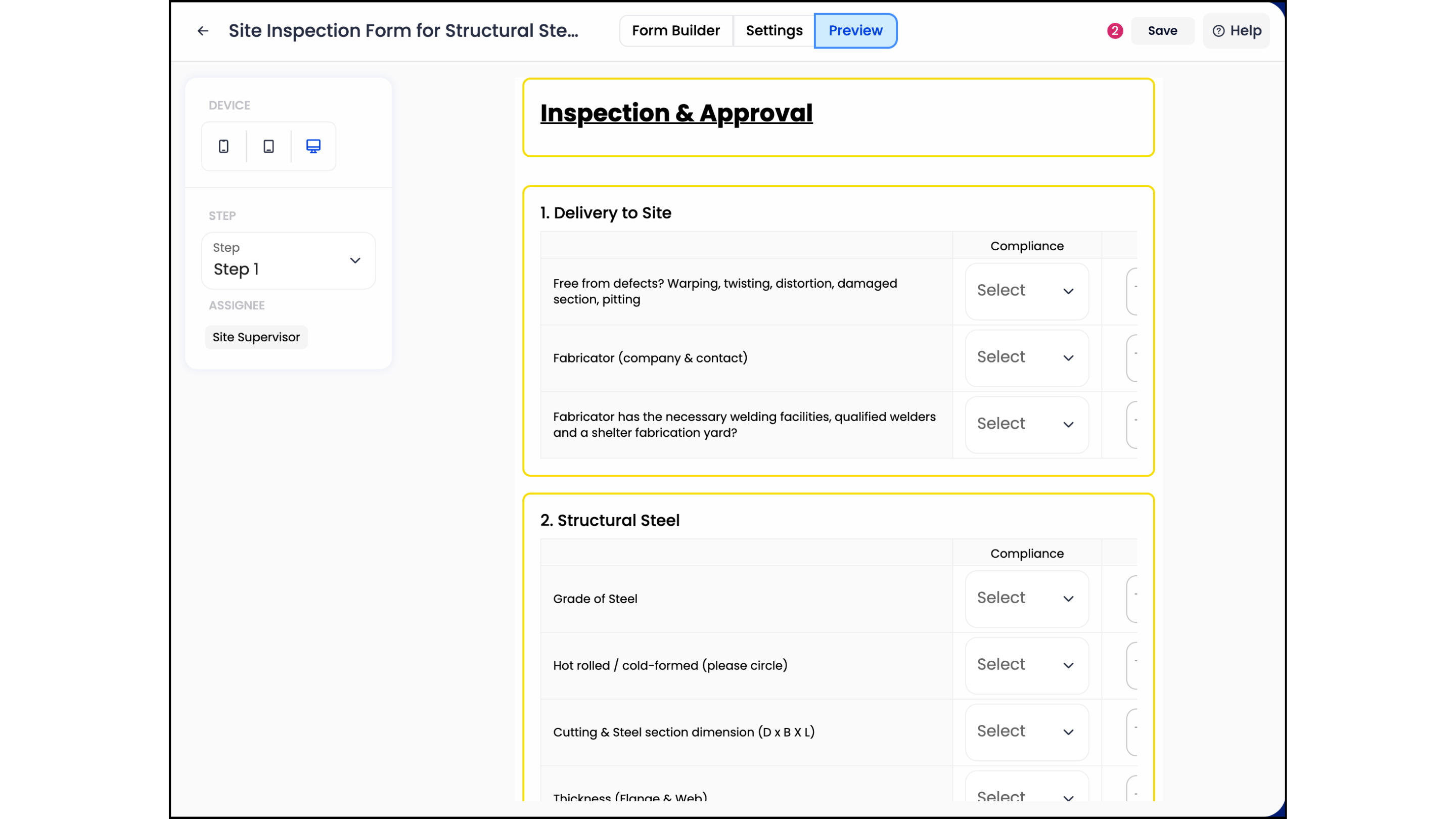
Digital forms prevent inspection bottlenecks by allowing teams to submit data from the field instantly. You don't have to wait for a physical clipboard to reach the office. Immediate visibility into safety risks allows you to rectify hazards before they lead to site shutdowns or accidents. Automating safety and quality inspections ensures compliance without adding friction to the schedule. This proactive oversight is a cornerstone of preventing construction project delays in a fast-paced environment.
Take Command of Your Project Timeline
Maintaining a schedule in 2026 requires more than just a good plan. It demands a digital infrastructure that captures site realities as they happen. You've seen how identifying communication bottlenecks and implementing a digital site diary can change your operational outcomes. Preventing construction project delays is no longer a matter of luck. It's a matter of data precision. You have the tools to bridge the gap between the field and the office.
Stop letting manual reporting and missing logs dictate your profit margins. You can regain control by centralizing your field data and automating your daily updates. This shift reduces administrative burn and provides the transparency needed to solve issues before they escalate into liquidated damages. Transitioning to a digital workflow isn't just an upgrade; it's a necessity for high-performance contracting.
Start streamlining your site documentation with GoBuid today. Our platform allows you to generate professional reports in one click and access real-time manpower and equipment tracking. We value your flexibility, which is why we offer no lock-in contracts. Build with confidence, eliminate the chaos, and keep your projects moving forward toward successful completion.
Frequently Asked Questions
What are the most common causes of construction project delays?
The primary causes of delays in 2026 include labor shortages, material cost volatility, and financing hurdles. Research shows that 45% of contractors reported project setbacks due to workforce shortages, while 20% of private projects currently face financing delays. Additionally, material price spikes, such as the 24.2% year-over-year increase in copper wire costs, often disrupt procurement schedules. Late-stage design changes and permitting bottlenecks also frequently halt progress on the critical path.
How does a digital site diary help in preventing delays?
A digital site diary prevents delays by providing immediate visibility into field activities and site conditions. It replaces fragmented paper logs with a centralized data stream, allowing project managers to spot sequencing errors as they happen. This real-time capture ensures that manpower and equipment are utilized effectively. By documenting progress with photos and time-stamped entries, you create an indisputable record that resolves disputes before they derail the project timeline.
What is the difference between excusable and inexcusable delays?
Excusable delays are caused by factors outside the contractor's control, such as extreme weather or unforeseen site conditions, and typically grant a time extension. Inexcusable delays result from the contractor's own actions or failures, such as poor scheduling or inadequate manpower. Distinguishing between them is vital for preventing construction project delays related to liquidated damages. Accurate documentation is the only way to prove which category a delay falls into during a dispute.
How can one-click reporting save time for project managers?
One-click reporting eliminates the administrative burn of manual data entry, saving project managers hours of weekly office work. Instead of manually compiling notes from various trades, the system aggregates data from digital logs instantly. This allows managers to spend more time on site solving operational issues rather than building spreadsheets. Faster reporting means stakeholders receive updates while the information is still actionable, enabling quicker decision-making and more efficient project execution.