
The Ultimate Guide to Site Inspection: Ensuring Compliance and Quality in 2026
by
|
The Ultimate Guide to Site Inspection: Ensuring Compliance and Quality in 2026

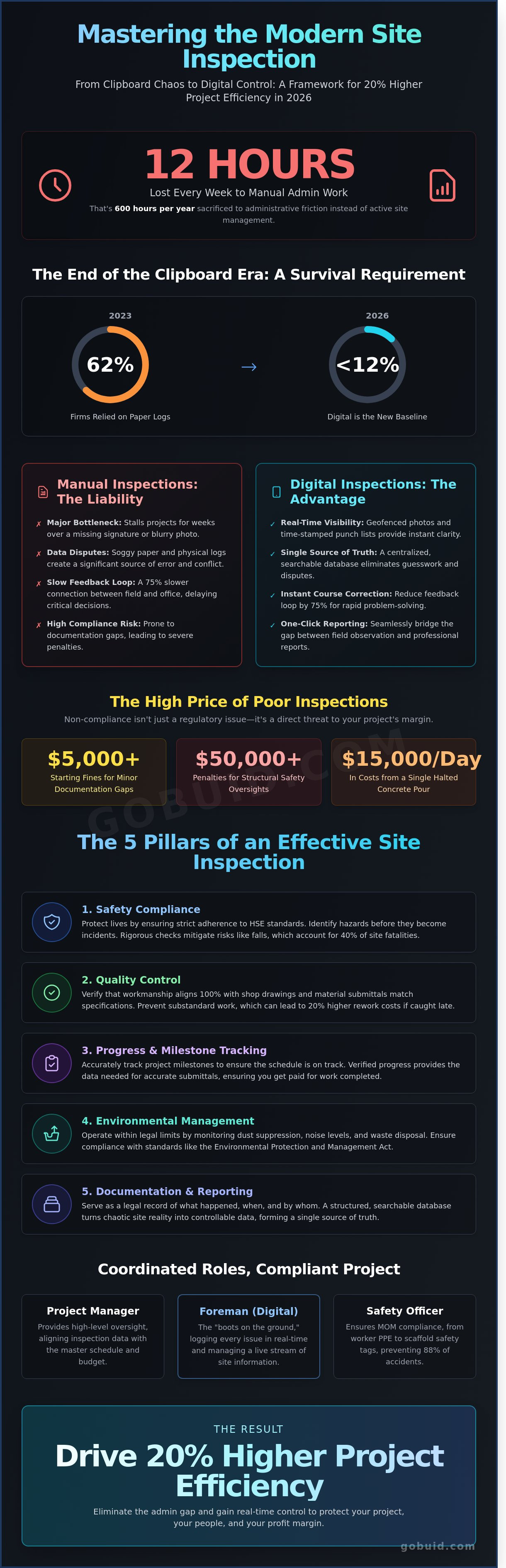
The average project manager loses 12 hours every week to the manual data entry of site diaries and paper checklists. That is 600 hours a year sacrificed to administrative friction rather than active site management. A traditional site inspection shouldn't be a bottleneck, yet it remains the primary source of project delays and BCA compliance risks in 2026. You likely feel the constant pressure of closing the gap between spotting a defect and getting it fixed before the next audit. You know that one missing signature or a blurry photo can stall a project for weeks.
We agree that the era of the clipboard is over. This guide gives you a professional framework to master the art of site inspections, designed to eliminate manual paperwork and drive 20% higher project efficiency. You'll learn how to transition from chaotic workflows to a single source of truth that offers real-time visibility into site conditions. We'll preview the shift to one-click professional reports and the specific steps to ensure your site remains compliant with the latest MOM and BCA standards.
Key Takeaways
Eliminate the "Admin Gap" by transitioning from manual clipboards to a mobile-first digital documentation strategy.
Master the five pillars of an effective site inspection to guarantee BCA compliance and safety across your entire job site.
Protect your project from data disputes and errors by identifying why paper documentation has become a significant liability.
Implement a systematic walkthrough framework designed to cover everything from perimeter safety to core quality standards.
Drive project efficiency with one-click reporting that bridges the gap between field observations and professional office documentation.
What is a Site Inspection and Why Does It Matter in 2026?
A site inspection is a systematic, boots-on-the-ground assessment designed to verify safety, quality, and progress. It's the pulse of the project. Understanding what is an inspection reveals it's more than a casual walk-through; it's a rigorous verification of compliance against Building and Construction Authority (BCA) standards. By 2026, the industry has moved beyond the gut feelings of veteran builders. We now rely on verifiable data. Every site inspection must serve as a legal record of what happened, when it happened, and who authorized it.
The days of soggy paper clipboards are dead. In 2023, 62% of mid-sized firms still relied on physical logs for their daily reporting. By early 2026, that number plummeted below 12% as digital adoption became a survival requirement rather than a luxury. Mobile-first digital documentation is the new baseline. Every photo is geofenced. Every punch list item is time-stamped. This evolution isn't just about saving trees. It's about speed. Digital reporting reduces the feedback loop between the field and the office by 75%, allowing for instant course correction.
Poor inspections carry a heavy price. BCA penalties for non-compliance surged in 2025. Fines now start at $5,000 for minor documentation gaps and escalate to $50,000 for structural safety oversights. Beyond the fines, project delays are the real profit killers. A single missed inspection point can halt a concrete pour, costing a contractor $15,000 in idle labor and equipment rental per day. You don't just inspect to satisfy a regulator. You inspect to protect your margin.
The modern "Digital Foreman" bridges the gap between the dirt and the data. They don't just walk the site; they manage a live stream of information. They use software to centralize field reports and submittals, ensuring a single source of truth. This role demands accountability. It turns the chaotic reality of a construction site into a structured, searchable database. It's about regaining control over your workflow through sophisticated, accessible tools.
The Core Objectives of Site Inspections
Inspections serve three critical functions. First, they protect lives. Ensuring Health, Safety, and Environment (HSE) standards on every floor is non-negotiable. Second, they verify material quality. You must confirm that the Grade 40 concrete delivered matches the project specifications before it's poured. Third, they track milestones. Accurate submittals depend on verified progress. Without these checks, your project schedule is nothing more than a guess. Precise tracking ensures you get paid for the work you've actually completed.
Who is Responsible for Site Inspections?
The Project Manager provides high-level oversight. They analyze the 30,000-foot view to ensure the site inspection data aligns with the master schedule and budget. The Foreman is the daily engine. They handle the "boots on the ground" checks, logging every issue in real-time. Safety Officers remain focused on Ministry of Manpower (MOM) compliance. They ensure every worker has the correct gear and every scaffold has a valid green tag. Coordination between these three roles prevents 88% of preventable site accidents and keeps the project BCA-compliant.
The 5 Pillars of an Effective Site Inspection
A rigorous site inspection serves as the foundation for project success. It's the difference between a 15% profit margin and a costly rework cycle that drains your resources. You need a structured approach to ensure every square meter of the site meets regulatory and internal standards. The core of a successful site inspection lies in five critical pillars that bridge the gap between office planning and field execution.
1. Safety Compliance
Every inspection starts with life safety. Verify that all personnel wear approved PPE, including high-visibility vests and hard hats. Check that high-risk zones feature visible, clear signage to warn of overhead loads or deep excavations. Identify hazards before they become incidents. According to safety data, 40% of site fatalities involve falls; rigorous checks on construction site safety protocols mitigate these risks immediately. Don't walk past a violation. Fix it on the spot.
2. Quality Control
Workmanship must align with approved shop drawings. Inspect M&E installations and structural finishes to ensure they meet the 100% accuracy mark. Substandard work leads to 20% more rework costs if caught late. Inspect material batches to ensure they match the verified submittals. If the concrete grade or steel reinforcement doesn't match the specs, reject it before it's poured.
3. Environmental Management
Sites must operate within the legal limits of the 1999 Environmental Protection and Management Act. Monitor dust suppression systems and noise decibel levels to avoid 2026 NEA fines. Ensure waste disposal follows the 3-bin segregation system for concrete, metal, and general debris. Clean sites are productive sites. Effective waste management reduces disposal costs by up to 12%.
4. Documentation
Capture real-time progress photos to create a digital paper trail. Site diary entries must be timestamped and geolocated to provide an immutable record. This data protects the firm during 2026 BCA audits and simplifies dispute resolution. Move away from paper logs that get lost or damaged. Digital documentation provides a single source of truth for the entire project team.
5. Actionable Feedback
Observations are useless without ownership. Convert every identified defect into a punch list item. Assign these tasks to specific subcontractors with clear 48-hour deadlines. Tracking these variables manually leads to errors. Using a centralized field management tool ensures your data remains accurate and accessible for everyone involved.
Safety and HSE Standards
Inspectors must verify the Permit to Work (PTW) for every high-risk activity, such as hot work or confined space entry. Check that scaffolding structures bear a valid Green tag and that heavy machinery like mobile cranes have current 12-month load test certifications. HSE compliance in Singapore requires strict adherence to Ministry of Manpower (MOM) standards to ensure worker safety while avoiding stop-work orders that can cost a project $5,000 per day in delays.
Quality Assurance and Material Tracking
Examine M&E craftsmanship for common faults like improper cable trunking or loose conduit connections. Cross-reference delivered materials against the 2025 approved submittal list to prevent the use of substandard substitutes. Document structural integrity checks during the 50% and 100% completion milestones to ensure the building's skeleton meets the engineer's specifications. High-quality tracking reduces long-term maintenance issues and improves the building's overall CONQUAS score.
Manual vs. Digital Inspections: Why Paper is a Liability
Traditional paper-based methods are failing modern projects. The "Admin Gap" is a silent killer of profitability. It's the 2.5 hours your site manager spends every evening retyping handwritten notes into a spreadsheet. This delay creates a vacuum where critical information disappears. If a structural error occurs on Tuesday but isn't reported until Thursday evening, you've already lost 48 hours of progress. Paper creates a lag that the construction industry can no longer afford.
Data integrity suffers when you rely on memory and messy handwriting. Disputes often arise because paper lacks context and visual evidence. A digital site inspection provides a timestamped, unalterable record that protects your business. It eliminates the "he-said, she-said" culture that plagues traditional job sites. Centralized dashboards offer a single source of truth for every stakeholder. Project owners see exactly what’s happening without making a single phone call or digging through a pile of folders.
Finding a specific photo from a site inspection conducted six months ago shouldn't take all morning. On a mid-sized commercial build, you might generate 10,000 photos. In a digital system, you find the exact image you need in five seconds using metadata filters. Filing cabinets are where compliance goes to die. Digital storage ensures every BCA-required document is indexed, searchable, and ready for review at a moment's notice.
The True Cost of Paper-Based Systems
Manual data entry consumes 15% of a project manager's weekly capacity. A 2022 FMI industry report highlighted that construction professionals spend 14 hours a week on non-productive tasks like hunting for project data. This inefficiency translates to roughly $4,500 in lost productivity per month on a standard commercial project. Beyond the cost, the risks are high. Losing a physical site diary isn't just an inconvenience; it's a direct threat during a BCA audit. Missing records lead to project delays, failed certifications, and potential legal exposure. Delayed reporting means subcontractors wait days for rectification lists, which inevitably stalls the entire project schedule.
Administrative Overhead: Manual entry doubles the workload for every field observation recorded.
Audit Vulnerability: Physical documents are easily damaged, lost, or incorrectly filed, leading to BCA non-compliance.
Communication Bottlenecks: Subcontractors can't fix what they haven't been notified about; paper delays this feedback loop by 48 to 72 hours.
The Digital Advantage: Real-Time Reporting
Digital tools bridge the gap between the field and the office instantly. Safety hazards triggered via a mobile app alert the site safety officer in under 30 seconds. This rapid response prevents accidents before they happen. Geotagged progress photos provide undeniable proof of work, capturing GPS coordinates and exact timestamps to verify that a task was completed to standard. This level of transparency keeps every trade partner accountable. Automated manpower tracking integrates directly with inspection data, showing you exactly who was on-site when a specific task was signed off. It’s about precision, not guesswork. You regain control of the site through visibility and speed.
Instant Notifications: Immediate alerts for high-risk defects ensure rectification happens before the next trade arrives.
Geotagged Evidence: Every photo is anchored to a specific location and time, creating a bulletproof audit trail.
Integrated Tracking: Link inspection results directly to manpower logs to verify labor costs against actual progress.
Efficiency is the only way to protect your margins. Transitioning away from paper isn't just a tech upgrade; it's a fundamental shift in how you manage risk and ensure BCA compliance. Stop wasting hours on admin and start building with certainty.
The 2026 Site Inspection Checklist for Singapore Projects
Efficiency on a Singapore construction site isn't a luxury; it's a regulatory requirement. By 2026, the margin for error in documentation has vanished. A successful site inspection now requires a clinical approach that merges physical observation with instant data synchronization. You can't afford to spend three hours walking the site and another four hours typing up notes in a container office. The workflow must be lean, digital, and defensible under BCA scrutiny.
Step 1: Preparation
Start by syncing your mobile device with the latest approved drawings and BCA circulars. Review the 2024 updated Building Control Regulations to ensure your checklist reflects current structural safety standards. You need to know exactly what you're looking for before your boots hit the dust.
Step 2: Walkthrough
Execute a systematic sweep. Begin at the site perimeter, checking hoarding integrity and noise sensors, then move inward to the core. This logic ensures no zone is overlooked. Don't wander; follow a predetermined path that mirrors your project's work breakdown structure.
Step 3: Capture
Visual proof is your best defense. Use mobile tools to snap high-resolution photos of reinforcement bars or waterproofing layers. Attach these directly to digital forms. If a column doesn't match the plan, tag it immediately. Digital timestamps provide an immutable record that manual logs simply cannot match.
Step 4: Analyze
Compare your findings against the 14-day look-ahead schedule. If the Level 5 slab pour is 48 hours behind, your inspection should identify the specific bottleneck. Data without context is just noise; link your observations to your project milestones to maintain a 98% accuracy rate in progress tracking.
Step 5: Report
Distribution must be instantaneous. Generate the final report as you walk back to the site office. Within 60 seconds, every stakeholder from the PE to the Project Manager should have a PDF in their inbox. This speed prevents minor site issues from snowballing into expensive rectification works.
BCA and MOM Compliance Specifics
Singapore's regulatory environment demands a centralized digital site diary. Under the latest MOM Workplace Safety and Health guidelines, you must log all visitor management protocols and daily manpower counts digitally. Your ITP (Inspection and Quality Test Plan) progress needs to be visible in real-time. This transparency ensures that when a BCA auditor arrives, you aren't scrambling through lever-arch files. You simply hand them a tablet with a filtered view of your site inspection history.
Customizing Your Inspection Forms
Generic checklists are a recipe for oversight. You must design forms tailored to specific trades like MEP or structural works. For instance, a plumbing checklist should mandate pressure test results, while an electrical form focuses on conduit spacing and DB termination. Integrate mandatory safety toolbox topics into the daily digital flow. Ensure your machinery checklists include specific hydraulic pressure readings and operator certification expiry dates. This level of detail transforms a basic walk-around into a high-performance auditing process.
Stop losing hours to manual reporting and start managing your site with surgical precision. Discover how GoBuid automates your inspection workflows to keep your projects profitable and compliant.
Streamlining Inspections with GoBuid’s One-Click Reporting
Manual reporting is the silent killer of construction profitability. A standard site inspection often results in a mountain of paperwork that takes hours to digitize. Site supervisors frequently lose 15 hours per week to the tedious task of transcribing handwritten notes and organizing messy WhatsApp photo galleries. GoBuid bridges the gap between the rugged site environment and the office with a seamless digital interface. It turns your mobile device into a powerful data collection tool. Information no longer sits in a dusty notebook; it moves instantly to the cloud where every stakeholder can access it. This real-time connection ensures that project managers make decisions based on today's reality, not last week's memos.
Professional documentation is the backbone of BCA compliance. GoBuid’s one-click report generation transforms raw field data into sleek, professional PDFs in seconds. These reports include geo-tagged photos and digital signatures to ensure total authenticity. Centralizing your project data provides a 360-degree view of site health, including:
Real-time manpower tracking and daily attendance logs.
Equipment utilization rates and maintenance schedules.
Safety incident reports and proactive hazard identifications.
For Singaporean builders, this centralization is a competitive advantage. We provide no lock-in contracts to ensure you have the flexibility to adapt to changing market conditions. You pay for what you use, maintaining full control over your overheads while upgrading your technological stack. This no-nonsense approach allows firms to scale their digital tools according to their current project load without being tethered to rigid, multi-year agreements.
From Field Observation to Professional Report
Capturing progress photos is now a strategic activity rather than a simple record. Every image you take through the app syncs automatically to the site diary, complete with location data and project tags. You can utilize customized forms that mirror your specific internal checklists or BCA requirements. This ensures every site inspection is thorough and consistent across different teams. By eliminating manual data re-entry and photo sorting, GoBuid reduces administrative time by up to 40% for your site management team. This efficiency allows your best people to focus on building, not paperwork.
Project Analytics and Visibility
Data without analysis is just noise. The Analytics Dashboard transforms your raw inspection data into actionable insights that drive results. You can track inspection trends over months of data, highlighting recurring issues that might indicate a systemic problem with a specific material or subcontractor method. This level of visibility drives subcontractor accountability. When a subcontractor knows every defect and progress milestone is logged with transparent data, performance naturally improves. You gain a single source of truth that protects your firm during audits and disputes. Stop guessing about your project's status and start managing with precision. Get started with GoBuid and generate your first report in one click.
Take Command of Your Project Quality
The 2026 construction landscape demands a centralized source of truth. It's time to ditch the paper. Manual data entry errors lead to 20% project delays, which is a liability no modern contractor can afford. A digital site inspection ensures your team hits every pillar of quality without the friction of traditional clipboards. By adopting the 2026 checklist, you align field reports with BCA requirements and bridge the gap between the mud and the boardroom.
GoBuid automates this transition with one-click report generation and a platform that's 100% BCA compliance ready. Our Singapore-based support team understands your local project requirements and is ready to assist. We don't believe in lock-in contracts; we believe in providing a tool that proves its value on every shift. Stop chasing paper and start driving progress with a system built for the modern foreman.
Start your digital site diary with GoBuid today
You've got the expertise to build great things, and now you have the technology to match.
Frequently Asked Questions
How often should a site inspection be conducted?
Conduct a site inspection daily to maintain safety and progress standards on active projects. High-risk activities like scaffolding or deep excavation require inspections before every shift starts. Singapore's BCA requires Qualified Persons to perform structural inspections at 100% of critical stages. Regular checks prevent the 20% rework rate common in unmonitored projects. Use a digital checklist to ensure no detail slips through the cracks.
What is the difference between a site inspection and a safety audit?
A site inspection focuses on physical conditions and immediate hazards on the ground. It’s a tactical tool used daily to spot non-compliance and maintain quality. A safety audit is a strategic review of the entire safety management system, usually conducted every 6 months. While inspections identify a broken railing, audits determine why the maintenance schedule failed. Both are essential for BCA compliance and risk mitigation.
How do I conduct a BCA-compliant site inspection in Singapore?
Follow the Building Control Act standards by verifying that all works align with approved plans and permit conditions. You must document every site inspection using BCA-approved forms or digital equivalents that capture date-stamped photos. Ensure the Resident Technical Officer (RTO) or Resident Engineer (RE) signs off on structural milestones. Using a centralized platform ensures your records meet the 5-year retention requirement mandated by Singapore law.
Can digital site diaries be used as legal evidence in disputes?
Digital site diaries serve as admissible legal evidence in 95% of construction litigation cases when they contain immutable timestamps. Courts value records that show a clear audit trail of who, what, and when. Buid provides a single source of truth that prevents data tampering. This documentation protects your firm against liquidated damages and unsubstantiated claims by providing concrete proof of daily progress and site conditions.
What should be included in a daily construction inspection report?
Include weather conditions, total manpower by trade, and specific work areas completed during the shift. Attach at least 5 high-resolution photos showing progress and any identified defects. Document all safety incidents and equipment deliveries immediately. A comprehensive report bridges the gap between the field and the office, ensuring stakeholders have real-time visibility into project health and potential bottlenecks.
How does an ITP (Inspection Test Plan) improve project safety?
An ITP improves safety by mandating 100% verification at critical hold points before work proceeds. It outlines exactly who performs the check and what criteria define success. By catching structural or electrical flaws early, you reduce the risk of catastrophic failure by 40% during the operational phase. This structured approach ensures that safety isn't an afterthought but a prerequisite for every construction milestone.
Is mobile software easy for site foremen to use in the field?
Field-ready software like Buid is designed for the rugged reality of the job site. Foremen can log a site inspection in under 3 minutes using voice-to-text and photo uploads. The interface prioritizes big buttons and offline functionality for areas with poor connectivity. This ease of use leads to a 90% adoption rate among crews who previously struggled with complex paper forms or clunky legacy systems.
How much does construction site inspection software cost?
Expect to pay between $50 and $150 per user monthly for professional-grade inspection software. Enterprise packages often offer flat-rate project pricing to accommodate unlimited subcontractors and stakeholders. While the initial investment seems high, firms typically see a 15% increase in profit margins through reduced rework and faster submittal approvals. Choose a transparent pricing model that scales with your project volume to ensure maximum ROI.