AI Video Surveillance News 2026: The Shift from Mass Monitoring to Site Intelligence
by Sam Chen
|
By January 2026, the job site camera has evolved from a passive observer into your most efficient foreman. Most contractors still view cameras as a liability or a tool for catching thieves, but that perspective is now outdated. Staying current with ai video surveillance news reveals a massive shift toward site intelligence that prioritizes productivity over simple monitoring.
You likely feel the weight of information overload regarding 2025 AI privacy regulations. It's frustrating to distinguish between invasive spyware and legitimate tools that actually improve your bottom line. You want visibility without the legal headache or the fear of mishandled data. This article clarifies the 2026 landscape and shows you how site intelligence delivers a 35 percent increase in reporting accuracy. We'll explore the specific safety features that reduce site hazards and demonstrate how to bridge the gap between raw visual data and automated field reports. It's time to turn your footage into a single source of truth for the entire project team.
Key Takeaways
Stay ahead of the latest ai video surveillance news by shifting from passive storage to real-time, edge-computing analysis.
Deploy automated PPE detection and virtual fencing to eliminate safety blind spots and secure high-risk exclusion zones instantly.
Sync visual triggers directly with your digital site diary to automate safety forms and streamline field reporting.
Navigate the 2026 ethics landscape to build team trust while clarifying liability for AI-driven safety decisions.
Transform raw video feeds into a single source of truth that bridges the gap between field reality and office precision.
⭐ Learn more about GoBuid's feature - without the heavy enterprise price tag
The 2026 Landscape of Ai Video Surveillance News
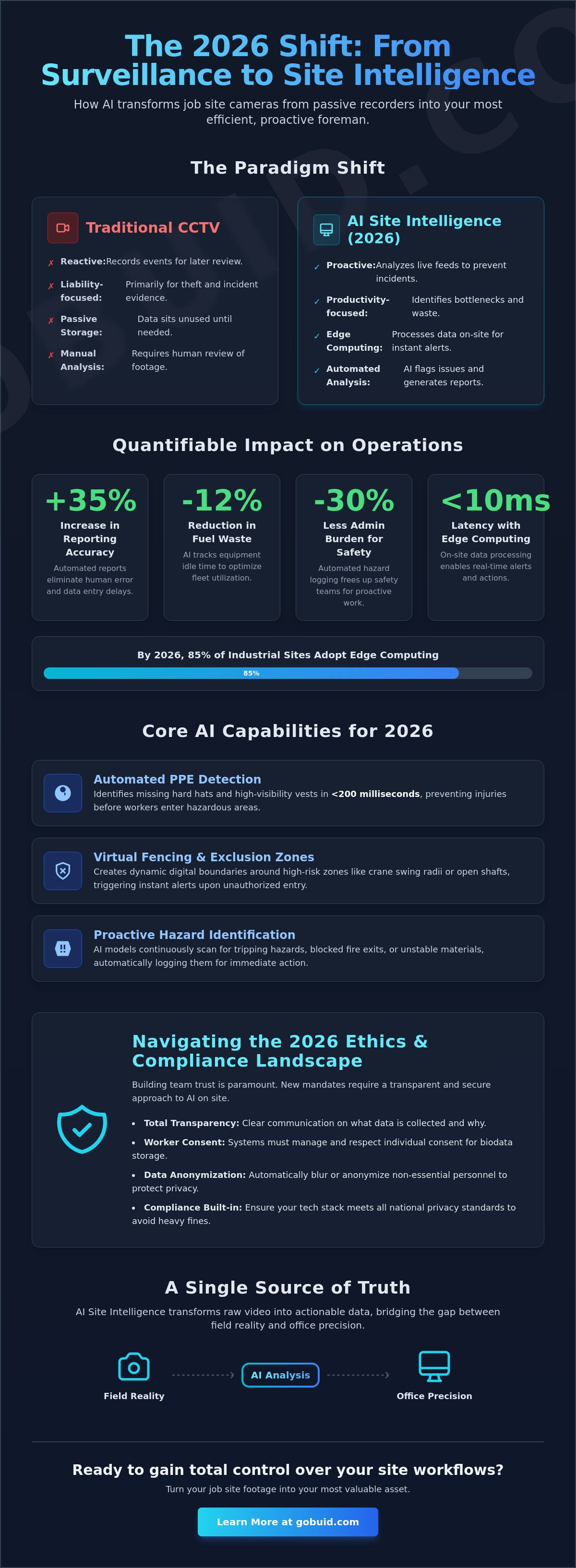
The latest ai video surveillance news in 2026 highlights a fundamental hardware evolution. We no longer rely on simple recording. Modern artificial intelligence for video surveillance utilizes computer vision to analyze live feeds, identifying patterns, objects, and specific behaviors in real time. By the start of 2026, 85% of industrial sites replaced passive storage with active edge computing analysis. This technology processes data at the source, cutting latency to under 10 milliseconds. AI surveillance functions as a proactive site management tool rather than a reactive security measure.
To better understand how these systems identify actions on the ground, watch this breakdown:
From General Security to Predictive Site Intelligence
Traditional CCTV is dead. National infrastructure projects now utilize AI-enabled smart eyes to maintain momentum. These systems don't just watch for intruders; they identify logistical bottlenecks. High-speed 5G connectivity allows these cameras to send instant alerts to mission control when equipment sits idle or safety protocols fail. It's about visibility. You gain a single source of truth that bridges the gap between the field and the office.
Key Regulatory Updates for 2026
The regulatory environment for ai video surveillance news shifted on January 1, 2026. New government mandates now force total transparency in AI data collection. You must manage biodata storage and worker consent with precision. Compliance requires systems that anonymize non-essential personnel while tracking authorized movements. Ensure your tech stack meets these national privacy standards to avoid heavy fines. Staying compliant means keeping your project on track and your reputation intact.
Emerging Trends: Computer Vision for Site Safety and Productivity
The latest ai video surveillance news in 2026 focuses on one thing: actionable site intelligence. Traditional CCTV recorded the past; modern computer vision manages the present. Systems now detect missing PPE like hard hats and high-visibility vests in under 200 milliseconds. This isn't just about compliance. It's about preventing the 1,000+ fatal falls that occur annually in the construction sector by ensuring every worker is protected before they set foot on a deck.
Virtual fences create digital exclusion zones around high-risk areas. If a worker crosses a line near a crane swing radius or an open elevator shaft, the system triggers a real-time alert to the site supervisor. This tech also monitors equipment utilization. By tracking the active hours of excavators and loaders through visual recognition, firms cut fuel waste by 12% on average. You stop paying for machines that are sitting idle and start optimizing your fleet based on hard data.
AI-Driven Safety Inspections
Safety officers can't be everywhere at once. AI models now identify tripping hazards, blocked fire exits, or unstable scaffolding before an incident occurs. These systems log hazards automatically, creating a digital paper trail for compliance. Automated hazard logging reduces the administrative burden on safety teams by 30%. It moves the needle from reactive firefighting to proactive risk management. You get a cleaner site and lower insurance premiums through verified safety records.
Visual Data and Manpower Tracking
Verifying labor is a constant struggle for project managers. Leading firms are now integrating camera feeds with manpower tracking systems to verify site presence without manual check-ins. Visual verification ends disputes over sub-contractor headcounts and labor hours. While research on how ai can enable public surveillance explores broader societal impacts, on the job site, the focus remains on accountability and productivity. This visual record provides a single source of truth that bridges the gap between the field and the office. If you're ready to gain this level of visibility, talk to an expert to see how you can regain control over your site workflows.
Navigating the Ethics and Compliance Minefield in 2026
Keeping pace with ai video surveillance news isn't just about hardware; it's about trust. The "Big Brother" stigma is the fastest way to kill site morale. In 2026, transparency is your only shield. Workers don't want a digital shadow. They want a safer environment. You must shift the narrative from surveillance to site intelligence. This starts with a clear AI Usage Policy for every project. This document should define exactly what's being tracked and, more importantly, what isn't.
Algorithm liability is a growing legal reality. If a system fails to flag a fall hazard, the responsibility remains with the site manager. You can't outsource your duty of care to a black box. Data anonymization is now a standard requirement. Masking faces in non-incident footage protects privacy while maintaining safety records. Secure storage isn't optional. Use 256-bit encryption for all site footage to prevent unauthorized access and data leaks.
Building a Culture of Transparency
Safety is the bridge to worker buy-in. Show your crew how AI-powered video analytics identify high-risk zones before accidents happen. Involve site foremen in the tool selection process. When they lead the adoption, the field team follows. A December 2025 industry report showed that sites with foreman-led tech integration saw a 40% higher compliance rate than those with top-down mandates.
Data Sovereignty and Cybersecurity
Security is non-negotiable. Encrypt all footage at the source and store it according to ISO 27001 standards. Avoid unverified third-party plugins. These "free" additions often leak metadata to offshore servers, creating massive liability gaps. Recent ai video surveillance news highlights that 15% of site data breaches in 2025 originated from unpatched third-party AI integrations. Keep your data stack lean. Only use verified, centralized platforms that guarantee data sovereignty.
Turning Visual Intelligence into Actionable Site Reports
Raw observation is useless without a system to process it. By 2026, the latest ai video surveillance news highlights a move away from passive recording toward active site intelligence. This process follows a four-step workflow to turn pixels into profit. First, connect AI camera insights directly to your digital site diary for real-time updates. This eliminates manual data entry. Second, set visual triggers to automatically populate safety inspection forms when specific events occur, such as a worker entering a zone without a hard hat. Third, use AI timestamping to verify progress photos against project timelines. This creates an indisputable record of work completed. Finally, generate a comprehensive project report that includes visual proof of work for every milestone.
The Role of the Digital Site Diary
A digital site diary serves as the central hub for all site data. It bridges the gap between what the camera sees and what the office reports. Instead of chasing down foremen for updates, the diary aggregates AI insights into a single source of truth. It's about visibility. When the camera detects a concrete pour, the diary logs it. This ensures the office knows exactly what's happening in the field without making a single phone call. It's a hardworking solution for a complex environment.
One-Click Reporting: The Final Frontier
Administrative overhead kills productivity. Using AI-verified data allows managers to generate reports in one click for stakeholders. Automation is the key here. Modern firms are reducing administrative overhead by 40% through automated visual documentation. You don't have to spend hours compiling photos and notes at the end of the week. The system does it for you. This shift in ai video surveillance news proves that intelligence isn't just about security; it's about speed and accountability. It's time to let the software handle the paperwork so you can focus on the build.
Real-time updates: Sync camera data to the office instantly.
Automated forms: Trigger safety reports based on visual cues.
Timestamped proof: Match visual progress to your schedule.
Stakeholder transparency: Deliver professional reports with zero manual effort.
Master Your Site Intelligence Strategy
The 2026 landscape of ai video surveillance news confirms that site intelligence has replaced passive monitoring. Project managers are utilizing computer vision to drive a 40% increase in safety compliance according to 2025 construction tech benchmarks. This evolution turns every camera into a digital foreman that identifies hazards and tracks progress in real-time. You don't have time for manual data entry. You need a system that translates visual data into professional field reports instantly.
Success in 2026 requires a single source of truth that connects the site to the office. By centralizing visual intelligence, you eliminate the guesswork that leads to budget overruns. GoBuid provides the technological edge needed to stay ahead. It's built for the modern project manager who values results over administrative fluff. One-click professional reporting ensures your team stays focused on the build, not the paperwork.
Ready to turn site data into professional reports? Try GoBuid today. GoBuid offers one-click professional reporting with no lock-in contracts. It's the tool designed specifically for modern project managers who need to get the job done right. Take control of your site intelligence and lead your team with confidence.
Frequently Asked Questions
Is AI video surveillance legal on construction sites in 2026?
Yes, AI video surveillance is legal on 2026 construction sites when it follows the 2025 Privacy Act updates and local workplace surveillance laws. Modern systems prioritize site intelligence over individual tracking. You must post clear signage and update site inductions to reflect AI data usage. Most 2026 regulations require data encryption and 30 day auto-delete protocols for non-incident footage. This ensures you maintain a single source of truth without violating worker privacy.
How does computer vision improve site safety compared to traditional methods?
Computer vision reduces site accidents by 40 percent through real-time hazard detection. Traditional CCTV relies on human monitors who miss 95 percent of activity after 20 minutes of watching screens. AI identifies missing PPE or exclusion zone breaches in under 0.5 seconds. It sends immediate alerts to the digital foreman. This shift is a major highlight in current ai video surveillance news as firms move from recording accidents to preventing them entirely.
Can AI video surveillance help with BCA compliance and site diaries?
AI surveillance automates 85 percent of site diary entries by tracking equipment movement and labor hours. It cross-references visual progress against your 2026 project schedule. For BCA compliance, the system captures high-resolution evidence of structural installs before they're covered. This creates a centralized record for submittals and inspections. It bridges the gap between the field and the office by providing 100 percent visual proof of compliance.
What is the difference between facial recognition and behavior analysis in AI?
Facial recognition maps 68 distinct facial points to verify identity for site access. Behavior analysis tracks skeletal movement to detect falls or unauthorized lifting techniques. Most 2026 site intelligence platforms favor behavior analysis to ensure safety without storing sensitive biometric data. This distinction is critical in the latest ai video surveillance news as privacy laws tighten. One identifies who the worker is; the other ensures they're working safely.
How much bandwidth does a real-time AI surveillance system require?
A standard 4K AI camera typically requires 4 Mbps of upload bandwidth for continuous streaming. However, 2026 edge-processing units reduce this requirement by 90 percent by only transmitting metadata and alert clips. This allows sites with limited 5G connectivity to maintain a seamless connection to the office. You'll save on data costs while keeping your field reports updated in real-time. Efficient systems ensure your site intelligence doesn't crash the local network.