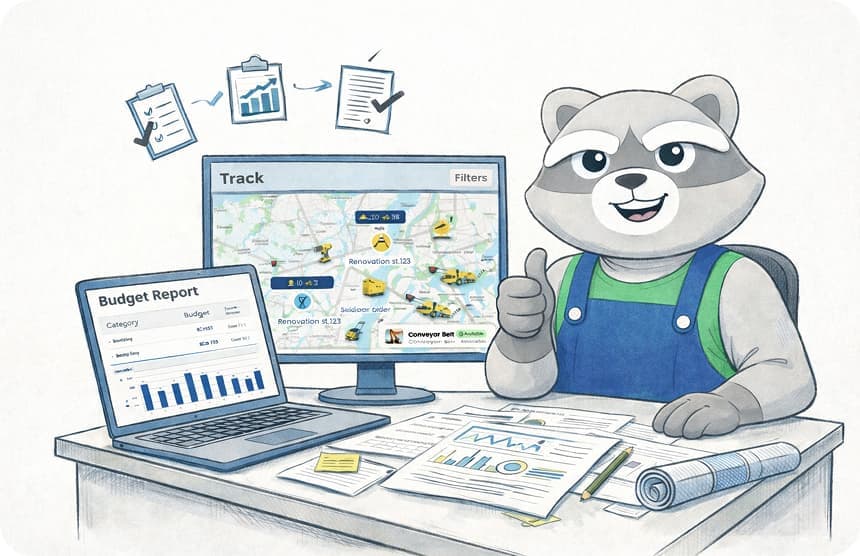
What Contractors Should Capture and Track in a Construction Report
Every construction project produces information long before anyone sits down to write a report. Learn which reports to use, what KPIs to track, what to include and how to turn site records into useful project information.
by Michael Camarador
|
Every construction project produces information long before anyone sits down to write a report.
The biggest challenge is not simply collecting more information but it’s making sure the information captured on site can still be understood and used when someone needs it later.
That is the purpose of construction reporting. Good reporting turns everyday site activity into clear records that help teams understand progress, identify problems, coordinate work and provide evidence of what actually happened.
This guide covers the main types of construction reports, the KPIs worth tracking, what every report should contain, and how contractors can build a reporting process that works from the site to the office.
What Is Construction Reporting?
Construction reporting is the process of recording, organizing and communicating information about the progress, cost, safety, quality, resources and activities of a construction project.
At its simplest, reporting does three jobs: it creates visibility, control and evidence.
Visibility helps teams understand what is happening across a project. Control helps them compare what is happening against what was planned. Evidence provides a traceable record of the work, decisions, inspections and events behind the project.
A construction report can therefore be as operational as today's site diary or as high-level as a portfolio dashboard covering several active projects.
The important part is that information moves between these levels without losing its context.
Why Honest, Clear Construction Reports Prevent Costly Mistakes
Construction teams rarely struggle because they have no information. More often, the right information is difficult to find, arrives too late or lacks enough context to act on.
Effective construction project reporting helps by creating a consistent record of what is happening.
- Earlier problem detection: Regular reporting can reveal delays, defects, missing resources or cost variances before they become larger problems.
- Better decisions: Project managers can make decisions using current site information rather than relying on recollection or fragmented updates.
- Clearer communication: Clients, consultants, subcontractors and internal teams can work from the same documented project information.
- Accountability: Records show what was completed, inspected, approved or raised, as well as when and by whom.
- Legal and financial protection: Photos, approvals, daily records and other supporting evidence can help establish what happened when questions, claims or disputes arise.
- Continuous improvement: Consistent reporting makes it easier to identify recurring delays, quality issues or operational bottlenecks across projects.
The objective of a good reporting system is to reduce the effort required to understand the project.
Types of Construction Reports
There is no single report that can explain everything happening on a construction project. Different decisions require different information.
Construction Daily Report
A construction daily report records what happened on site during a particular day. It typically includes manpower, work performed, equipment used, deliveries, weather or site conditions, delays, incidents, visitors and photographs.
Daily reports create the underlying record that many later reports depend on. They are most useful when completed close to the work rather than reconstructed several days later.
Construction Progress Report
A construction progress report shows how completed work compares with the programme, milestones or expected output.
It may include percentage complete, activities finished during the reporting period, upcoming work, delays, photographs and unresolved issues. Project managers use these reports to understand whether work is moving as planned and where intervention may be needed.
Budget and Cost Report
Budget reports compare planned expenditure with actual or committed costs.
They may show the approved budget, spending to date, budget variance, changes and forecast to complete. The purpose is not simply to report how much has been spent, but to identify where actual project performance is moving away from the financial plan.
Construction Job Cost Report
A construction job cost report provides a more detailed view of costs by activity, work package, labor, equipment, materials or subcontract.
This helps commercial and project teams understand where money is being used rather than looking only at the overall project total. Consistent cost coding is important because poorly categorized information makes comparisons less useful.
WIP Report
A WIP report in construction—or work-in-progress report—connects operational progress with the project's financial position.
Depending on the company's accounting and commercial processes, it can compare contract value, costs incurred, recognized revenue, billed amounts and estimated completion. Management and finance teams use WIP reporting to understand the financial position of active work.
Safety and Incident Reports
Safety reports document inspections, observations, hazards, toolbox activities and incidents.
A safety incident report should clearly capture what occurred, where and when it happened, who was involved, immediate actions taken and any supporting evidence required by the organization or relevant jurisdiction.
Reporting requirements differ between countries, so contractors should follow the occupational safety and recordkeeping requirements that apply where they operate.
Inspection and Quality Reports
An inspection report documents whether completed work meets the project's required drawings, specifications, quality standards and agreed checkpoints.
Records may include checklist responses, photographs, signatures, comments, defects and corrective actions. Connecting the evidence to the actual inspection makes it easier to trace workmanship later instead of searching through separate photo folders and messages.
Risk Assessment Reports
Risk assessments identify hazards or project risks, evaluate their potential impact and document appropriate controls.
They should reflect the actual work being performed. When the scope, environment, equipment or method changes, the relevant assessment may also need to be reviewed rather than treated as a document that is completed once and forgotten.
Equipment and Materials Reports
These reports help teams understand what resources are available, where they are and how they are being used.
Equipment records can cover deployment, movement, inspections or operating status. Material reports can document deliveries, quantities, usage and shortages. Together, they help site teams identify resource problems that could affect upcoming work.
Punch List and Closeout Reports
A punch list tracks incomplete, defective or outstanding work as the project approaches completion.
Closeout reporting goes further by bringing together the records needed to complete and hand over the project. Depending on the contract, these may include inspections, approvals, photographs, warranties, manuals, completed forms and other evidence.
The easier these records are to trace during construction, the less work teams have to reconstruct at closeout.
What to Include in Every Construction Report
The contents will vary by report, but every useful construction report should answer a few basic questions:
Which project does this relate to? What happened? When did it happen? Who recorded it? What requires attention next?
A consistent construction report template should capture:
- Project name, location or relevant work area
- Report author and date
- Reporting period
- Summary of activity or status
- Relevant measurements and project data
- Planned versus actual results or variances
- Issues, delays, defects and risks
- Required actions and next steps
- Responsible parties where applicable
- Supporting photographs, forms, documents and approvals
Construction Reporting KPIs to Track and What it Tells About a Project
Not every number collected on a construction project needs to become a KPI.
Useful construction KPIs help someone make a decision. A project manager may need schedule variance, while management may need a higher-level view of cost, progress and risk across several projects.
A dashboard with dozens of measurements is not automatically more useful than one with six.
Choose a focused group of KPIs that reflects the decisions each audience needs to make. Site teams may require operational detail, while directors or owners may need trends, exceptions and significant risks.
Reporting at the Site, Project and Portfolio Levels
Construction information becomes more valuable when it can move upward without being manually recreated at every level.
The detail should change as information moves upward, but the source should remain traceable. A dashboard showing a problem is far more useful when someone can trace it back to the underlying site record.
Who Is Responsible for Construction Reporting?
Construction reporting is usually shared across several roles.
Foremen and supervisors record daily activities. Safety teams document inspections and incidents. QA/QC teams maintain inspection and quality records. Subcontractors may submit their own progress, manpower, safety or quality information. Project managers bring these inputs together, while owners, consultants and management review the information relevant to their responsibilities.
Teams should know who creates each record, when it is due, who reviews it and where the final version belongs. Without that structure, reporting easily becomes duplicated or dependent on someone chasing updates every week.
Best Practices of a Good Construction Reporting
Good reporting starts with the workflow, not the final PDF.
- Define reporting requirements early. Decide which reports are required, who prepares them, how frequently they are submitted and who needs access before the project becomes busy.
- Standardize templates. Consistent fields make information easier to compare between reporting periods, teams and projects.
- Capture information close to the work. Recording an inspection, delivery or issue when it happens reduces reliance on memory at the end of the day or week.
- Avoid entering the same information twice. Where possible, information captured in the field should feed later reports rather than being manually copied into another spreadsheet or document.
- Tie reporting to decisions. Every KPI or reporting field should have a purpose. If nobody uses a piece of information, ask whether it still needs to be collected.
- Use photographs with context. A photo is more useful when it is connected to the correct project, activity, location, date and record.
- Control access appropriately. Project information should be available to the people who need it while maintaining appropriate permissions for sensitive or controlled records.
- Keep a traceable archive. Forms, approvals, photos and reports may be needed months after the original activity, especially during claims, audits, handover or disputes.
- Review the process regularly. Reporting requirements change as projects and organisations evolve. Periodically remove unnecessary fields and improve areas that repeatedly cause delays or incomplete information.
The strongest construction reporting best practices make reporting a consequence of good recordkeeping rather than a separate administrative exercise.
From Spreadsheets to Construction Reporting Software
Spreadsheets remain useful in construction. They are flexible, familiar and appropriate for many calculations and smaller reporting tasks. Problems begin when the spreadsheet becomes responsible for information it was never designed to capture directly.
A supervisor records something on site. Photos are sent through a messaging app. A form is completed elsewhere. Someone in the office then copies the information into a spreadsheet before creating a report. Every additional handoff creates another opportunity for information to arrive late, lose context or exist in several versions.
Construction reporting software changes this by connecting field data capture with the records and reports that depend on it. Instead of treating the report as the first step, the process starts with the activity itself.
For example, a site inspection can be completed through a digital form, supported with photographs and signed off from a mobile device. That record remains connected to the project instead of becoming another attachment that someone must organise later.
How GoBuid Supports Construction Reporting
Gobuid helps you create instant reports from the project records and information you log into the app.
You can choose one or more projects, add the report fields you need, set date ranges, and export the result for review, approval, payment claims, or client communication.


The format matters less than consistency. Teams should be able to understand today's report and compare it with records from previous days without having to interpret a completely different structure.
👉Turn your site records into reports whenever you need them with GoBuid
Frequently Asked Questions
What is construction reporting?
Construction reporting is the process of recording and communicating information about project activities, progress, cost, safety, quality and resources. Reports help construction teams understand current conditions, compare actual performance against plans and maintain evidence of work and decisions throughout a project.
What are the most common types of construction reports?
Common types of construction reports include daily reports, progress reports, budget and cost reports, job cost reports, WIP reports, safety reports, inspection and quality reports, risk assessments, equipment and materials reports, and punch list or closeout reports. The exact mix depends on the project, contract and organisation.
How often should construction reports be submitted?
Frequency depends on the report. Site diaries and daily reports are generally completed each working day, while progress, commercial and management reports may be weekly or monthly. Incident, inspection and risk records should follow the timing required by the activity, company procedure, contract and applicable regulations.
What should a construction progress report include?
A construction progress report should identify the reporting period, work completed, current progress against the program, upcoming activities, delays or constraints, key issues, responsible parties and supporting evidence such as photographs. It should help readers quickly understand what changed during the reporting period and what needs attention next.
Who is responsible for construction reports?
Responsibility is normally shared. Site supervisors may handle daily records, safety personnel manage safety reporting, QA/QC teams maintain inspection records, and project managers consolidate information for wider project reporting. Contractors should define reporting ownership, deadlines, approval responsibilities and storage locations before work begins.
What is the best software for construction reporting?
The appropriate software depends on how a contractor works. Look for tools that make information practical to capture on site, keep records connected to the correct project, support photographs and approvals, and reduce repeated data entry. The reporting system should fit the field workflow rather than creating a second process purely for administration.
Conclusion
Good construction reporting makes project information easier to understand, trace, and use. When site records are captured consistently, teams spend less time chasing updates and more time using that information to keep work moving.