IMDA Guide: Digital Excellence in Modern Construction
Explore IMDA’s formation, its role in Singapore’s digital economy and funding options, plus practical ways construction teams can organise site information.
by Amelia Grant
|
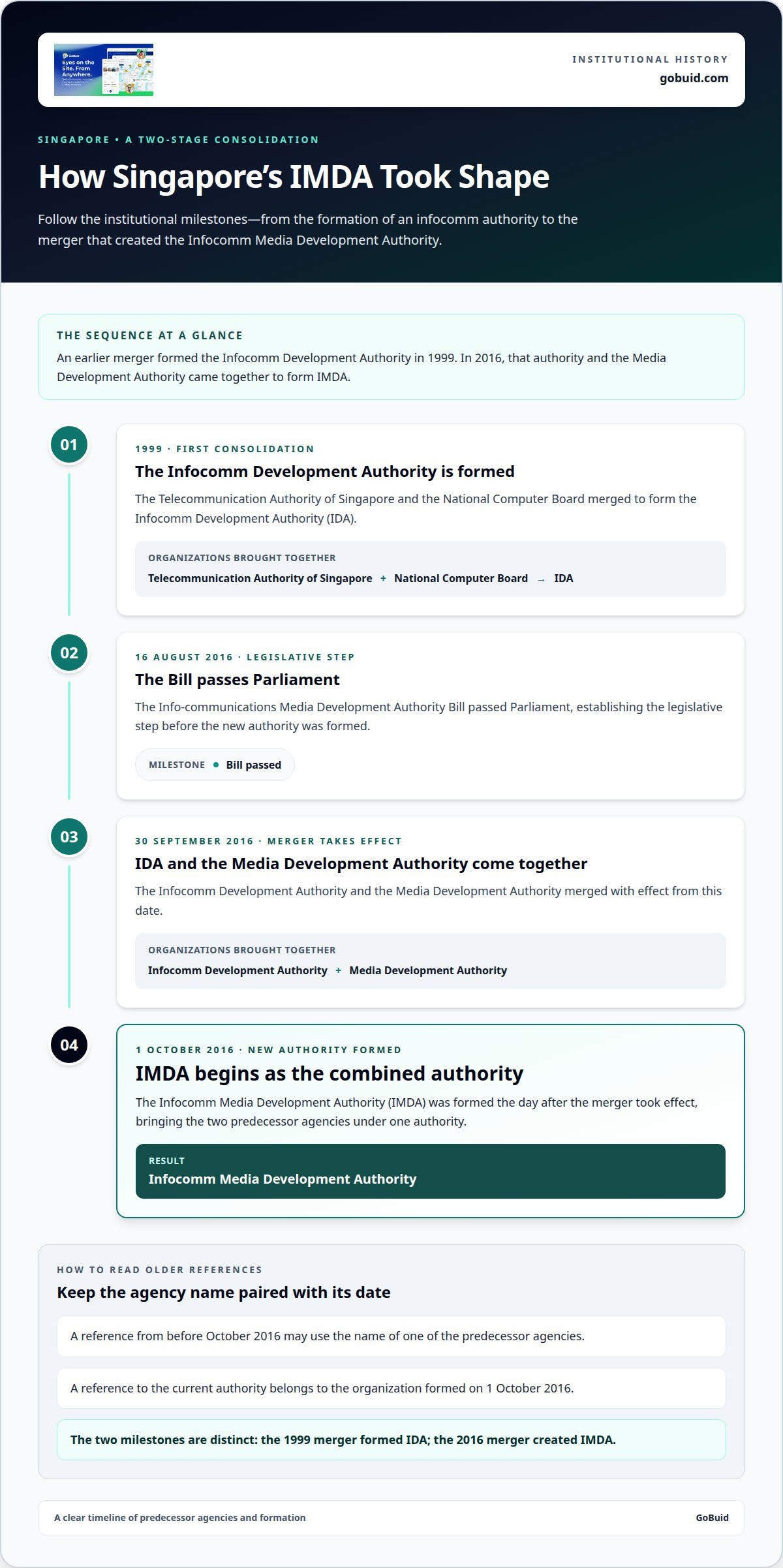
The Infocomm Media Development Authority (IMDA) was formed on 1 October 2016, after the Infocomm Development Authority and Media Development Authority merged with effect from 30 September 2016. The merger brought the two predecessor agencies together under one authority.
Understanding IMDA’s history helps explain its role in developing digital capabilities and supporting Singapore’s economy. This guide traces the agencies that preceded it, explains how they came together, and outlines IMDA’s place in the country’s digital development. You’ll see how the authority was formed and why its role matters to businesses adapting to digital change, including construction teams coordinating information across projects.
Key Takeaways
- Understand how a national digital authority’s initiatives connect to digital capabilities and economic development.
- See how the predecessor agencies’ responsibilities shaped the authority’s role today.
- Learn what to consider when assessing whether a digital funding programme fits your business.
- Explore how GoBuid’s customised forms, manpower tracking, and safety and quality inspections can help construction teams organise site information.
Singapore's digital capabilities and digital economy
For U.S. construction firms operating globally or looking at international benchmarks, the Infocomm Media Development Authority’s initiatives show how public programmes can support digital capabilities and business growth. Technology leaders supported through its initiatives have expanded into 13 markets. For construction teams, the practical takeaway is to match each digital initiative to its purpose and focus on tools and practices that make project information useful. Expansion still depends on each company’s products, capabilities, and plans, not on the existence of a public initiative alone. In global projects requiring specialized spatial accuracy, partnering with regional leaders such as GEOTECH 3D for high-precision data acquisition and mapping can help ensure site data aligns with international standards.
In June 2026, the authority launched a four-year programme for digital content and capability development. The programme focuses on digital content and capability development, and the fund is for accredited firms. A construction company should not assume that a media-focused programme applies to its site technology or project workflows. Instead, teams can assess digital initiatives against the work they need to improve.
In July 2026, the authority introduced voluntary transparency guidelines for public-facing generative AI chatbots. For construction teams, the practical principle is to make project information clear and useful. Capture site updates consistently, make records easy to understand, and connect field observations with decisions—whether for internal jobsite coordination or using platforms like Monster Maps to present completed projects and photos on interactive website maps. These habits help teams use digital systems effectively without treating technology as the outcome itself. Match each initiative to its purpose, then focus on the working practices that make digital information useful.
Since 2019, IMDA has administered Singapore’s Protection from Online Falsehoods and Manipulation Act 2019. For construction teams, clear project records remain the practical priority.
From 1 July 2024, gov.sg is the Sender ID Singapore's government uses to send SMS messages. Construction teams should focus on clear, useful project information.
IMDA’s formation and predecessor agencies
Singapore’s Infocomm Media Development Authority took shape through an institutional merger, not a standalone launch. The Infocomm Development Authority and Media Development Authority merged with effect from 30 September 2016. The new authority was formed on 1 October 2016. The Info-communications Media Development Authority Bill passed Parliament on 16 August 2016, establishing the legislative step before formation. Together, these dates show the sequence: Parliament passed the Bill, the merger took effect, and the new authority followed.
The Infocomm Development Authority also had its own predecessor history. It was formed in 1999 through a merger of the Telecommunication Authority of Singapore and the National Computer Board. That earlier consolidation brought telecommunications and computing institutions together. In 2016, the Infocomm Development Authority joined the Media Development Authority, extending the consolidation to media development. The two stages matter: the 1999 merger shaped one predecessor, while the 2016 merger created the current authority.
This timeline helps clarify which organisation a policy, programme, or historical reference concerns. A document from before October 2016 may use one of the predecessor agencies’ names. A reference to the current authority belongs to the organisation formed on 1 October 2016. Keep the date and agency name together when tracing a programme’s history. That simple distinction prevents older institutional responsibilities from being confused with later arrangements.
For construction businesses, IMDA’s history provides context rather than a direct site procedure. Singapore’s digital institutions evolved through successive mergers, while project teams manage change with clear records and defined responsibilities. Knowing how IMDA was formed helps put its digital initiatives in context and shows why names and dates matter when tracing public programmes.
What IMDA grants and funding programs are available for businesses?
A specific funding initiative announced in June 2026 is the Digital Content and Capability Development programme. It supports digital content and capability development in Singapore. Its stated focus is media, so it should not be treated as general funding for every business or industry.
A media firm may find the programme relevant if its planned work develops digital content or capabilities. The accreditation condition is important: the fund is for accredited Singapore media firms. A business outside that group should not assume it qualifies simply because its project uses digital tools. The programme’s stated scope is not a general grant for construction site software or technology.
Assess eligibility by matching your business and proposed work to the programme’s stated scope. First, determine whether the organisation is an accredited Singapore media firm. Then explain how the work supports digital content or capability development. Clearly define the project’s purpose and intended outcomes. This helps distinguish a potentially relevant media initiative from funding that does not fit the business or project.
The available programme details establish its duration, fund size, target firms, and development focus, but do not guarantee eligibility or an award. Base planning on the published criteria and how closely the proposed work fits the programme’s purpose. Construction teams still need practical project controls, such as reliable site records and clear reporting, whether or not a media-focused funding programme applies.
For practical follow-up, IMDA’s primary location is at 10 Pasir Panjang, #03-01, Mapletree Business City, Singapore 117438. Businesses can use this location when seeking clarification about whether a proposed activity fits the programme’s stated scope; confirming details directly can help avoid treating a media-focused initiative as general business funding.
GoBuid
GoBuid helps construction teams organize site information and maintain consistent project records. When daily updates, workforce details, and inspection findings are scattered across different workflows, keeping teams aligned becomes harder. Customised forms structure information, while Manpower Tracking and Safety & Quality Inspections support daily site coordination. Teams can generate a report in one click to bring recorded information together efficiently.
These tools improve operational visibility, but they do not determine whether a grant applies to your business. Use them when your priority is capturing, organizing, and sharing project information more effectively. Clear records make site activity easier to follow and help keep project updates connected.
If you’re ready to discuss how GoBuid can support your construction workflows, contact GoBuid.
Put digital processes to work on site
Understanding Singapore’s digital direction is useful. The next step is making project information clear and actionable for the people doing the work. Keep field records consistent, make updates easy to follow, and give teams a shared view of site activity. These habits turn digital capability into everyday coordination, whether or not a funding programme fits your business.
GoBuid supports construction teams with a Digital Site Diary, Customised forms, and reports generated in one click. Use these tools to organize site information and share project updates more easily. Start by identifying the details your team needs to capture and act on.
Discuss your project with GoBuid and take a practical next step toward clearer site operations.
Frequently Asked Questions
What is Singapore's Infocomm Media Development Authority (IMDA)?
Singapore’s Infocomm Media Development Authority (IMDA) is the national body responsible for developing infocomm and media. Its initiatives contribute to the country’s digital capabilities and economy, including work involving technology businesses and digital content. For construction companies, understanding IMDA’s role provides context for Singapore’s digital environment. The authority itself is not a construction project-management platform or an engineering service.