Efficient Foundations: A Guide to Helical Piles
by Sam Chen
|
A single manual entry error in your torque-to-load log can jeopardize an entire foundation handover and stall a project for weeks. When you're in the field managing subcontractors and verifying deep foundation specs, you can't afford to rely on muddy notebooks or guesswork. You already know that manual tracking is a liability that drives up administrative overhead by as much as 20 percent on complex jobsites. It's time to trade the clipboard for precision.
This guide helps you master the technical mechanics of Helical Piles (Screw Piles) installation while streamlining your site documentation for maximum efficiency. We'll show you how to ensure every pile meets its design capacity without the typical reporting headaches. You'll learn to generate accurate logs in real time, reduce the hours spent on daily diaries, and secure a seamless handover to the structural engineer. From mechanical torque monitoring to automated field reports, we're bridging the gap between the rig and the office to get your project out of the ground faster.
Key Takeaways
Identify why Helical Piles (Screw Piles) are the preferred solution for high-performance deep foundations and underpinning repairs.
Master the technical installation of Helical Piles (Screw Piles) to ensure maximum load capacity without compromising soil integrity.
Replace manual paperwork with a digital site diary to capture real-time torque readings for Helical Piles (Screw Piles) and ensure engineering compliance.
Bridge the gap between the field and the office by leveraging automated data syncing and one-click report generation for Helical Piles (Screw Piles).
Establish a single source of truth for your project stakeholders through centralized, professional reporting on all Helical Piles (Screw Piles) installations.
⭐ Learn more about GoBuid's feature- without the heavy enterprise price tag
Streamlining Foundation Reporting with GoBuid
Installing Helical Piles (Screw Piles) demands precision and rigorous documentation. Traditional paper logs often lead to delays, errors, and lost data. GoBuid eliminates the gap between the job site and the office with instant data syncing. When a pile hits the target depth or torque, the office knows immediately. You can generate professional reports for structural engineers and project stakeholders with a single click. This isn't just about speed; it's about accuracy. Maintaining a single source of truth for all foundation data reduces liability and prevents costly disputes. Your site foremen and engineers can focus on the build, reducing their administrative burden and increasing overall site productivity.
Bridging the Gap Between Field and Office
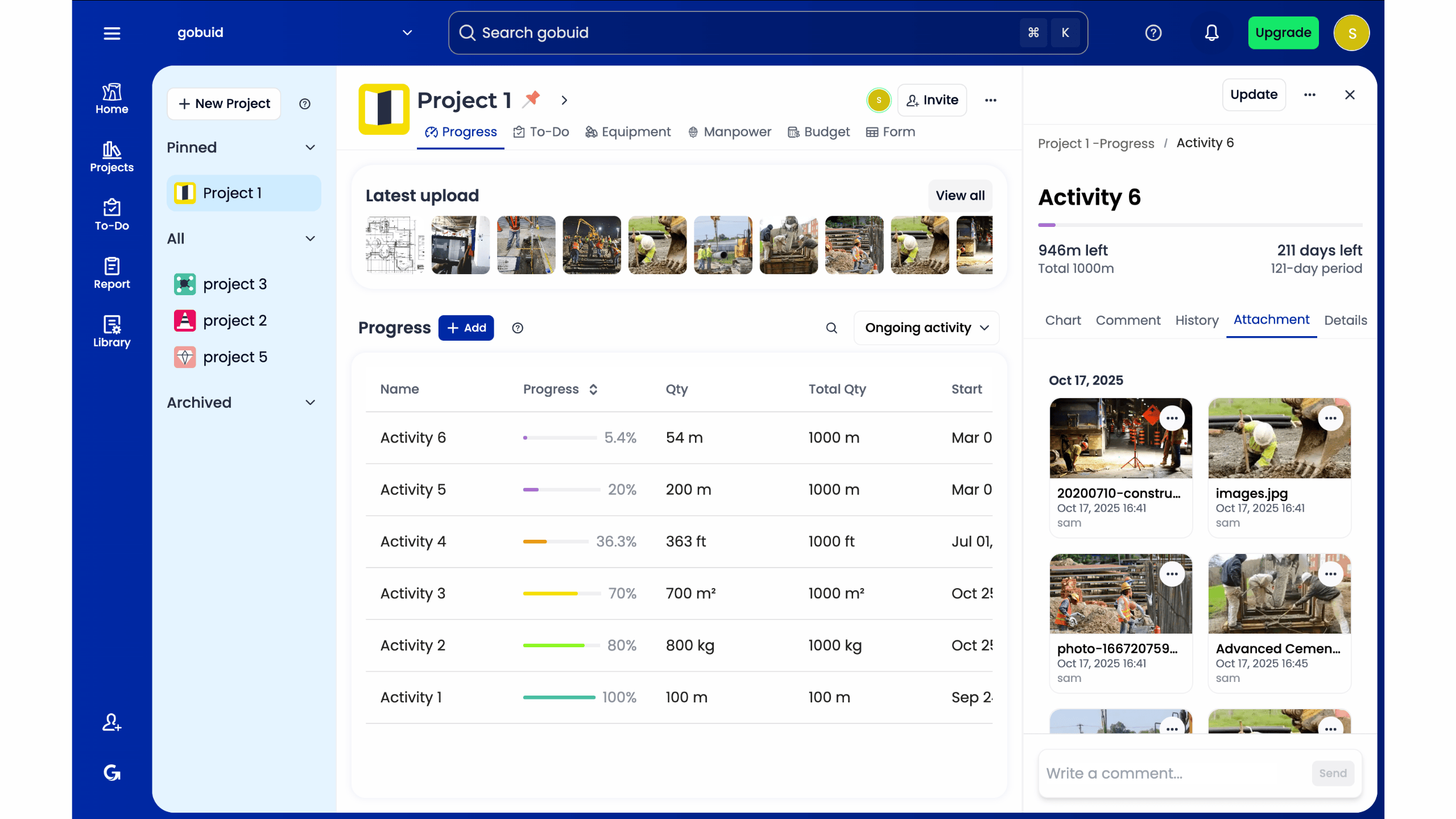
Real-time visibility prevents errors in pile placement and torque verification before the rig moves to the next location. You don't have to wait for weekly meetings to identify issues. Use the project analytics dashboard to monitor foundation progress against the master schedule in real time. Automation helps teams reduce the time spent on daily reporting by up to 40%. This efficiency ensures that structural engineers receive the data they need to approve the next phase of construction without delay. It's a lean approach to complex deep foundation management that keeps projects on track and within scope.
Ready to Digitize Your Foundation Works?

GoBuid is the preferred tool for contractors who manage complex projects involving Helical Piles (Screw Piles) and other deep foundations. The platform is designed for both the dirt and the data. There are no lock-in contracts, giving you the flexibility to scale across different project phases as needed. Transitioning to a digital workflow shouldn't be a hurdle for your team. Start your free trial with GoBuid and generate your first report today. Regain control of your site data and move your project forward with confidence.
What are Helical Piles (Screw Piles) and Why Use Them?
Helical Piles (Screw Piles) are high-strength steel shafts featuring one or more helical plates welded to the lead section. They don't rely on brute force or impact. Instead, they're screwed into the ground using hydraulic machinery. To understand the engineering behind these components, it's helpful to ask: What are helical piles? Essentially, they function as screw-in anchors that transfer structural loads to deeper, more stable soil strata. Contractors prioritize them for deep foundations in new construction and for underpinning failing existing structures that require immediate stabilization.
To see this technology in action on a job site, watch this installation breakdown:
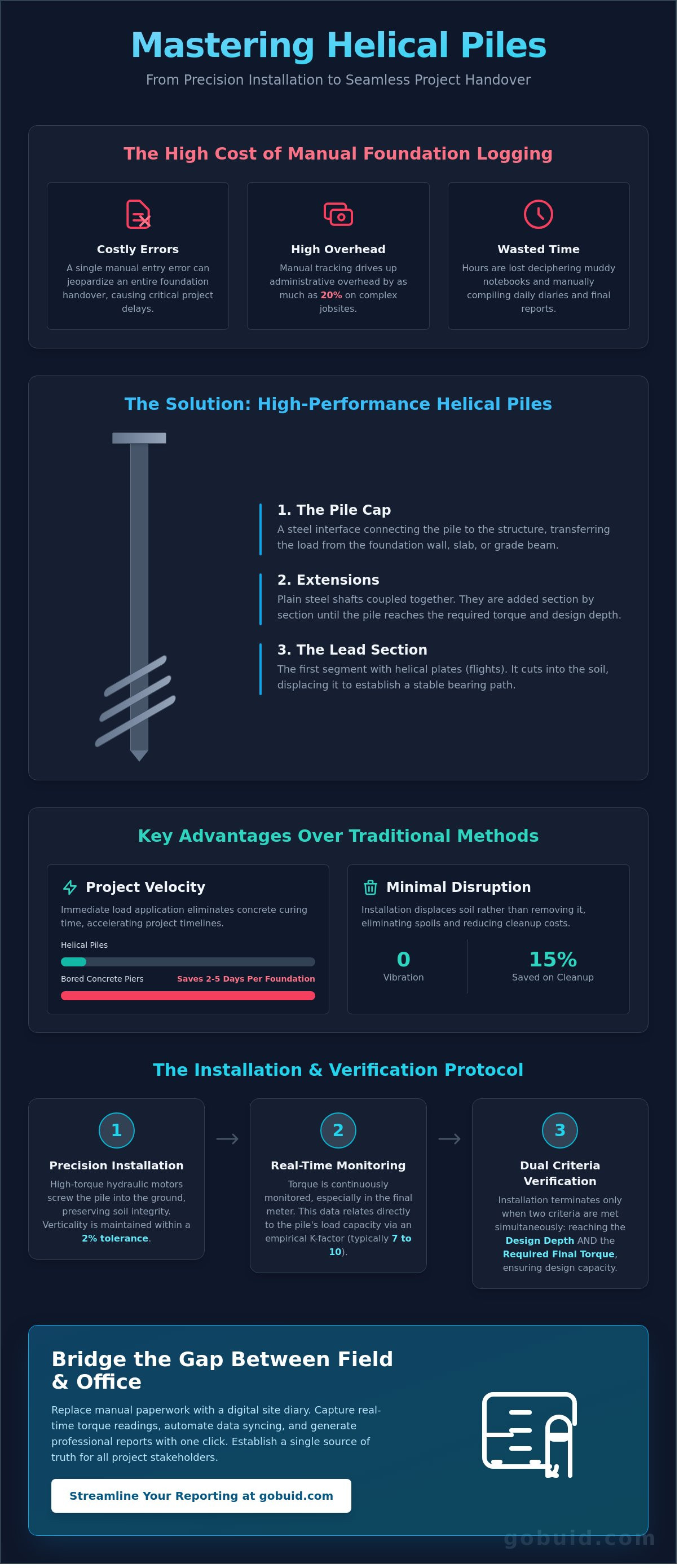
Speed defines the helical pile's value in the field. Unlike bored piers, there's no curing time for concrete. You install the pile and immediately apply the load. This eliminates 2 to 5 days of downtime per foundation. On constrained sites, these piles outperform driven piles because they produce zero vibration. This protects adjacent structures from seismic damage or settlement. They're also cleaner; there's no soil spoils to haul away, which can save a project up to 15% in site cleanup and disposal costs.
Common Structural Uses
Helical piles handle both axial compression and tension loads with precision. They're essential for stabilizing structures in areas with 90% water saturation or sensitive soil profiles where traditional excavating is impossible. Beyond permanent foundations, they provide temporary support for excavation shoring or tower crane bases. This versatility allows project managers to maintain a single source of truth for foundation stability across various ground conditions.
The Anatomy of a Screw Pile
The lead section: The initial segment featuring the helical flights. It cuts into the soil and establishes the bearing path.
Extensions: Plain steel shafts coupled to the lead. These are added until the pile reaches the specified torque or bearing depth.
The pile cap: The steel interface that connects the pile to the concrete grade beam, slab, or existing foundation wall.
Choosing Helical Piles (Screw Piles) isn't just about structural integrity; it's about project velocity. By removing the wait times associated with concrete or the noise complaints of driven piles, you regain control over the project timeline. It's a modern solution for a high-stakes industry.
The Installation Process: Verifying Torque and Capacity
Installing Helical Piles (Screw Piles) requires specialized equipment and surgical precision. Operators use tracked or wheeled excavators fitted with high-torque hydraulic motors. The process involves advancing the pile into the ground through rotation. Unlike traditional drilling, this method avoids augering. It preserves soil integrity by displacing soil rather than removing it. This maintains the lateral stability essential for deep foundations.
Verification relies on the Torque-to-Capacity Ratio. This empirical relationship links installation torque to the pile's ultimate capacity. Engineers use a K-factor, often ranging from 7 to 10 depending on shaft geometry, to calculate the safe working load (SWL). Installation terminates only when the pile reaches the predetermined design depth and the required final torque reading simultaneously. This dual criteria ensures the foundation meets the structural demands of the project.
Monitoring Torque in Real-Time
Data collection is most critical during the final 1 meter of advancement. The torque motor attachment provides real-time, verified design data. Changes in soil strata, measured by SPT 'N' values, directly impact installation speed. A jump from an N-value of 15 to 35 will cause a measurable spike in torque. Monitoring these fluctuations ensures the pile sits in a competent bearing stratum. It provides immediate proof of performance without waiting for static load tests.
Quality Assurance Standards
Accuracy begins with the initial lead section placement. Operators must maintain verticality and alignment within a 2 percent tolerance. Every bolted connection between steel sections requires documentation to ensure structural continuity. Final steps involve verifying the datum level before termination. Capturing these details in digital field reports provides a single source of truth for the entire project team. This visibility eliminates guesswork and keeps the site schedule moving forward.
Best Practices for Documenting Helical Pile Projects
Installing Helical Piles (Screw Piles) requires more than just mechanical force. It demands absolute precision in data capture to satisfy applicable US building codes and engineering specifications. Stop relying on mud-stained paper logs that get lost in the truck. Implement a digital site diary to capture real-time progress. This creates a single source of truth that bridges the gap between the field and the office.
Record specific torque readings for every pile installed. Engineering compliance depends on verifying that the installation torque correlates with the required design capacity. If a pile doesn't reach the specified 5,500 Nm, you need to know instantly. Use progress photos to document the depth and condition of every lead section. Visual evidence prevents future disputes and confirms that ground conditions match the initial geotechnical report.
Track specialized equipment like hydraulic torque motors. Maintenance and calibration are non-negotiable. A motor that is 15% out of calibration can lead to structural failure. Digital tracking ensures you never miss a service interval. This level of oversight turns a chaotic job site into a streamlined production line.
Essential Data Points for Your Site Diary
Your digital records must be granular. Every entry should include individual pile IDs, installation dates, and final depth measurements. Don't overlook the human element. Track manpower for specialized piling crews and hydraulic operators to monitor productivity. Record weather conditions and soil observations. If a 20mm rainfall event changes the soil shear strength, your torque readings will reflect that change. Having this data protects your margins and your reputation.
Using Custom Forms for Inspections
Standardization is the enemy of error. Create customised forms for pre-installation safety checks to ensure every operator is compliant before the first turn. Use quality control checklists for pile cap welding or bolting to eliminate rework. Centralizing this field data allows for immediate office review. It ensures that 100% of your field data is captured before the crew leaves the site.
Ready to gain full visibility into your foundation projects? Explore GoBuid Mission Control to manage your site data with total authority.
Master Your Foundation Documentation
Precision installation is only half the battle. You've seen how Helical Piles (Screw Piles) provide a fast, reliable foundation, but their success rests on the torque data you capture in the field. Proving load capacity requires more than a glance at a gauge; it demands rigorous, real-time site documentation. When you bridge the gap between the rugged job site and the office, you eliminate the risk of disputes and ensure every project meets its engineering specs.
You don't have time for manual data entry or hunting down missing field notes. Leading contractors rely on GoBuid to maintain a single source of truth for their reporting. You'll generate professional foundation reports in one click, saving hours of administrative work. Because there are no lock-in contracts, you get the project flexibility you need to stay competitive in a fast-moving industry. It's the most efficient way to turn raw field data into a polished submittal that clients trust.
Streamline your foundation reporting with GoBuid today
Get the job done right and move on to the next site with total confidence.
Frequently Asked Questions
How do helical piles work in soft soil?
Helical piles work in soft soil by transferring structural loads through unstable surface layers to load-bearing strata deeper underground. The steel shafts feature one or more helix-shaped plates that screw into the earth with minimal disturbance. This design creates a stable foundation by utilizing end-bearing capacity on the helix plates rather than relying on skin friction. Engineers monitor installation torque in real-time to ensure the pile reaches the required depth and capacity.
What is the maximum load capacity of a typical screw pile?
Maximum load capacity depends on the shaft diameter and soil density. A standard 2.875 inch residential helical pile typically supports between 10 and 30 tons of compression. For heavy industrial applications, large-diameter piles exceeding 10 inches can manage loads over 200 tons per pile. You must match the pile specifications to the field reports and structural requirements to ensure the foundation remains centralized and secure under stress.
How much does helical pile installation cost per pile?
Helical pile installation costs fluctuate based on depth and soil conditions. Industry data from 2023 indicates that residential installations typically range from 1,000 to 3,000 dollars per pile. This price includes materials and labor but excludes the specialized engineering fees required for complex sites. Using screw piles often reduces overall project costs by 20 percent because they eliminate the need for concrete curing time and extensive excavation.
Can helical piles be removed and reused for temporary structures?
You can remove and reuse helical piles for temporary structures with zero impact on the surrounding environment. This makes them the ideal choice for 12 month construction offices or temporary modular units. The installation process is completely reversible, allowing teams to unscrew the piles and transport them to the next job site. This circular utility streamlines your punch list and reduces material waste across multiple project phases.
Do I need a soil report before installing helical piles?
You need a soil report to determine the exact depth and torque required for a successful installation. Geotechnical data provides the N-value, which tells engineers how the soil will react to the helix plates. Without this single source of truth, you risk foundation failure or material overages. A professional report ensures your submittals are accurate and your project stays on schedule without unexpected underground obstacles.