How Real-Time Field Data Improves Construction Daily Reports in 2026
by Sam Chen
|
In 2026, a daily report that only exists for compliance is a wasted opportunity and a significant financial risk. You're likely tired of chasing down inaccurate manpower logs or realizing too late that missing progress photos just cost you a legitimate claim. Understanding how field data improves construction daily reports is no longer optional if you want to maintain control over chaotic workflows. We know that disconnected data makes your WIP reports unreliable and leaves you vulnerable to payroll disputes and budget overruns.
This article shows you how to transform raw site observations into actionable project intelligence. You'll discover how to capture precise field data to automate report generation and align field costs with your project budget in real time. We'll look at the tools and strategies that provide instant visibility into site progress while eliminating the administrative lag that slows down your team. Stop treating reports as a chore and start using them as the raw fuel for your project's financial accuracy and operational control.
Key Takeaways
Eliminate the 48-hour data lag that hides operational risks. Learn why real-time site inputs are the necessary engine for project control in 2026.
Discover how field data improves construction daily reports by capturing precise manpower and equipment metrics to prevent payroll disputes.
Connect field productivity directly to your financial WIP reports. Prevent month-end billing surprises by tracking trade distribution and utilization rates as they happen.
Streamline your documentation with one-click reporting. Turn continuous site entries into professional, audit-ready PDFs instantly to remove the administrative burden.
⭐ Learn more about GoBuid's feature - without the heavy enterprise price tag
Beyond Compliance: Why Field Data is the Engine of Modern Daily Reports
Modern site documentation has evolved far beyond a simple legal safety net. In 2026, field data represents a live stream of inputs regarding manpower, equipment utilization, and changing site conditions. This real-time visibility is the core of effective construction management, where every data point informs the next strategic move. You aren't just recording history; you're capturing the pulse of the project to drive better outcomes.
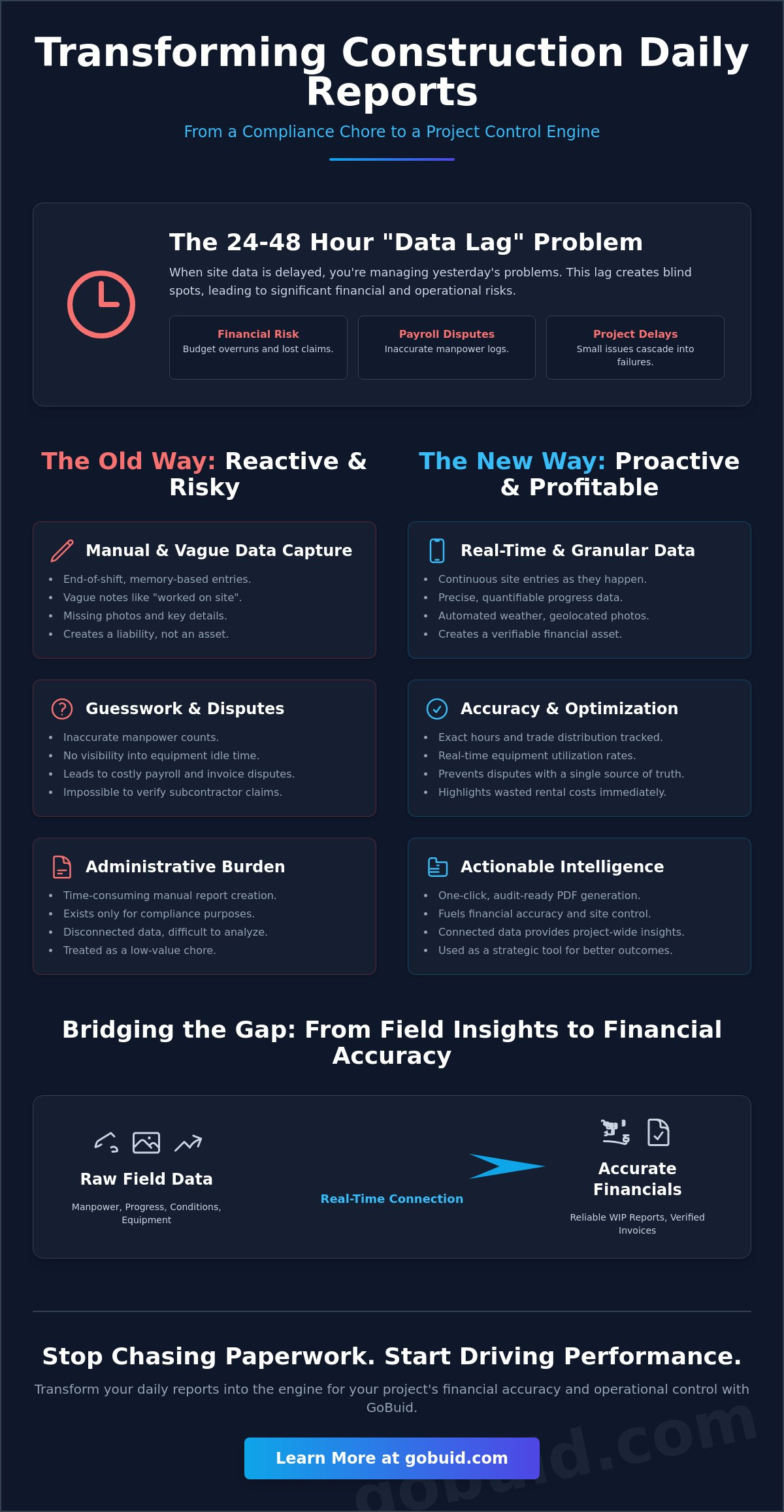
Traditional workflows suffer from a persistent "Data Lag" problem. When supervisors wait until the end of the shift or the following morning to log activities, project visibility is delayed by 24 to 48 hours. This gap makes it impossible to pivot when issues arise. You can see how field data improves construction daily reports by turning static logs into dynamic tools for site control. High-quality, immediate data prevents small delays from cascading into project-wide failures.
To better understand this concept, watch this helpful video:
Field-driven reporting serves as the essential bridge between site reality and office strategy.
The Cost of Ambiguity in Site Documentation
Vague notes like "worked on site" or "equipment used" trigger expensive disputes and missed deadlines. Without specificity, you can't defend against a claim or verify a subcontractor's invoice. Moving from "work completed" to "quantifiable progress data" changes the narrative. Detailed logs ensure that every hour and every asset is accounted for accurately. By utilizing a one-click report system, you replace guesswork with verified evidence. This shift ensures your documentation is a financial asset rather than a liability. It creates a unified data point that everyone on the professional team can trust.
From Site to Dashboard: How Real-Time Data Points Refine Accuracy
Precision on a construction site isn't a byproduct of luck; it's the result of granular, real-time tracking. By capturing specific data points as they occur, you move from general guesses to surgical accuracy. This is exactly how field data improves construction daily reports in a competitive market. When you track manpower with exact hours and trade distribution, you eliminate the ambiguity that leads to payroll errors and labor disputes. You aren't just counting heads; you're verifying productivity.
Asset management requires the same level of detail. Equipment management allows you to monitor utilization rates in real time. If a specialized excavator sits idle for three days, the data highlights that wasted rental cost immediately. This level of visibility is transforming the industry's future by ensuring maintenance is proactive and assets are optimized. Digital site diaries then centralize these observations with progress photos, creating a single, searchable source of truth that validates work-in-place and resolves safety queries instantly.
Capturing the Invisible: Weather and Site Conditions
Manual weather entry is a liability that often leads to rejected delay claims. Automating weather data provides a verified, third-party record to substantiate claims without the risk of human error. By linking these conditions to specific productivity dips, you gain the data needed for more accurate bidding on future projects. You stop guessing why a pour took longer and start seeing the correlation between environment and output.
Customized Forms for Specific Site Needs
Generic templates fail because they ignore the unique requirements of specialized trades. A mechanical contractor needs different data points than a concrete crew. Using customized forms allows you to standardize high-quality data collection across your entire project. This ensures that every entry is relevant and every report is actionable. If you are ready to stop chasing paperwork, you can explore the GoBuid platform to see how centralized data points drive project success.
Bridging the Gap: How Field Insights Impact Construction WIP Reports
Your financial health depends on the accuracy of your Work-in-Progress (WIP) reports. In 2026, these reports serve as the primary indicator of whether a project is profitable or bleeding cash. Most contractors struggle with billing surprises at the end of the month because their office data doesn't match site reality. This is exactly how field data improves construction daily reports; it provides the granular evidence needed to justify every line item on your financial statements. When site entries are verified in real time, the gap between performance and billing disappears.
Accurate labor data is the first line of defense against over-billing or under-billing. When manpower is logged precisely in the field, your accounting team can verify progress against hours worked immediately. This prevents the panic of realizing a task is 50% complete but has consumed 80% of the budget. Similarly, equipment utilization data ensures you recover project overhead by accurately charging for asset time on site. If you don't know exactly how long a crane was active, you can't bill for it correctly. A WIP report is only as reliable as the field data feeding it.
Real-Time Job Costing vs. Historical Analysis
Traditional accounting is a post-mortem exercise. You find out you lost money weeks after the mistake happened. Shifting to proactive cost management requires integrating budget tracking with daily field inputs. This creates a live financial snapshot that allows project managers to make informed decisions before the budget is blown. When site reality and financial strategy align, you gain total transparency over your cash flow. You can improve your project visibility by centralizing these financial insights into a single dashboard that updates with every field entry.
One-Click Reporting: Streamlining Site Documentation with GoBuid
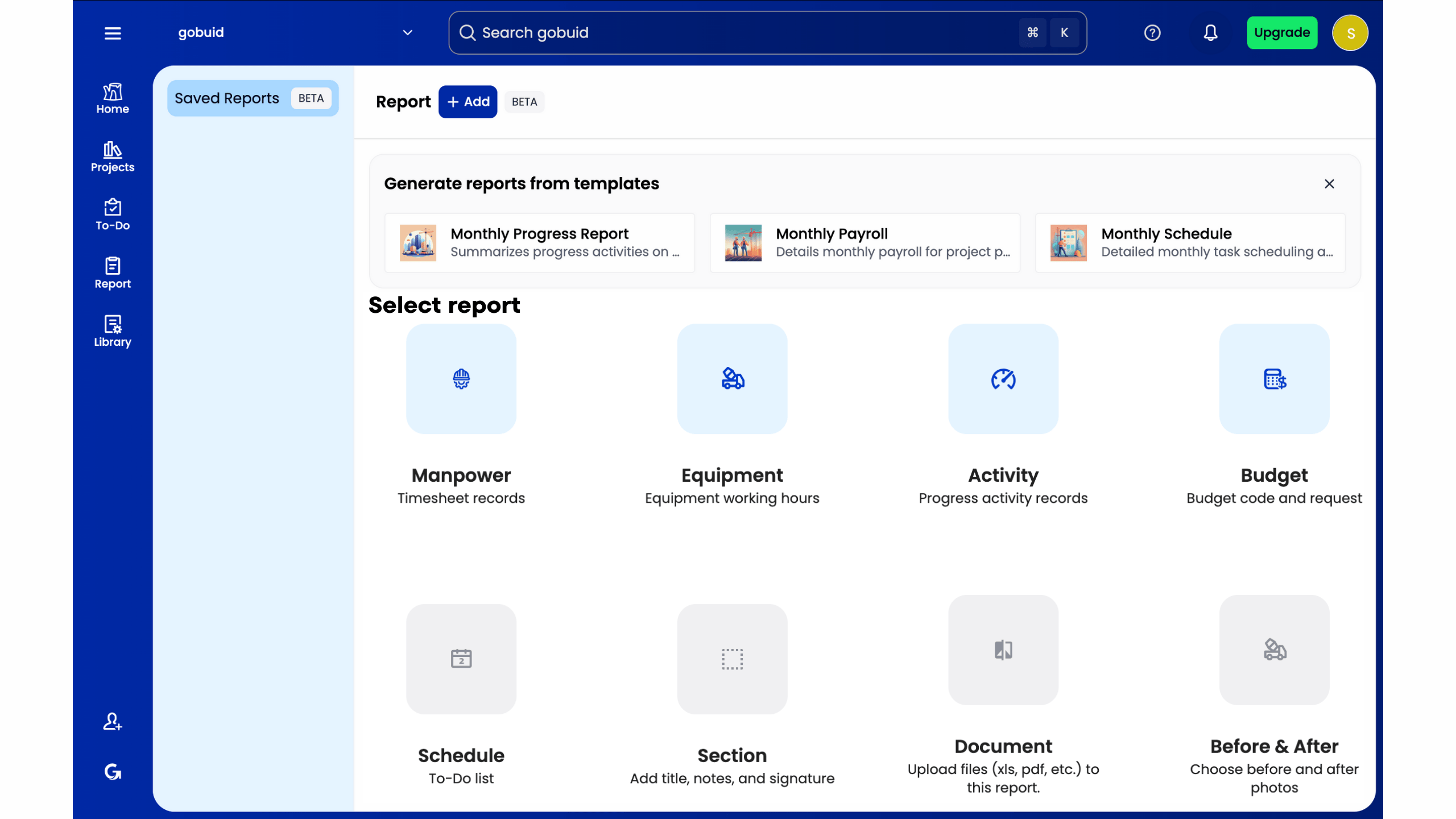
The "End-of-Day" reporting crunch is a relic of the past. Supervisors shouldn't spend their final hour on site trying to recall events from eight hours prior. Continuous data capture allows your team to log observations, manpower, and safety checks as they happen. This shift ensures that the information is fresh and accurate. When the shift ends, the work is already done. This is the most practical way to see how field data improves construction daily reports; it replaces the stress of deadlines with the ease of automation.
The core of this efficiency is the one-click report. You can turn a full day of field entries into a professional, branded PDF instantly. There's no manual formatting or photo uploading required. This speed allows you to share site progress with stakeholders before you even leave the trailer. Beyond speed, these reports maintain a digital site diary that meets national compliance standards. You get total transparency without the extra administrative effort.
Project analytics dashboards take this verified data and turn it into visual trends. You can spot a productivity dip or a rising labor cost before it becomes a budget-killer. By centralizing site observations, you create a historical record that is searchable and audit-ready. This level of organization is essential for modern construction firms that value accountability and high-quality execution. Understanding how field data improves construction daily reports allows you to focus on building rather than paperwork.
Implementing a No-Friction Data Strategy
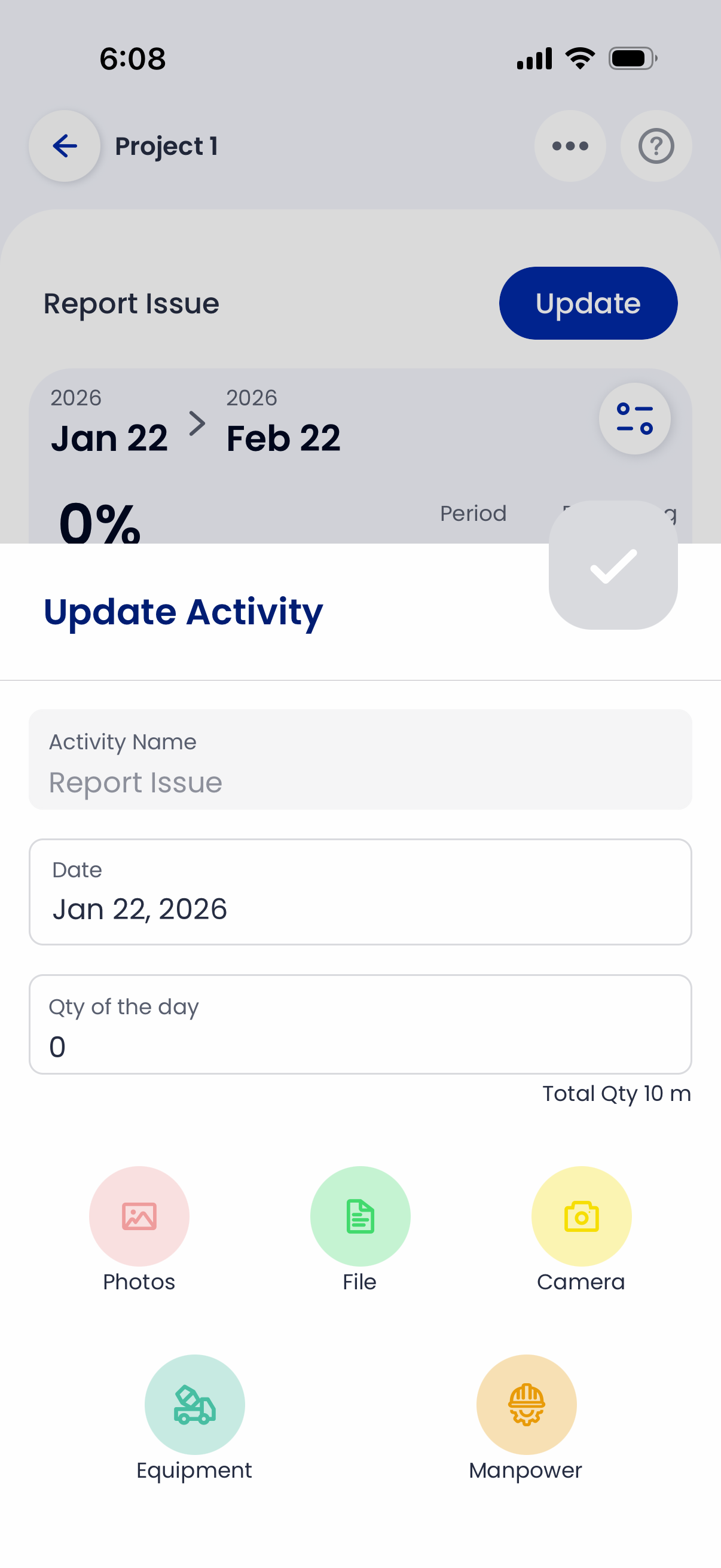
Adoption is the biggest barrier to new technology. GoBuid simplifies this transition for field crews with an intuitive mobile interface designed for the physical work environment. It's built for speed and ease of use, ensuring that data entry doesn't slow down the actual work. For firms looking to scale, the benefit of no lock-in contracts allows you to adjust your seats based on current project needs. You gain the power of a sophisticated project management tool with the flexibility to grow at your own pace.
Master Project Visibility with Field Intelligence
Site documentation is no longer just a record of the past. It's the primary engine for your project's financial and operational success. By now, you understand exactly how field data improves construction daily reports by turning passive logs into active financial tools. You've seen how real-time manpower and equipment tracking eliminate the data lag that threatens your profit margins. Precise field inputs don't just fill pages; they fuel your WIP reports and protect your business from costly disputes.
Transitioning to a digital site diary removes the administrative friction that slows down your supervisors. You can generate professional, audit-ready reports in one click without being tied to a desk. With no lock-in contracts, you have the flexibility to scale your data strategy as your project portfolio grows. Stop chasing missing information and start leveraging site reality to drive your strategy forward.
Streamline your reporting with GoBuid's one-click digital site diary today. You have the expertise to build; we provide the tools to ensure every detail is captured with precision. Take control of your site documentation and build with total confidence.
Frequently Asked Questions
What is the difference between a site diary and a daily report?
A site diary is a continuous, internal log of all site activities, while a daily report is a formal summary of that data shared with stakeholders. The diary captures raw observations as they happen throughout the shift. The daily report then distills these entries into a professional, audit-ready document. Using real-time inputs ensures the final report is accurate and verifiable without the usual end-of-day administrative crunch.
How does digital field data help in construction dispute resolution?
Digital field data provides a time-stamped, unalterable record of site events that serves as verified evidence during disputes. High-quality progress photos and automated weather logs eliminate hearsay by providing objective proof of conditions and work-in-place. This transparency protects your firm from false claims and ensures you have the documentation needed to substantiate delay claims or payment requests when disputes arise.
Can field data improve the accuracy of my WIP reports?
Yes, field data is the foundational layer for accurate Work-in-Progress (WIP) reporting. Understanding how field data improves construction daily reports allows you to track labor hours and equipment utilization in real time rather than relying on lagging estimates. This precision prevents over-billing or under-billing surprises by aligning your financial snapshots with actual site productivity as it occurs. It bridges the gap between field reality and office accounting.
Is it difficult for field crews to switch to digital reporting software?
Modern digital reporting software is designed for the physical realities of the job site, prioritizing speed and ease of use. Intuitive mobile interfaces allow crews to log data with minimal training, often saving them an hour of paperwork at the end of every shift. A no-friction data strategy ensures high adoption rates because the tool solves the user's pain of manual documentation rather than adding to it.
What are the most important field data points to track for daily reports?
Focus on tracking manpower hours by trade, equipment utilization rates, automated weather conditions, and visual progress documentation. These metrics provide the most significant impact on project visibility and financial control. Capturing these specific points illustrates how field data improves construction daily reports by transforming a simple compliance log into a strategic tool for managing project overhead and operational risk. Every data point should serve a specific financial or legal purpose.