How to Justify Buying Construction Software: A Framework for ROI in 2026
Learn how to justify buying construction software with our ROI framework. Stop paying the hidden "Administrative Tax" and build a bulletproof business case.
by Michael R. Henderson
|
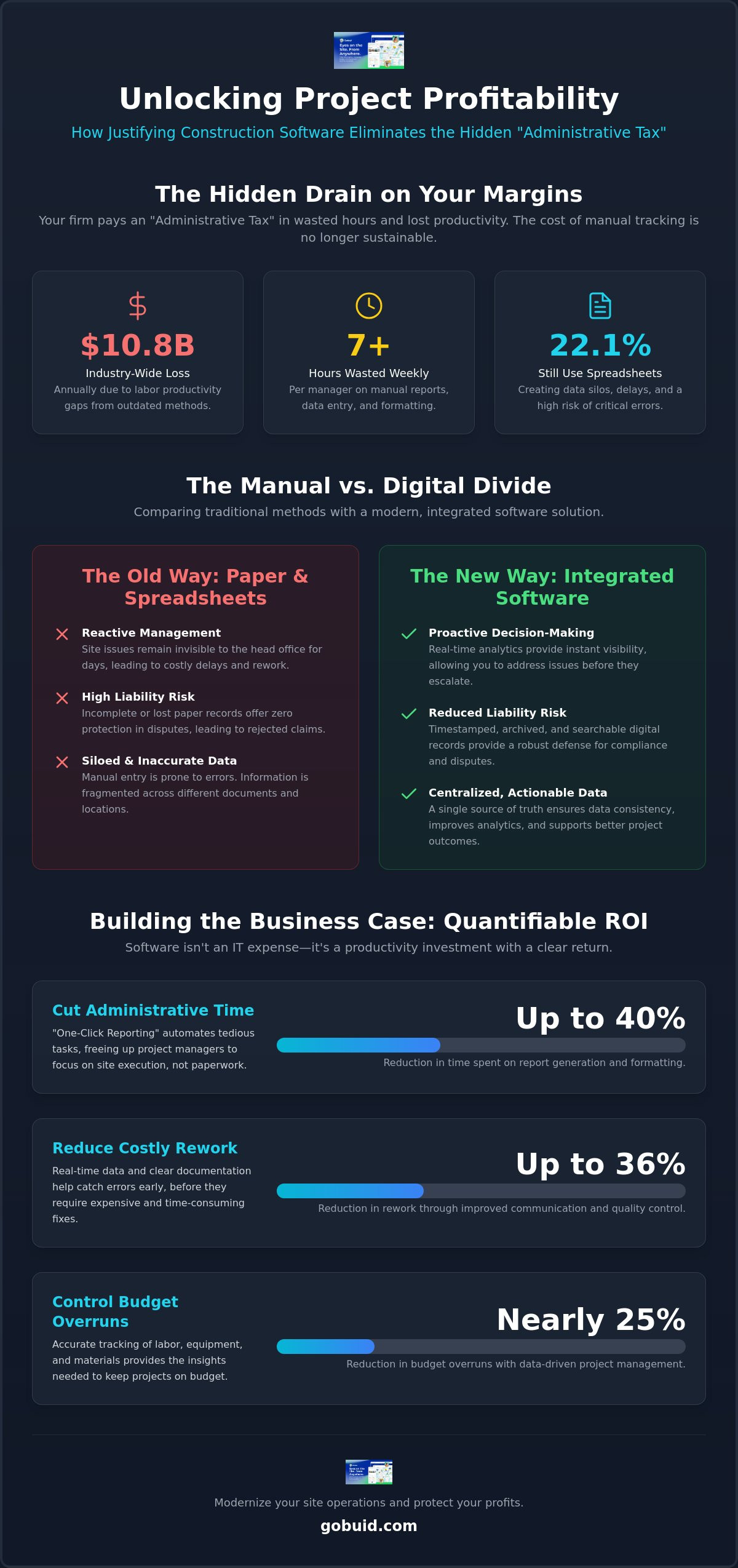
Your firm is likely paying a hidden "Administrative Tax" on every project that never appears on a balance sheet. Between hours wasted on manual daily reports and the $10.8 billion industry-wide loss due to labor productivity gaps, the cost of sticking to paper and spreadsheets is no longer sustainable. You know that manual tracking is bleeding your margins, but translating that gut feeling into a board-approved budget requires a strategic approach. Learning how to justify buying construction software in 2026 isn't about chasing a tech trend; it's about proving how digital tools eliminate the friction that stalls your progress.
We agree that your team's time is better spent building than chasing down manpower data or equipment logs. This article provides a clear framework to quantify efficiency gains, from reducing rework by up to 36% to cutting budget overruns by nearly a quarter. You'll learn how to build a bulletproof business case that replaces administrative overhead with high-quality, actionable data. We will walk through the specific metrics you need to secure buy-in and regain control over your site operations.
Key Takeaways
- Identify the "Administrative Tax" by auditing the manual hours your field staff currently spend on daily site diaries and photo documentation.
- Discover how to justify buying construction software by mapping your reporting workflow and quantifying the time saved through automated report generation.
- Isolate the "one-click" advantage to show stakeholders how centralized data improves project analytics and reduces administrative overhead.
- Solve adoption hurdles by choosing mobile-first tools that integrate seamlessly into existing site routines without adding technical complexity.
- Move from reactive management to proactive decision-making by using precise documentation to eliminate liability risks and budget overruns.
The Cost of Inaction: Auditing Your Current 'Administrative Tax'
Sticking to traditional methods creates a persistent drain on your resources. This is the Administrative Tax. It is the invisible fee your firm pays every time a site supervisor spends two hours at the end of a shift manually compiling a daily diary. When you calculate the cumulative hours field staff spend on manual data entry across multiple projects, the financial impact is staggering. You cannot optimize what you do not measure, and manual systems ensure your data remains siloed and late.
To build a compelling case, you need a solid framework for ROI that accounts for these leaks. Many firms struggle with how to justify buying construction software because they treat it as an IT expense rather than a productivity solution. However, with 22.1% of builders still relying on spreadsheets for estimating and reporting, the gap between manual laggards and digital leaders is widening. The cost of inaction includes inaccurate manpower tracking and equipment idling that goes unnoticed until the budget is already blown.
To better understand this concept, watch this helpful video:
Identifying Hidden Labor Costs in Manual Documentation
Determining how to justify buying construction software starts with a cold audit of your payroll. Consider the math of manual reporting. If a Project Manager spends five hours per week on report formatting and data consolidation, you are losing significant capital on a single employee every year. This doesn't account for the "office lag." When site events are recorded on paper, the head office remains blind to issues for days. This delay leads to missed project milestones and rework that could have been avoided with real-time visibility.
The Liability Gap: Risk Management and Compliance
Paper systems offer zero protection in a legal dispute. Missing progress photos or incomplete site logs lead to rejected claims and unpaid variations. You effectively lose money on work you have already completed. A single failed safety inspection or a disorganized record during a compliance audit can cost more than an annual software subscription. Implementing Digital Site Diaries acts as a defensive insurance policy. It ensures every action, delivery, and safety check is timestamped and archived. This transparency protects your firm from liability and ensures your team is always audit-ready.
Building the Business Case: Quantifying Site Efficiency
To move from auditing costs to securing approval, you must visualize the efficiency gap. Map your current reporting workflow from the moment data is captured on-site to the final client delivery. Most firms realize their process is fragmented. Information gets lost between the site and the office. When you understand how to justify buying construction software, you focus on the speed of information. Integrating academic research on software selection shows that firms prioritizing data integration see significantly higher long-term performance.
By quantifying these site efficiencies, you provide a logical answer for how to justify buying construction software to stakeholders who only care about the bottom line. You aren't just buying a tool; you are installing a system that protects your margins. Use the Project Analytics Dashboard to turn raw site data into a proactive defense against project slippage.
The ROI of One-Click Reporting
Manual report formatting is a drain on your most expensive assets. GoBuid enables site staff to generate reports in one click, which eliminates hours of tedious office work every week. Standardized customised forms ensure data consistency across all subcontractors, removing the need for follow-up calls or clarification emails. Automated reporting reduces admin time by up to 40%, allowing PMs to focus on site execution. This shift alone often pays for the software within the first few months of a project.
Data-Driven Decisions via Real-Time Analytics
Gut-feeling management is a liability in 2026. Real-time analytics allow you to spot manpower trends before they trigger a schedule overrun. If a specific trade is lagging, the data shows it immediately. Effective Equipment Management prevents unnecessary rental costs by identifying idling machinery that should be off-hired. This transition from reactive to data-backed oversight ensures every decision is grounded in reality. You can increase productivity across your entire portfolio by centralizing these disparate data points into a single source of truth.
Overcoming Objections and Implementing Without Risk
Resistance to change is a standard hurdle in heavy industry. Most project leaders worry their site crew will reject new digital tools. This is often a myth based on outdated enterprise software. Modern, mobile-first design ensures high adoption rates because the interface is as intuitive as a social media app. When you are determining how to justify buying construction software, emphasize that the tool simplifies the worker's day rather than adding to it. Transitioning from scattered paper notes to Digital Site Diaries happens in days. High adoption leads to the total transparency needed for accurate project oversight.
Addressing the 'Excel is Enough' Myth
Excel is a powerful calculator, but it is a poor project management tool. It functions as a data silo. It prevents real-time collaboration between the site and the head office. Storing progress photos on personal mobile devices is a liability. it creates a massive security risk and makes data retrieval nearly impossible during a legal dispute. Automated reporting provides professional, consistent branding that manual spreadsheets cannot match. You are not just moving numbers; you are professionalizing your entire delivery process. This shift eliminates the Administrative Tax discussed earlier by centralizing every data point into a unified system.
Scaling with Confidence: Flexible Subscription Models
The final step in how to justify buying construction software is to remove the financial risk of a bad investment. GoBuid offers flexible pricing that scales with your project volume. This ensures you only pay for the capacity you actually use on-site. This flexibility removes the fear of long-term financial commitments that don't deliver value. We recommend starting with a pilot project on a single high-visibility site. Use the resulting data to prove the ROI framework to your executive team. A successful pilot provides the hard evidence needed for a full national rollout. Secure your margins and protect your team with a system built for the field. Contact GoBuid to start your risk-free pilot today.
Secure Your Margins and Lead the Digital Shift
Transitioning to digital site management isn't just a technical upgrade. It's a fundamental shift in how you protect your project's profitability. You've audited the Administrative Tax and mapped the efficiency gains of automated workflows. Now you have the data needed for how to justify buying construction software to any stakeholder. By replacing manual silos with a unified data point, you eliminate the friction that causes budget overruns and project delays.
GoBuid provides the precision tools required for modern site operations. You gain one-click professional report generation alongside real-time manpower and equipment tracking. These features ensure total transparency across every operational location. With no lock-in contracts, you maintain maximum flexibility while scaling your digital capabilities. It's time to regain control over chaotic workflows and empower your professional team with the precision of modern digital tools.
Start streamlining your site documentation with GoBuid today. You're ready to build a more accountable, efficient, and profitable future.
Frequently Asked Questions
How do I calculate the ROI of construction software?
Calculate your return by subtracting the annual software cost from the total value of saved administrative hours and reduced rework. If your Project Manager saves five hours every week on report formatting, that labor value alone often exceeds the subscription cost. You should also factor in the 18–24% reduction in budget overruns typically seen by firms that move from manual workflows to integrated digital reporting.
What is the biggest cost of NOT using construction management software?
The primary cost is the "Administrative Tax" on labor productivity, which contributes to an industry-wide loss of over $10.8 billion annually. Without digital tools, you risk losing money on unpaid variations due to missing or disorganized progress photos. Incomplete site records leave your firm vulnerable to expensive legal disputes and safety audits that could have been mitigated with a timestamped Digital Site Diary.
How do I convince my field team to use a digital site diary?
Demonstrate the immediate reduction in their daily paperwork burden to secure buy-in. Show them how they can generate a report in one click instead of staying late to manually compile site notes and photos. Mobile-first tools mirror the apps they already use on their personal devices, which makes the transition from paper feel like a benefit rather than an additional task.
Will construction software replace our existing spreadsheets?
Yes, because software replaces static data silos with a dynamic, unified data point. While spreadsheets are useful for basic calculations, they prevent real-time collaboration and lead to version control errors. Moving your data to a Project Analytics Dashboard ensures every stakeholder has access to live project information, which is a key factor in how to justify buying construction software to your executive team.
What features are most important for justifying the cost of construction software?
Prioritize features that provide immediate visibility into site costs, such as Manpower Tracking and Equipment Management. These tools allow you to identify idling machinery and labor inefficiencies before they impact the budget. High-quality Progress Photos & Documentation and customised forms are also essential, as they provide the professional evidence needed to protect your margins and settle claims quickly.