How to Track Labor Cost Codes in Real-Time: A Practical Field Guide
Tired of budget surprises? Our guide to tracking labor cost codes in real-time helps you protect margins and get instant visibility into your labor spend.
by Michael R. Henderson
|
You're reviewing weekly numbers and notice a major budget overrun on a task finished three days ago. The money is spent and it's too late to adjust. You know that relying on paper logs leads to inaccurate job costing and manual entry errors. Successfully tracking labor cost codes in real-time is the only way to stop these leaks. Waiting days for data to reach the office isn't a viable way to run a profitable project.
You don't have to fly blind. This guide helps you master the transition to digital tracking to protect your margins and boost productivity. We'll show you how to replace delayed logs with instant activity logging. You'll learn to create a unified data point that connects your site team to your office. We'll also cover how to generate reports in one click to keep every project on track.
Key Takeaways
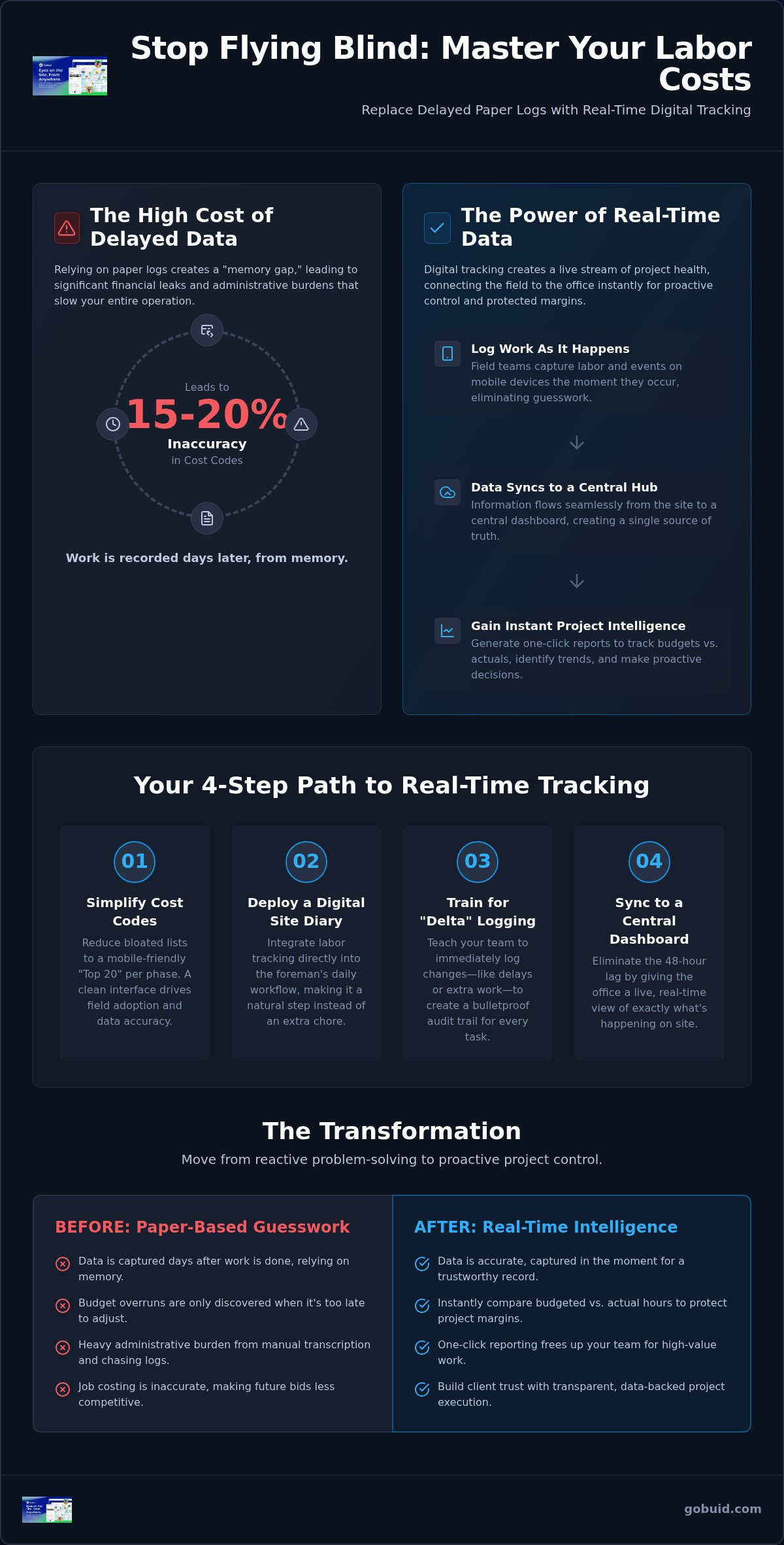
- Identify how the "memory gap" from delayed paper logs leads to 15% to 20% inaccuracies in your cost code allocation.
- Simplify your cost code library to make mobile logging faster and more accurate for teams in the field.
- Protect your project margins by tracking labor cost codes in real-time within a digital site diary.
- Replace manual data entry with one-click reporting to gain instant visibility into your total labor spend.
The High Cost of Delayed Labor Data
Delayed data isn't just a nuisance; it's a financial leak. When supervisors log hours days after the work is done, the "memory gap" takes over. Field observations suggest this delay leads to 15% to 20% inaccuracies in how hours are assigned to specific construction cost codes. These errors ripple through your project, distorting cash flow management and making accurate forecasting impossible. You can't manage what you can't see until three days too late.
There is a common misconception that paper logs are faster for the field. While scribbling on a clipboard takes seconds, the downstream cost is massive. Manual office transcription and chasing down illegible notes creates a heavy administrative burden that slows the entire company down. Transitioning to digital Manpower Tracking turns your data into a live stream of project health. It stops being a static record of what happened and becomes a proactive tool for immediate adjustment.
Breaking the Cycle of Friday Afternoon Logging
The typical Friday afternoon scramble is where precision goes to die. Supervisors often guess where time was spent, creating "ghost hours" allocated to the wrong tasks just to balance the books. This guesswork ruins your job costing. By tracking labor cost codes in real-time, you capture the work as it happens. This "as-it-happens" documentation provides a bulletproof audit trail for dispute avoidance and ensures every dollar is accounted for. Real-time tracking is the immediate bridge between field activity and office analytics.
Step-by-Step: Implementing Real-Time Tracking in the Field
Transitioning from paper to digital requires a practical, phased approach. Start by standardizing your cost code library for mobile accessibility. A bloated list slows entry and leads to errors. Deploy a digital site diary that integrates manpower tracking directly into the daily log. This ensures that tracking labor cost codes in real-time becomes a natural part of the foreman's workflow rather than an extra chore. Train your team to log "delta" changes, such as unexpected delays or extra work, immediately to specific codes. Finally, sync this data to a central dashboard for instant office review. Following these best practices for cost estimating ensures your office sees exactly what the field experiences without the typical 48-hour lag.
Simplifying Cost Codes for Field Adoption
A 500-item cost code list fails on a mobile screen. Foremen won't scroll through hundreds of options while standing on a busy job site. Create a "Top 20" list of the most frequent codes for each specific project phase. Group these codes by trade or work package to reduce searching time and mental load. You can manage these categories easily using GoBuid's budget features. This focused approach reduces friction and ensures higher data quality from your field team. When the interface is clean, adoption rates climb. This simplified workflow for tracking labor cost codes in real-time keeps your projects profitable and your teams moving faster. You can explore more field-first features to see how this works in practice.
Turning Field Data into One-Click Project Intelligence
Field data provides zero value if it stays buried in a notebook. True project intelligence starts when you move from manual spreadsheet consolidation to a centralized system. By tracking labor cost codes in real-time, you gain "Mission Control" oversight across multiple job sites simultaneously. Stop chasing supervisors for missing logs and start generating reports in one click. This immediacy allows you to compare actual versus budgeted labor hours instantly. If a specific trade is over-burning its allocation, you can implement a course correction mid-week. This proactive approach follows the core principles of Construction Project Cost Control, ensuring your financial health remains visible. High-quality data builds stakeholder transparency and reinforces client trust through total accountability.
Using Project Analytics to Protect Your Margins
Analytics allow you to identify labor productivity trends before they become budget-breaking issues. Use your Project Analytics Dashboard to visualize manpower levels against your original estimates. When labor spend spikes, use integrated progress photos and documentation to explain the "why" behind the numbers. This evidence is essential for justifying extra labor hours to owners or navigating contract variations. You aren't just logging time; you're creating a defensible record of project execution. This level of clarity simplifies tracking labor cost codes in real-time and reduces friction between the field and the office. It keeps your team focused on high-quality delivery rather than administrative disputes.
Master Your Labor Spend from the Ground Up
Stop letting delayed paper logs erode your profits. Transitioning from manual entry to digital activity logging eliminates the inaccuracies caused by the memory gap. By tracking labor cost codes in real-time, you gain the visibility needed to fix budget overruns before they become permanent. A simplified code library and a digital site diary keep your team focused on the work, not the paperwork. GoBuid offers a digital site diary designed for field teams and a real-time project analytics dashboard. We value your agility, so we provide no lock-in contracts. Regain control over chaotic workflows with a tool built for the precision of modern construction.
Streamline your field reporting with GoBuid's one-click generator. You have the power to protect your margins and move your projects forward with confidence.
Frequently Asked Questions
What are construction cost codes and why do they matter?
Construction cost codes are alphanumeric tags used to categorize specific work tasks on a project. They matter because they provide the granular data needed to measure actual performance against your budget. Without them, labor costs become an unmanageable lump sum that hides inefficiencies and drains your project margins.
How do I get my crew to actually use a labor tracking app?
Adoption starts with reducing friction in the field. Simplify your code library to a "Top 20" list so foremen don't have to scroll through hundreds of options. When teams see that digital logging replaces messy paper logs and speeds up their daily site diary entries, they'll view the tool as a teammate rather than a chore.
Can real-time tracking help with payroll processing?
Yes, tracking labor cost codes in real-time eliminates the administrative bottleneck of manual data entry. Digital logs provide a clean, verified data set that flows directly into payroll systems. This reduces transcription errors and ensures workers are paid accurately for the specific tasks they performed, saving hours of office work every week.
Do I need a complex ERP system to track cost codes in real-time?
No, you don't need a heavy, expensive ERP system to gain visibility. Specialized field-first platforms provide the same precision without the complexity or high setup costs. These tools focus on capturing high-quality data at the source, allowing smaller teams to master tracking labor cost codes in real-time without an army of IT specialists.
How does real-time labor tracking reduce project disputes?
Real-time tracking creates a contemporary record of exactly when and where work happened. When hours are logged alongside progress photos and documentation, you have a bulletproof audit trail. This transparency makes it much harder for clients or subcontractors to dispute labor charges or delays, as the evidence is captured as it occurs.