Presenting a Construction Tech Business Case to Executives
Presenting a business case for construction tech to executives: link field problems to company goals, assess costs and benefits, and make a clear decision.
by Sam Chen
|
A technology proposal earns executive attention when it links a real field problem to an organizational priority. Presenting a business case for construction tech to executives means explaining the need, proposed solution, costs and benefits, and the decision leaders must make. Show how the technology addresses the problem and supports broader company objectives.
A strong case does more than name a tool or list its features. Start with the friction teams face on site, then explain how addressing it could improve operations and advance business goals. This guide covers how to define the problem before selecting technology, connect your proposal to organizational objectives, and present information clearly so executives can evaluate the investment and make an informed decision.
Key Takeaways
- Build a decision-ready case around the business need, expected benefits, costs, risks, and proposed solution.
- Define and support the field problem before selecting technology, so the proposed tool addresses a real operational gap.
- Include acquisition and ongoing maintenance costs, then connect expected value to organizational objectives.
- GoBuid’s one-click reports, customised forms, manpower tracking, and safety and quality inspections can support clearer project information and workflows.
What is a business case?
- A business case is a structured proposal that gives decision-makers the information they need to approve, reject, or revise an investment. For construction technology, use a concise format that covers the need, solution, costs, benefits, risks, and requested decision.
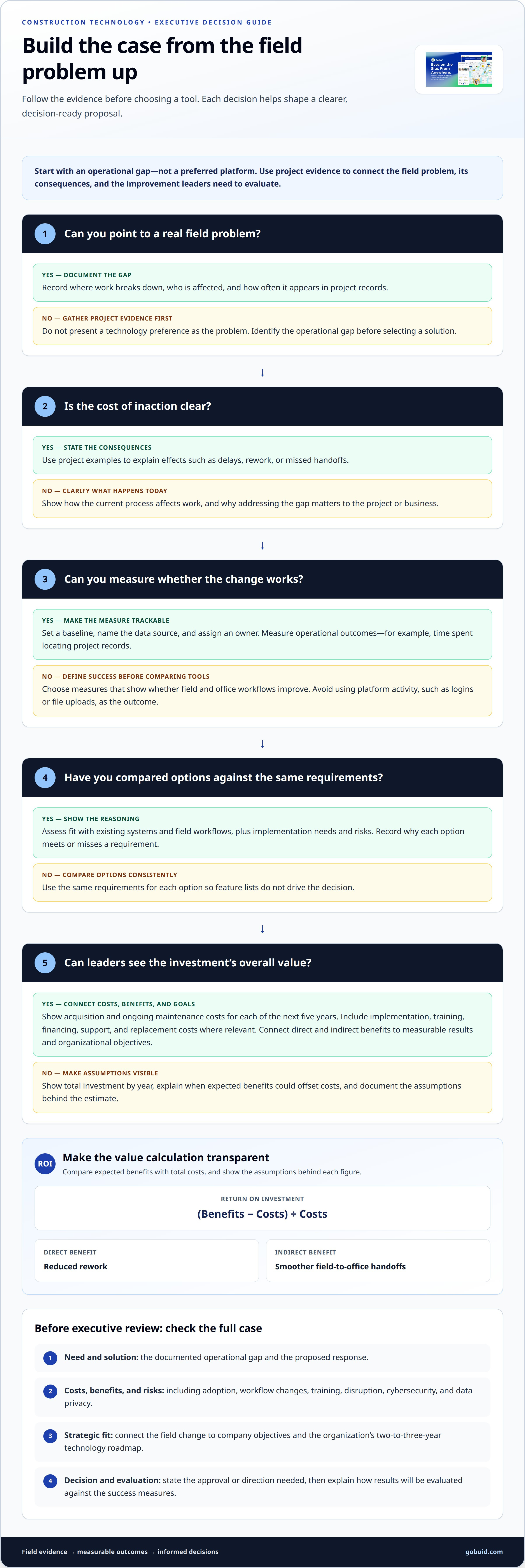
- List project acquisition and ongoing maintenance costs for each of the next five years. Include implementation, training, financing, support, and replacement costs where relevant. Show the total investment by year, then use the payback period to explain when expected benefits could offset costs.
- Estimate direct benefits, such as reduced rework, and indirect benefits, such as smoother handoffs between field and office teams. Calculate return on investment using evidence from current workflows, and connect each benefit to a measurable business result, such as productivity or profitability.
- Show how the technology supports customer experience and organizational goals. For instance, clearer progress records may help teams communicate project status more consistently. Investments can fall short because of weak strategic alignment, inadequate planning, limited training, or insufficient evaluation of available options.
- Assess adoption and implementation risks by identifying affected roles, workflow changes, training needs, and likely disruption. Before rollout, ask project stakeholders to map milestones, responsibilities, and success measures, and allow time for teams to learn the new process.
- Address cybersecurity and data privacy risks. Assess who can access project records, how sensitive information is handled, and what could happen if data is exposed, lost, or unavailable. Describe the controls and response steps planned to manage these risks.
Build the case around the business need and proposed solution, showing how expected benefits, costs, and risks together establish the investment’s overall value. Include acquisition and ongoing maintenance costs in projections. Explain how the benefits address business needs and support broader organizational goals.
IT and business leaders should work together to connect the proposal to the company’s mission and long-term vision. Check for strategic alignment, sound planning and analysis, adequate skills and training, and careful evaluation of available options. Gaps in these areas can undermine technology investments.
Defining the business problem before selecting a solution
Start with the operational gap, not a preferred platform. When presenting a business case for construction tech to executives, connect the problem to evidence, consequences, and measurable improvement.
Define the problem and inaction consequences
Record where work breaks down, who is affected, and how often the issue appears in project records. For example, if teams repeatedly search for current drawings, use project evidence to describe delays, rework, or missed handoffs. Explain the impact of continuing with the current process, rather than presenting a technology preference as the problem.
Set success metrics
Choose measures that show whether the change improves field and office workflows. Set a baseline, name its data source, and assign an owner to each measure. For example, compare the time spent locating project records before and after implementation. Define success through operational outcomes, not platform activity such as logins or file uploads.
- Compare technology options against the same requirements. Assess how each fits existing systems and field workflows, as well as its implementation needs and risks. Record why each option meets or misses a requirement so feature lists do not drive the decision.
- Calculate return on investment by comparing expected benefits with total costs. Use (benefits minus costs) divided by costs, and show the assumptions behind each figure. This gives stakeholders a transparent basis for assessing the estimate.
- When presenting a business case for construction tech to executives, provide decision-ready evidence: the baseline, expected improvement, risks, and success measures. Use project examples and concise visuals. State the approval or direction needed, then explain how you will evaluate the results.
Aligning a business case with organizational objectives
Connect the proposed field-level change to the company’s mission, vision, and long-term goals. A clear structure helps leaders see why the investment matters beyond the technology itself.
- Translate an organizational objective into a project outcome. If leaders prioritize profitability, explain how better coordination could support that goal, then identify the workflow and evidence behind the connection. Make the chain clear: company objective, operational change, expected business benefit. This helps leaders assess the technology’s role without treating adoption as the end result.
- Engage key stakeholders early, especially project leaders and teams affected by the change. Ask how current workflows support or obstruct company priorities. Their input can reveal dependencies between site operations, office processes, and customer commitments. Use their perspectives to refine the proposal before executive review, rather than presenting a plan without operational context.
- Frame the proposal around priorities leaders already discuss. Recent board meeting topics can clarify why an initiative matters now. Your case for construction tech should also show how the investment fits the organization’s two-to-three-year technology roadmap. Explain the tradeoffs, strategic fit, and decision required.
- Show how the organization’s ability to deliver its goals could improve, then define how leaders will track progress. For example, connect clearer project reporting to a stated need for timely operational decisions. A disciplined approach to presenting a business case for construction tech to executives makes assumptions and adoption dependencies visible and connects field workflows with business priorities.
GoBuid
GoBuid helps construction teams build a clearer picture of field operations for a technology business case. Its project tools include customised forms, Manpower Tracking, and Safety & Quality Inspections. These workflows help teams capture consistent information from site activity and document operational processes.
When a proposal depends on timely project records, GoBuid can generate a report in one click. Use this capability alongside your defined business problem and success measures to show how information is gathered and shared. It fits cases focused on clearer field documentation, workforce tracking, or inspection workflows.
If you’re considering how GoBuid fits your construction workflows, contact GoBuid.
Turn the case into a clear next step
Once your proposal is tied to a business priority, keep that connection visible as the work moves from approval to field use. Presenting a business case for construction tech to executives is not only about gaining a decision. It also means ensuring the operational information behind that decision remains clear and useful to the people doing the work.
GoBuid’s Digital Site Diary, customised forms, and one-click reporting help teams capture and organize project information. These tools connect daily site activity with the outcomes your proposal aims to improve. Choose workflows that fit the problem and keep the resulting information useful to field teams and decision-makers.
Discuss your construction tech case with GoBuid and take the next step with a clear view of what your teams need.
Frequently Asked Questions
Why Do So Many Technology Investments Fail to Deliver?
Technology investments can fall short when tools do not fit the way crews and office staff work. A platform may offer useful features, but if field teams cannot apply them in daily tasks, the expected operational change will not follow. For example, a reporting tool will not resolve inconsistent records if teams continue to capture site updates in different ways.
Why are business cases important?
Business cases give leaders a structured basis for deciding whether to commit resources. They also help project sponsors explain tradeoffs, record key assumptions, and agree on what the organization expects from the investment. For example, documenting who owns adoption and how outcomes will be reviewed can help an approved project stay focused after implementation begins.
What metrics show ROI for construction technology investments?
Useful metrics link system use to project outcomes. Depending on the problem, track time spent reconciling records, how quickly inspection issues are closed, or how often teams correct incomplete reports. Compare these measures against a consistent baseline and review them alongside implementation and operating costs. Choose measures tied directly to the investment’s intended outcome.