Rotary Bored Piling: A Contractor’s Guide to Efficiency and Digital Documentation
by Sheldon Huang
|
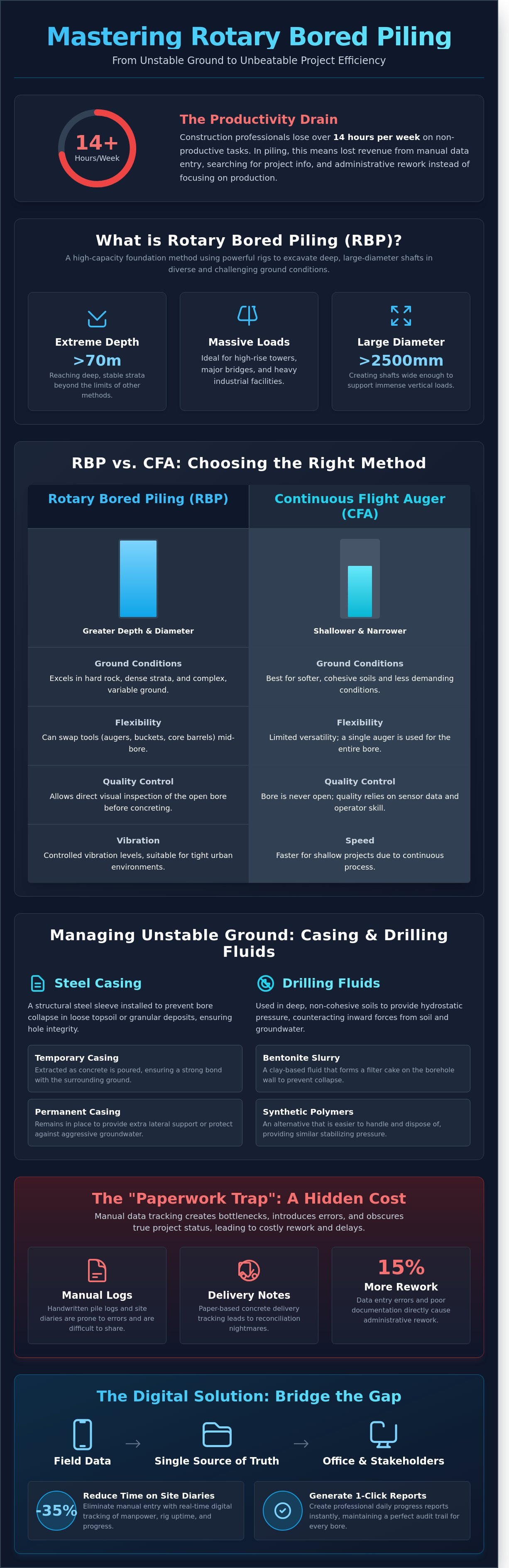
What if your rig operators spent 100% of their shift focused on production instead of losing hours to manual piling logs? According to industry data from FMI Corporation, construction professionals spend over 14 hours per week on non-productive activities like searching for project data and manual reporting. In the high-stakes world of Rotary Bored Piling, that lost time is a direct hit to your bottom line. You already understand that managing unstable ground conditions and groundwater ingress is a full-time job. You shouldn't have to battle a mountain of paperwork at the same time.
It's time to regain control of your site. This guide will help you master the technical essentials of the rotary method while showing you exactly how to eliminate administrative overhead. We'll show you how to bridge the gap between the field and the office to ensure every concrete record and pile log is captured with precision. You'll learn how to determine suitability for specific ground conditions, reduce time spent on site diaries by 35%, and maintain a single source of truth for all your piling data. We are moving past the era of lost paperwork and into a new standard of project visibility.
Key Takeaways
Learn when to deploy Rotary Bored Piling for high-capacity foundations and how it outperforms CFA in depth and diameter.
Master ground stabilization techniques using temporary casing and drilling fluids to prevent bore collapse in deep, unstable strata.
Eliminate the "paperwork trap" by replacing manual logs and delivery notes with real-time digital tracking.
Bridge the gap between the field and the office with centralized manpower and rig uptime data.
Generate professional daily progress reports in one click to maintain a single source of truth for every bore.
⭐ Learn more about GoBuid's feature- without the heavy enterprise price tag
What is Rotary Bored Piling and When Should You Use It?
Rotary Bored Piling is a high-capacity foundation solution built for the toughest structural demands. It uses powerful hydraulic rigs to rotate a telescopic Kelly bar, driving specialized augers or buckets into the ground. This method excels where standard systems fail. While basic techniques struggle with extreme depth, RBP reaches beyond 70 meters in diverse soil strata. It's the primary choice for 50-story high-rise towers, massive bridge piers, and heavy industrial foundations. The Piling process allows for large-diameter shafts, often exceeding 2,500mm, to support vertical loads that would crush lesser systems.
RBP vs. CFA: Choosing the Right Method
Choosing between Rotary Bored Piling and Continuous Flight Auger (CFA) comes down to load and ground conditions. RBP wins on massive structural loads because it creates larger diameters and deeper bores. If your site data shows hard rock or dense strata, RBP is the only viable path. CFA is faster for shallower, soft-ground projects, but it lacks the versatility to swap tools mid-bore. In tight urban environments, RBP rigs offer controlled vibration levels. This protects adjacent structures while maintaining the high torque required for deep penetration. Efficient equipment tracking is essential here to ensure these high-cost rigs stay productive.
Key Advantages of the Rotary Method
Quality control is the standout benefit. You can inspect the bore directly before any concrete is poured, ensuring the base is clean and secure. This visibility eliminates the guesswork common in displacement piling. The system also offers unmatched flexibility. Operators switch between augers, cleaning buckets, and core barrels to handle changing ground conditions in a single hole. For unstable ground, the use of temporary or permanent steel casing provides 100% borehole stability. This prevents collapse in loose sands or high water tables, ensuring a perfect pile every time.
Managing Unstable Ground: Casing and Drilling Fluids
Unstable ground demands immediate control. In loose topsoil or granular deposits, Rotary Bored Piling requires temporary casing to prevent immediate bore collapse. This steel sleeve acts as a structural barrier while the auger removes spoil. Without it, sidewall failure is inevitable. It's the primary method for maintaining hole integrity before the concrete pour begins. These casings typically extend through the loose upper layers to a depth where the soil becomes self-supporting.
Temporary vs. Permanent Casing
Contractors choose casing based on soil conditions and design requirements. Temporary casing is extracted as concrete is poured, ensuring a clean bond with the surrounding ground. Permanent casing remains in place. This is standard for piles in aggressive groundwater or where extra lateral support is required. To install these, rigs use high-torque oscillators or vibratory hammers to twist or drive the steel deep into the substrate. The mechanical force must be precise to avoid damaging the casing or the rig itself.
Drilling Fluid Management
Deep bores in non-cohesive soils require more than just steel. Drilling fluids, like bentonite slurry or synthetic polymers, fill the shaft to provide hydrostatic pressure. This pressure counteracts the inward force of groundwater and soil. Managing these fluids is a logistical hurdle. You need desanding plants to recycle the slurry and specialized vacuum tankers for on-site disposal. Keeping a detailed field report of fluid levels and viscosity ensures the bore stays stable until the steel cage is lowered.
Once the hole reaches the target depth, crews lower reinforced steel cages into the fluid-filled cavity. The fluid keeps the cage centered and prevents debris from settling at the base. Every inch of casing depth and every gallon of fluid must be recorded. Precision here prevents structural voids. Rotary Bored Piling relies on this data to ensure the structural integrity of the foundation. Accurate documentation turns a chaotic site into a controlled, professional environment where every variable is tracked and managed.
The Administrative Burden: Tracking Piling Progress
Rotary Bored Piling projects generate massive amounts of data every shift. Most sites fall into the paperwork trap. Manual logs, handwritten concrete delivery notes, and rig uptime trackers often contain errors that lead to 15% more administrative rework. Real-time manpower tracking for specialized piling crews is a necessity, not a luxury. Without it, productivity leaks remain invisible until the budget is blown.
Poor documentation carries heavy consequences. Incomplete records trigger payment delays and safety failures. A single missing inspection report can halt a project for 72 hours while engineers verify structural integrity. Replace outdated paper logs with a Digital Site Diary to centralize field data and ensure a single source of truth.
Equipment and Rig Management
Rotary Bored Piling rigs are the heart of the operation. Track rig hours and maintenance needs to prevent downtime on critical path activities. A 5% increase in rig efficiency can save thousands in daily operating costs. Use the equipment management guide to optimize asset utilization. Preventative maintenance keeps the bore moving and the schedule on track.
Quality Control and Site Inspections
Every pile requires absolute precision. Implement digital Safety & Quality Inspections to verify depth and diameter for every installation. Don't rely on memory or messy notebooks. Capture progress photos of the bore and steel cage before pouring concrete. This provides visual proof of compliance and protects against future litigation.
Stop chasing paperwork and start managing your site with real-time project visibility.
Streamlining Piling Operations with GoBuid
Construction sites are inherently chaotic. Rotary Bored Piling involves complex variables like shifting soil conditions, torque requirements, and precise concrete pressure. GoBuid acts as your digital foreman. It bridges the gap between the drilling rig and the head office, providing a single source of truth for every pile driven. You gain total control over your workflow through a platform designed for the rugged reality of the field.
Managing project-based piling work requires high flexibility. GoBuid supports this by offering no lock-in contracts. You pay for the utility you need when the rigs are active. This approach ensures your software costs scale naturally with your project pipeline. It's a no-nonsense partnership built on results rather than restrictive agreements.
One-Click Reporting for Piling Logs
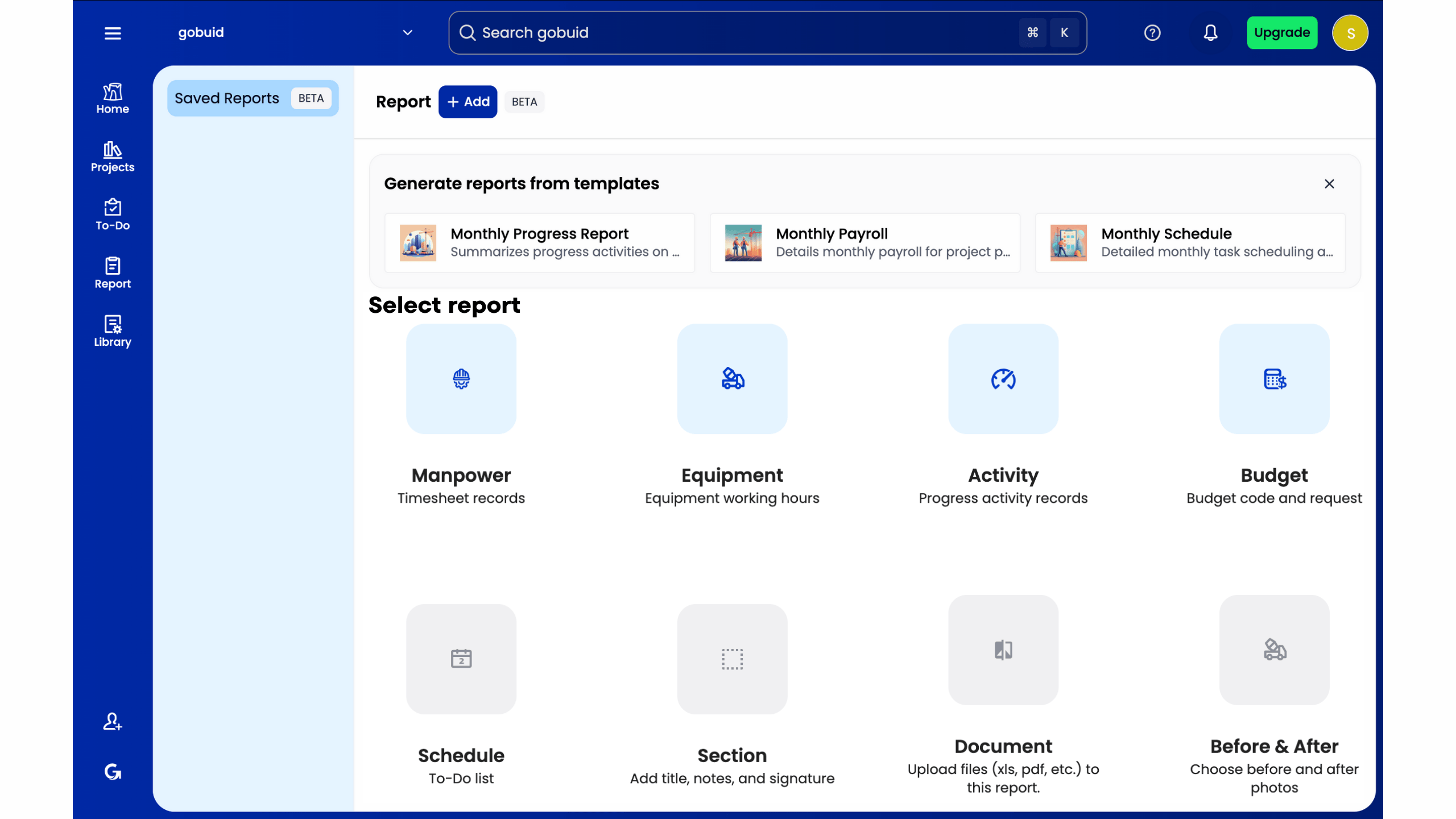
Speed translates directly to profit. Manual data entry often wastes over 2 hours of a foreman's day. GoBuid allows your team to generate reports in one click, pulling data directly from site inputs. The system automates the consolidation of critical metrics:
Concrete Volumes: Track planned versus actual consumption to identify wastage immediately.
Depth Logs: Monitor drilling progress against design specifications for every Rotary Bored Piling unit.
Manpower Data: Record hours and trades to streamline payroll and cost allocation.
These automated logs ensure 100% BCA compliance. You deliver professional, accurate documentation to project stakeholders without the typical administrative lag. It's about maintaining precision under pressure.
Real-Time Field-to-Office Connectivity
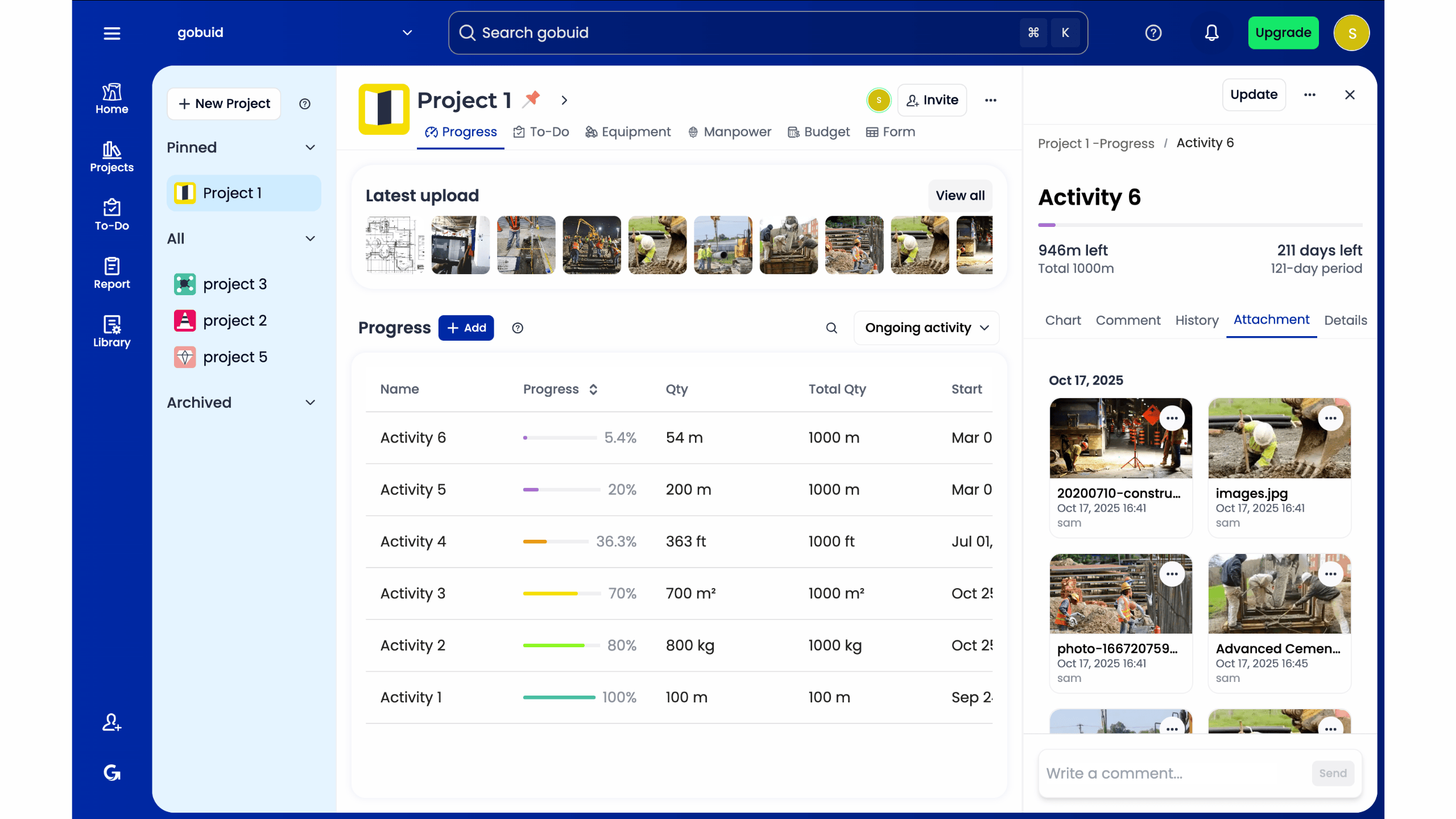
Visibility shouldn't wait for the end-of-week meeting. Foremen submit site diaries via mobile devices directly from the site. This eliminates the need for exhausting end-of-day office admin. Project managers access a centralized dashboard to view real-time project analytics. You see the pulse of the job site as it happens.
Centralized data allows for faster decision-making. When a rig hits an unexpected obstruction, the office knows instantly. This connectivity reduces downtime and keeps the project on schedule. Contact our team for a customized demo to see how these piling-specific workflows can transform your operations.
Master Your Piling Operations with Digital Precision
Successful Rotary Bored Piling requires a delicate balance between technical site management and rigorous documentation. Managing unstable ground with casing and drilling fluids is only half the battle. The other half is won in the office, where administrative delays often consume up to 10 hours of a supervisor's work week. By bridging the gap between the field and the office, you ensure that every pile drilled is documented accurately. Transitioning to a centralized digital system eliminates the risk of lost field notes and mismatched equipment logs.
GoBuid acts as your digital foreman, providing real-time manpower and equipment tracking to keep your project on schedule. You can generate BCA compliant digital site diaries and detailed piling reports in one click, saving hours during the final handover phase. This level of visibility ensures total accountability across the entire job site. It's time to replace the rugged chaos of paper logs with the sleek precision of modern software. You have the expertise to drill; we have the tools to help you manage the data. Let's get to work.
Streamline your piling reports with GoBuid, Start for free today
Frequently Asked Questions
What is the maximum depth achievable with rotary bored piling?
Rotary Bored Piling can reach depths exceeding 70 meters in favorable ground conditions. Large diameter rigs, like the Bauer BG series, often achieve 100 meters for heavy infrastructure projects. This capacity makes it the primary choice for skyscrapers and bridges where load-bearing requirements are extreme. It's the standard for projects requiring diameters up to 3000mm, providing structural stability that smaller rigs can't match.
How does rotary bored piling differ from CFA piling?
Rotary Bored Piling uses a telescopic kelly bar to excavate soil in stages, whereas CFA piling utilizes a continuous flight auger to drill the full depth in one pass. Rotary methods allow for larger diameters up to 3000mm, while CFA typically caps at 1200mm. Use rotary for hard rock or deep foundations and CFA for faster, low-vibration work in softer soils. It's about choosing the right tool for the strata.
When is bentonite or polymer fluid required in the piling process?
Support fluids like bentonite or polymer are required when drilling through granular soils or below the water table to prevent borehole collapse. These fluids exert hydrostatic pressure against the soil walls, maintaining stability during the 4 to 8 hour excavation window. Polymer is increasingly preferred over bentonite because it requires 50% less footprint for recycling equipment on tight urban sites. This ensures the shaft remains open for reinforcement cage installation.
What are the common causes of failure in bored piles?
The 3 most common causes of failure include inadequate base cleaning, concrete segregation during pouring, and necking caused by soil intrusion. If 5% or more of the pile base contains loose debris, the end-bearing capacity drops. Contractors must ensure the tremie pipe remains submerged 2 meters into the fresh concrete to prevent contamination. Proper site oversight prevents these structural voids from compromising the foundation's integrity.
How can I digitize my daily piling logs and site reports?
Digitize your daily piling logs by moving from paper forms to a centralized platform like Buid. Field teams capture drilling depths, soil strata, and concrete volumes in real time via a mobile interface. This creates a single source of truth that bridges the gap between the rig and the office, cutting report turnaround time by 40% while ensuring 100% data accuracy. Stop chasing lost paperwork and start managing your site with precision.