Types of Construction Vehicles and Heavy Machinery: Uses and Equipment Management
Explore types of construction vehicles and heavy machinery, what each is used for, how to choose the right equipment, and how to manage it across sites.
by Cooper Boss
|
Construction vehicles are the trucks and machines that move earth, haul materials, lift loads, and shape surfaces on a site. The most common types are excavators, bulldozers, loaders, dump trucks, cranes, rollers, and concrete pumps, and each is built for a specific stage of work. Picking the wrong one slows a job down; losing track of the right one slows it down more.
In this guide, you will learn:
• What construction vehicles, heavy machinery, and construction equipment mean, and how the terms differ in practice.
• What the most common machines do across earth-moving, trucking, lifting, road, and concrete work, including how dump trucks and tipper trucks relate.
• Which machinery typically suits earthworks, building, road, foundation, and material transportation projects.
• How to choose equipment based on site conditions, capacity, schedule, rental versus ownership, and safety.
• How to keep equipment organised across multiple jobsites, and how to plan equipment hours against project budgets.
• What Singapore’s MOM and the WSH Act require for operator certification, equipment inspection and registration, and site procedures such as permits-to-work.
What Are Construction Vehicles and Heavy Machinery?
The three terms overlap, and most people use them interchangeably. The practical distinctions are:
- Construction vehicles are trucks and mobile machines that transport materials, people, or loads around and between sites. Dump trucks, concrete mixer trucks, and flatbeds are typical examples.
- Heavy machinery (also called heavy construction equipment) refers to large, powered machines that do the physical work: digging, pushing, lifting, and compacting. Excavators, bulldozers, and cranes fall here.
- Construction equipment is the broadest term. It covers vehicles and heavy machinery, plus smaller items such as plate compactors, mixers, and generators.
The distinction matters for planning. Large machines often need trailer transport, a specific operator, and inspections before use, while smaller equipment can move with the crew.
Types of Construction Machinery and Their Uses
Construction equipment types are usually grouped by the job they perform. The sections below cover the 19 machines contractors encounter most often.

Earth-Moving Equipment
Earth-moving machines (also called earthmoving equipment) cut, push, load, and level soil and rock during site preparation and excavation.
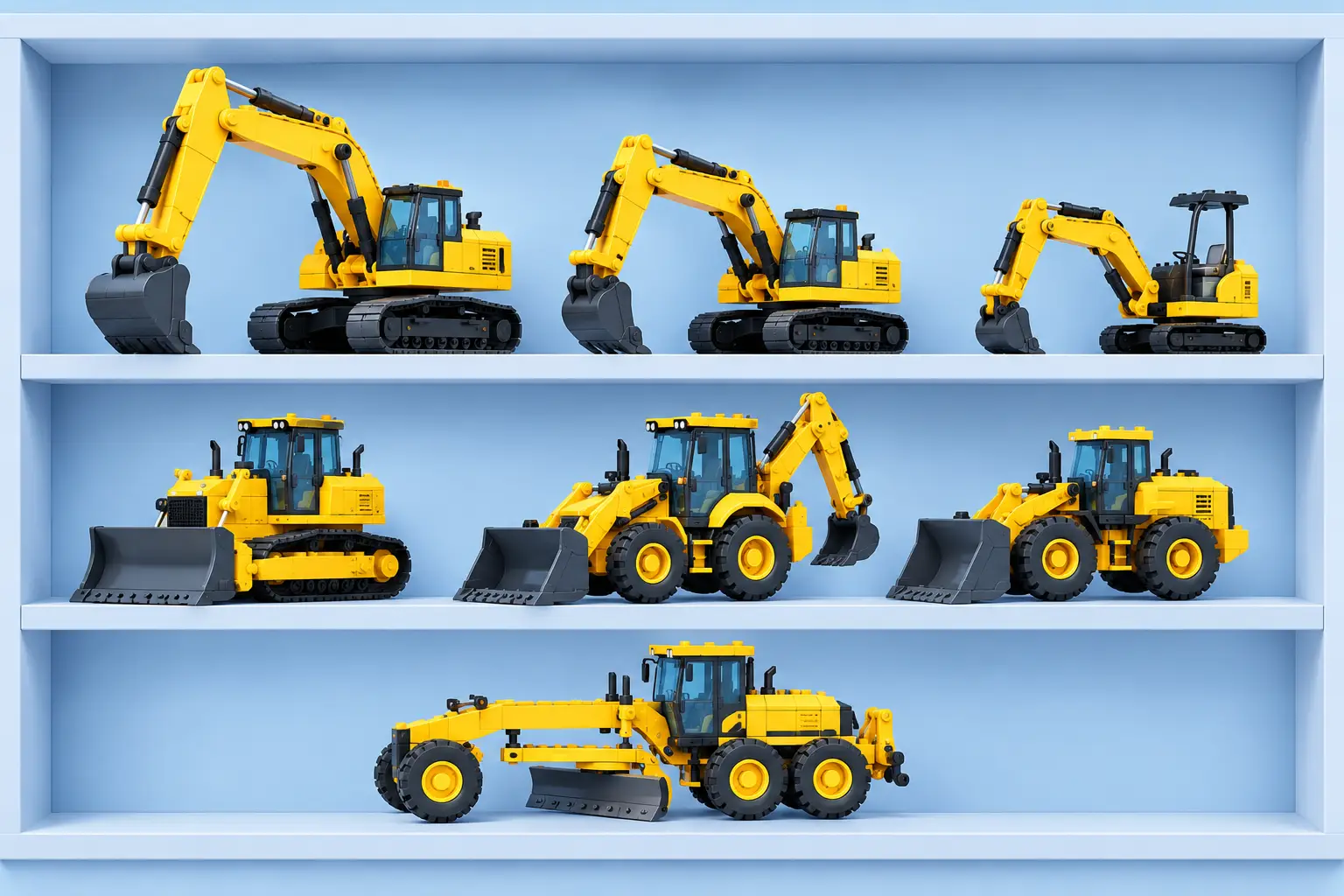
- Excavators. A rotating cab with a boom, arm, and bucket, mounted on tracks or wheels. The excavator machine digs trenches, foundations, and basements and loads trucks. Mini excavators suit tight urban sites; larger models handle bulk excavation.
- Bulldozers. Tracked machines with a wide front blade for pushing soil, rubble, and debris over short distances. Used for site clearing, rough grading, and spreading fill. Tracks give strong traction on soft or uneven ground.
- Backhoe loaders. A tractor with a loading bucket at the front and a digging arm at the back. Less capable than a dedicated excavator or loader, but versatile for small trenches, utility work, and light loading.
- Wheel loaders. Wheeled machines with a large front bucket for scooping and carrying loose material such as sand, aggregate, and spoil. Common for stockpile handling and loading trucks.
- Motor graders. Long machines with an adjustable blade between the axles, used to finish surfaces to a precise level and slope. Typical for road bases, haul roads, and large platforms.
Construction Trucks
There are several types of construction trucks, but four cover most site work.

- Dump trucks and tipper trucks. These are essentially the same machine: a truck with an open bed that tilts to discharge its load. “Dump truck” is the common term in North America, while “tipper” (or tipper lorry) is more common in the UK and much of Asia, including Singapore. Variants include rigid on-road trucks, articulated off-road dump trucks, and small site dumpers. They haul soil, aggregate, spoil, and demolition waste.
- Concrete mixer trucks. A rotating drum on a truck chassis that carries ready-mixed concrete from the plant and keeps it workable in transit. Used for slabs, columns, and foundations.
- Flatbed trucks. An open, flat deck for steel bars, formwork, pipes, precast elements, and smaller machinery. Versions with a mounted crane are commonly called lorry cranes in Singapore and handle loading and unloading on site.
Lifting and Material Handling Equipment

- Mobile cranes. Truck- or crawler-mounted cranes that travel between sites and set up quickly. Best for short-duration or one-off lifts such as placing precast units, steel, or plant. They need a lift plan and ground that can bear the load.
- Tower cranes. Tall, fixed cranes used for continuous lifting on multi-storey projects. A tower crane covers the building footprint for the project’s duration, but setup and dismantling take time and planning.
- Forklifts. Fork-equipped vehicles for moving palletised materials over flat, firm ground. Typically used in storage areas, loading bays, and for unloading deliveries.
- Telehandlers. A telescopic boom with forks or attachments. Unlike a standard forklift, a telehandler can reach over obstacles, lift to upper levels, and work on rougher terrain.
Road Construction and Compaction Equipment

- Road rollers. Heavy drum machines that compact soil, aggregate, and asphalt. Smooth-drum rollers finish surfaces, while padfoot rollers work cohesive soils.
- Asphalt pavers. Lay and level hot asphalt mix to a consistent thickness, with rollers following behind to compact it.
- Plate compactors. Walk-behind machines with a vibrating plate, used to compact soil and aggregate in trenches, backfill areas, and paving bases where larger rollers cannot reach.
Concrete and Foundation Equipment

- Concrete pumps. Deliver concrete through a boom or pipeline to the pour location. Boom pumps are truck-mounted, while line pumps use hoses and pipes. They are valuable for high-rise work and sites with restricted access.
- Piling rigs. Install piles for deep foundations, either by boring or driving them into the ground. The method depends on soil conditions, load requirements, and nearby structures.
- Concrete mixers. Smaller drum mixers used on site for minor works, repairs, and locations without easy ready-mix access. They differ from mixer trucks, which transport concrete rather than produce small batches.
Construction Equipment by Project Type
No project uses every machine. The right mix depends on project scope, ground conditions, access, and construction method. The table below shows typical pairings.
Treat this as a starting point. A confined urban site might replace a bulldozer with a mini excavator, while soft ground may call for a different piling method.
How to Choose the Right Construction Equipment
Start with the activities and site conditions
List the work packages first, then match machines to them. Check ground bearing capacity, slope, access widths, overhead obstructions, and nearby structures before settling on a machine.
Match size and capacity to the task
An oversized machine wastes fuel and can be hard to manoeuvre on site, while an undersized one slows production and can become a safety risk. Check rated capacity, such as bucket size, lifting capacity, and reach, against the heaviest or furthest task.
Check availability against the schedule
Machines are often needed on specific dates. Confirm when each is needed, how long it will stay, and where it will come from, including whether it is committed to another project.
Weigh rental against ownership
Owning tends to suit machines used steadily across projects. Renting tends to suit specialised, short-duration, or peak-demand needs. Compare rental rates and utilisation realistically rather than assuming either is cheaper.
Plan for maintenance and safety
Factor in servicing intervals, inspection requirements, operator competence, and downtime. Lifting equipment in particular carries regulatory requirements in Singapore. Confirm current requirements with the Ministry of Manpower before planning lifts.
Managing Construction Machinery Across Multiple Jobsites
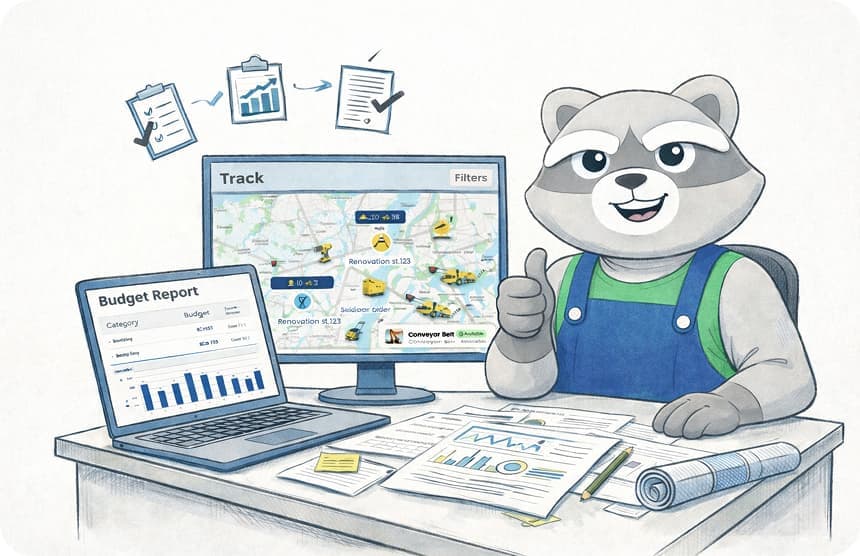
Managing equipment becomes more challenging as contractors take on multiple projects. Machines move between sites, availability changes, and maintenance records can become scattered and without a clear visibility, teams may struggle to know where equipment is assigned, whether it's available, and if it's ready for use.
Heavy Machinery Regulations in Singapore
Heavy machinery operations in Singapore are governed primarily by the Ministry of Manpower (MOM) and the Workplace Safety and Health (WSH) Act. Requirements differ by machine type, so confirm current rules with MOM before deploying equipment. The points below cover the main areas contractors deal with.
Operator Certification and Training
- Machine-specific training. Operators must complete an approved training course for the machine they will use, such as a forklift, crane, or excavator course. Certification for one machine type does not qualify an operator for another.
- WSQ accreditation. Forklift operators must hold a valid Forklift Operator Certificate from a WSQ-accredited training provider.
- Lifting roles. Roles such as lifting supervisors, crane operators, riggers, and signalmen require specific competency training, for example Supervise Safe Lifting Operations (SSLO) and Perform Rigger and Signalman Tasks (PRST).
- Employer duty. Employers must verify and record that every operator holds a valid, unexpired certificate before deploying them on site.
Equipment Registration and Inspection
- Lifting machine certification. Heavy lifting machinery, such as cranes and piling rigs, must be examined, load-tested, and certified by an Authorised Examiner (AE) before use and periodically afterwards.
- MOM registration. Certain lifting equipment, including tower cranes and specific hoists, must be registered with MOM. Tower cranes also require type approval.
- Machinery supply rules. Under the WSH Act’s Fifth Schedule, with updates effective January 2025, additional machinery categories such as lathes, milling machines, and industrial mixing units must meet design, safety information, and manufacturing compliance standards.
- Pressure vessels. Air receivers, steam boilers, and gas plants require Commissioner approval, safety valves, pressure gauges, and regular examinations.
Site and Operational Requirements
- Permit-to-Work and documentation. High-risk operations, particularly lifting and heavy construction, require a lifting plan with risk assessment (RA), a safe work procedure (SWP), and an active permit-to-work (PTW) system.
- Supervision. Close supervision is mandatory, with extra vigilance during night shifts, early mornings, weekends, and public holidays, when site management is often reduced.
- Emergency response. Sites must keep a documented Emergency Response Procedure (ERP), injury management protocols, and run regular drills.
Frequently Asked Questions About Construction Machinery
What are the most common construction vehicles?
The most common construction vehicles are excavators, bulldozers, wheel loaders, dump or tipper trucks, concrete mixer trucks, mobile cranes, and road rollers. Together they cover excavation, hauling, lifting, concreting, and compaction, which are the core activities on most building and infrastructure sites.
What machines are used for earthmoving?
Earthmoving machines include excavators for digging, bulldozers for pushing and clearing, wheel loaders for scooping and loading, motor graders for finishing surfaces, backhoe loaders for smaller jobs, and dump or tipper trucks for hauling material away. Which ones you need depends on soil, volume, and site access.
What is the difference between an excavator and a backhoe?
An excavator is a dedicated digging machine with a rotating cab, designed for deep and high-volume excavation. A backhoe loader is a tractor with a loader bucket at the front and a digging arm at the rear. It is more versatile but less powerful for heavy digging.
What types of trucks are used in construction?
Construction sites commonly use dump or tipper trucks for hauling soil and aggregate, concrete mixer trucks for delivering ready-mix concrete, and flatbed trucks for steel, formwork, and pipes. Lorry cranes, which are flatbeds with a mounted crane, are also widely used to load and unload materials.
How do contractors manage equipment across multiple construction sites?
Contractors keep a central equipment register, give each machine a unique identifier such as a QR code, assign equipment to specific sites, and track whether each unit is available, in use, or under repair. Digital tools replace scattered spreadsheets and messages, giving the office clearer visibility into where machines are.