Vibro-Replacement (Stone Columns): A Professional Guide
by Sam Chen
|
Your ground improvement project is only as strong as the site diary that documents it. Managing the mountain of stone delivery tickets and real-time installation logs often feels like a second job for your site engineers. You understand that a single gap in BCA compliance data can trigger delays that stall a project for weeks. Vibro-Replacement (Stone Columns) requires absolute precision in the field, yet the reporting process often remains stuck in a cycle of manual entry and lost paperwork. It's time to stop chasing missing data and start building with confidence.
This technical guide helps you master the mechanics of Vibro-Replacement (Stone Columns) while implementing a system that reduces administrative overhead by 35%. We'll show you how to transform chaotic field reports into a streamlined, digital workflow that satisfies every stakeholder and ensures total project visibility. We will break down the engineering fundamentals of stone columns and provide a tactical roadmap for bridging the gap between rugged site reality and the sleek precision of modern project management software.
Key Takeaways
Master the mechanics of Vibro-Replacement (Stone Columns) to increase bearing capacity and mitigate settlement in weak soil conditions.
Compare wet top-feed and dry bottom-feed Vibro-Replacement (Stone Columns) installation techniques to select the optimal equipment and method for your site constraints.
Streamline the high-volume documentation required for Vibro-Replacement (Stone Columns) to ensure every column is tracked with precision.
Identify and resolve the administrative bottlenecks in manpower and rig crew tracking that often stall Vibro-Replacement (Stone Columns) project momentum.
Bridge the gap between field data and office reports using digital tools that transform Vibro-Replacement (Stone Columns) paperwork into one-click submittals.
⭐ Learn more about GoBuid's feature- without the heavy enterprise price tag
Digitising Vibro-Replacement with GoBuid
Managing Vibro-Replacement (Stone Columns) requires absolute precision and constant oversight. GoBuid acts as your digital foreman, bridging the gap between the heavy machinery in the field and the strategic decisions in the office. It eliminates the lag between data collection and project visibility. You get a clear, real-time view of ground improvement progress without the administrative burden of traditional paperwork.
Automated Reporting and Custom Forms
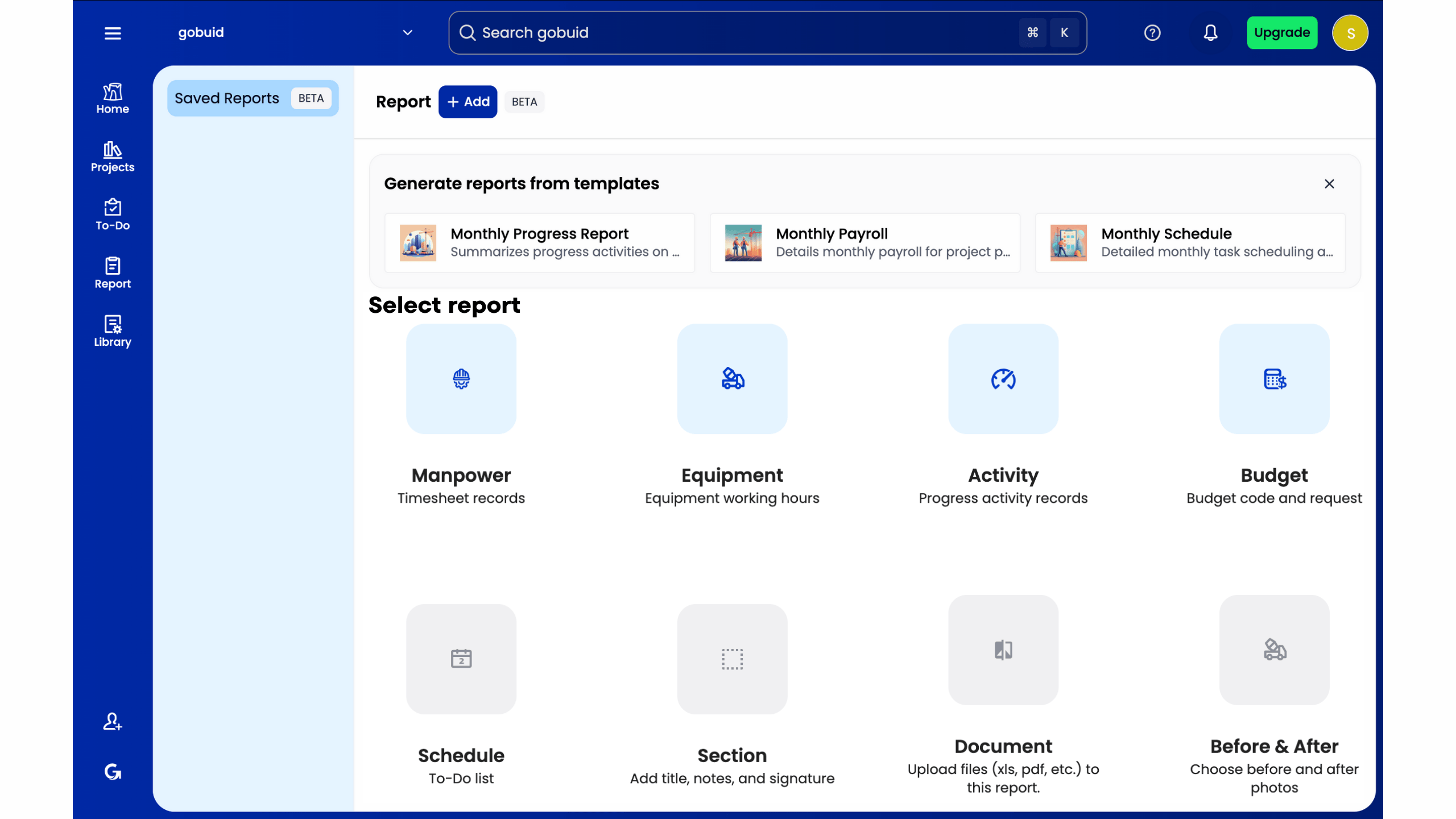
Standardise your data collection using customised forms designed for specific stone column installation logs. Field teams record stone consumption, probe depth, and vibrator amperage directly from their mobile devices. This data feeds into the system to generate a professional site report with a single click. Project managers save an average of 5 to 8 hours per week by removing manual data transcription. The reports are consistent, branded, and ready for immediate distribution to clients or engineers.
Field-to-Office Collaboration
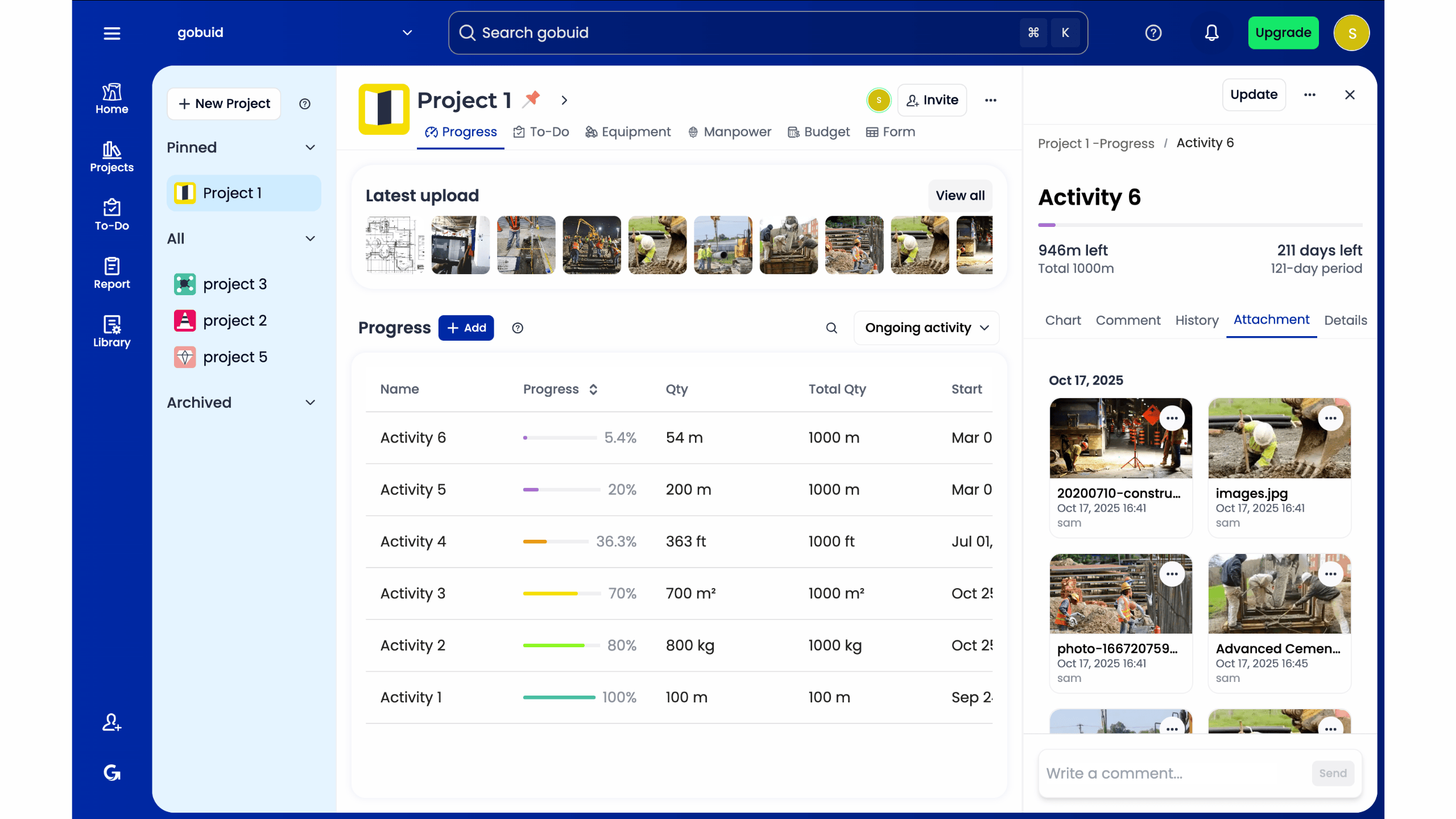
Maintain a single source of truth for all stakeholders with a digital site diary. This tool ensures that every crew member and office executive looks at the same data. Real-time manpower tracking improves safety compliance and helps you monitor crew productivity across multiple rigs. High-resolution progress photos allow you to verify column locations and stone quality from any location. You don't have to be on-site to confirm the work meets technical specifications.
The project analytics dashboard provides a high-level overview of your ground improvement timeline. It tracks actual progress against planned targets, highlighting potential delays before they impact the budget. By centralising your field data, you gain the clarity needed to keep complex Vibro-Replacement (Stone Columns) projects on track and profitable. It's about moving away from reactive management and toward data-driven execution.
What is Vibro-Replacement (Stone Columns)?
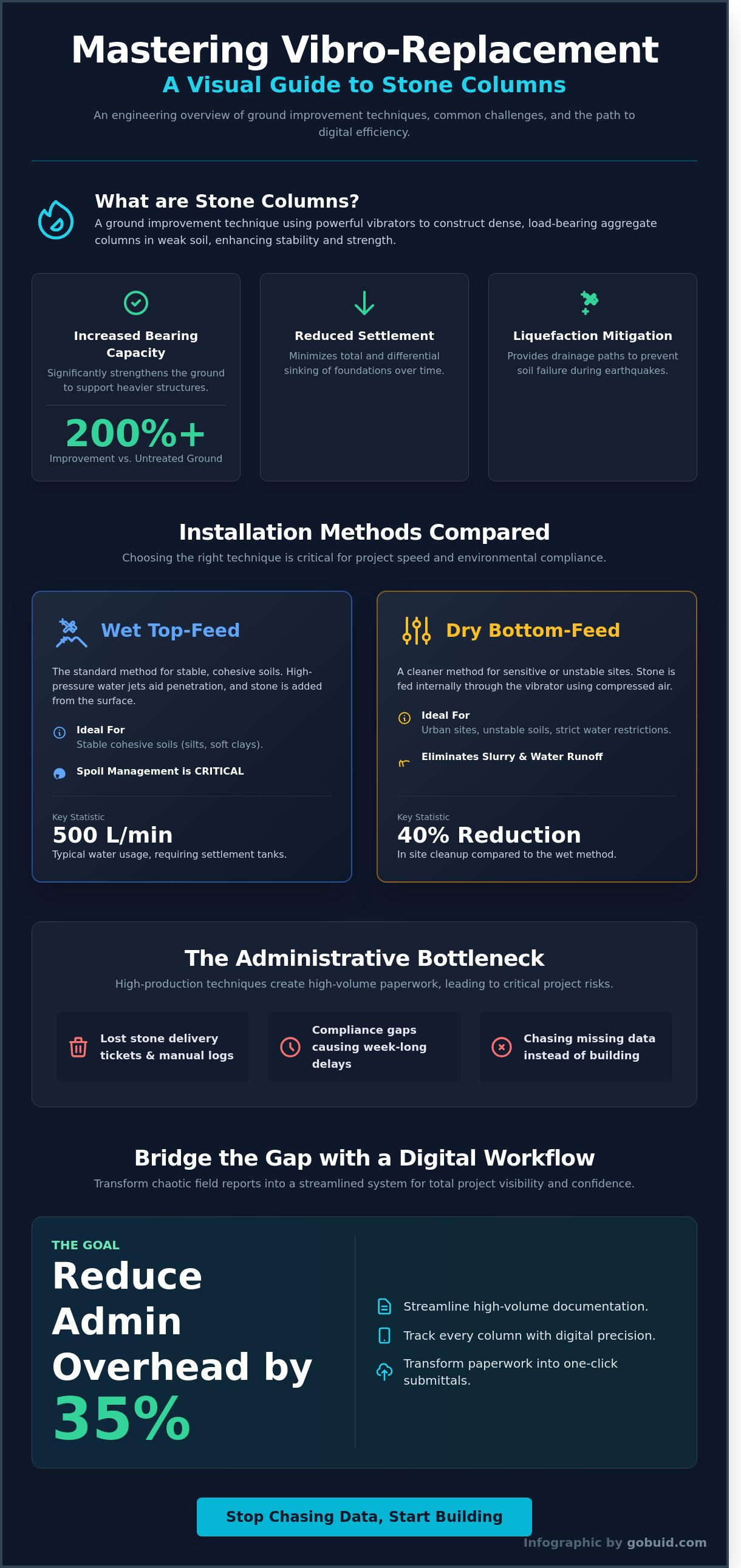
Vibro-Replacement (Stone Columns) is a high-production ground improvement technique. It uses powerful down-hole vibrators to construct dense, load-bearing aggregate columns within the soil matrix. The primary objective is clear. It targets an increase in bearing capacity while slashing total and differential settlement in weak strata. Engineers often see bearing capacity improvements of 200% or more compared to untreated ground. Understanding What is Vibro-Replacement (Stone Columns)? is essential for any project manager dealing with marginal ground conditions. This method excels in silts, soft clays, and loose granular soils where traditional foundations might fail or exceed the budget.
Beyond load support, it's a proven defense against seismic risks. The columns mitigate liquefaction in earthquake-prone regions by providing rapid drainage paths and increasing the overall shear strength of the soil mass. It's a dual-purpose solution that handles both static loads and dynamic threats. To better understand this concept, watch this helpful video:
The Physical Mechanism of Soil Densification
The system works through displacement and reinforcement. In granular soils, lateral vibration forces soil particles into a denser state. This increases the soil's friction angle and stiffness immediately. In cohesive soils like soft clay, the vibrator replaces weak material with a high-modulus stone column. This column acts as a rigid inclusion that intercepts the majority of the structural load. It's a mechanical upgrade for the earth. Aggregate piers is a common industry synonym used in international projects.
Lateral Displacement: The vibrator pushes soil aside, compacting the surrounding area.
Vibration: High-frequency energy re-arranges soil grains into a tighter matrix.
Reinforcement: The stone column provides a stiff vertical element that reduces the stress on native soil.
Contractors typically install these columns in a grid pattern. Spacing usually ranges from 6 to 12 feet on center, depending on the required load support. It's a fast, clean, and measurable way to turn a failing site into a buildable one.
Installation Methods: Wet Top-Feed vs. Dry Bottom-Feed
Choosing the right installation technique for Vibro-Replacement (Stone Columns) determines your project's speed and environmental compliance. Engineers select between wet and dry methods based on soil stability and site constraints. Equipment setups typically include a heavy-duty crane, a deep vibrator, and either a high-volume water pump or a 350 cfm air compressor. A 2021 industry study showed that selecting the wrong method can increase mobilization costs by 15%. Understanding the technical nuances of Wet Top-Feed vs. Dry Bottom-Feed ensures your foundation meets spec without blowing the budget.
The Wet Top-Feed Process
Wet top-feed is the standard for stable, cohesive soils. The vibrator uses high-pressure water jets to penetrate the ground, creating an annular space between the probe and the borehole wall. Stone is added from the surface and flushed down the hole by the water flow. This method requires rigorous spoil management. You'll need settlement tanks to handle the 500 liters of water typically used per minute. Failure to manage runoff leads to site shutdowns and environmental fines. Tracking these variables in daily field reports keeps the project moving and ensures accountability for every cubic meter of material.
The Dry Bottom-Feed Process
Urban sites with strict water restrictions demand the dry bottom-feed process. The vibrator stays in the ground while stone travels through an internal feed pipe directly to the tip. Compressed air, usually delivered at 7 to 10 bar, assists the stone delivery. This method eliminates slurry and reduces site cleanup by 40%. It's a cleaner, more controlled process for installing Vibro-Replacement (Stone Columns). Use this when working near existing structures where water jetting might cause unwanted soil softening. It provides a reliable solution for maintaining column integrity in challenging, unstable conditions.
Operational Challenges in Ground Improvement Projects
The administrative burden of Vibro-Replacement (Stone Columns) is the primary obstacle for project managers. Tracking 500 individual columns across a site isn't just a clerical task; it's a geotechnical necessity. Missing a single column's data can lead to foundation failure or non-compliance with strict safety standards. Inaccurate reporting risks the structural integrity of the entire project. Technical reports like Soil Improvement Through Vibro-Compaction and Vibro-Replacement confirm that design precision is useless without rigorous field execution. You need to know exactly how much stone went into each hole, the amperage reached, and the depth achieved for every single point on the grid.
Managing specialized rig crews adds another layer of complexity. These aren't general laborers; they're highly trained technicians operating million-dollar machinery. Mismanaged manpower tracking leads to expensive idle time. You must maintain real-time visibility over crew output to keep the project on schedule. Without a centralized system, the office stays blind to site progress until the day ends, making it impossible to pivot when ground conditions change.
Managing Site Documentation and BCA Compliance
BCA requirements for a site diary are uncompromising. You must log weather conditions, crew counts, and rig activities daily. Manual paper logs are a liability. They create data silos where critical information stays trapped in a foreman's truck for days. This delay prevents project managers from identifying trends or spotting errors before they become costly rework. Using GoBuid's Features transforms these fragmented notes into a single source of truth. Digital tools ensure that site diaries are completed on time and sync immediately with the office for instant review.
Tracking Equipment and Stone Delivery
Logging stone volumes per column is vital to ensure design specifications are met. If a column doesn't reach the target volume, its load-bearing capacity is compromised. You also need proactive equipment management to maintain high-torque vibrators. These rigs face extreme stress; a breakdown can halt the entire production line.
Track stone delivery tickets against actual consumption per column.
Monitor rig run-hours to schedule preventative maintenance.
Log fuel consumption to manage operational costs effectively.
Master Your Ground Improvement Operations
Successful site stabilization depends on selecting the right installation method for your specific soil conditions. Whether you utilize wet top-feed or dry bottom-feed techniques, Vibro-Replacement (Stone Columns) remains a critical foundation for modern infrastructure. Leading contractors now mitigate operational risks by moving away from manual data entry. Transitioning to a digital workflow ensures your field data matches the technical precision required for complex geotechnical work.
GoBuid bridges the gap between the rig and the office. It's used by top-tier contractors to manage complex geotechnical projects in 2024 with total transparency. You can generate professional reports in one click and maintain full control with no lock-in contracts. This flexibility allows your team to focus on production rather than paperwork. It's time to replace chaotic spreadsheets with a single source of truth that drives project profitability. You'll gain the visibility needed to keep every project on schedule and every stakeholder informed.
Streamline your site reporting with GoBuid; Start for free today
Take control of your job site and build with confidence.
Frequently Asked Questions
What is the difference between vibro-compaction and vibro-replacement?
Vibro-compaction densifies non-cohesive granular soils like sands, while vibro-replacement creates load-bearing stone columns in cohesive soils like silts and clays. Vibro-compaction relies on the vibration-driven rearrangement of existing particles. Vibro-Replacement (Stone Columns) involves backfilling a probe-created void with imported aggregate. This technique increases shear strength by 50% to 100% depending on the replacement ratio. It bridges the gap between weak soil and structural requirements.
How deep can stone columns be installed using vibro-replacement?
Standard equipment allows stone column installation to depths of 15 to 30 meters. Specialized heavy-duty rigs can reach 50 meters in specific soil profiles. Depth limits depend on crane capacity and the vibroflot's power rating. Operators monitor verticality and pressure in real-time to ensure the column maintains its structural integrity. This visibility ensures that every meter of the column meets the engineer's specifications without any guesswork in the field.
Is vibro-replacement more cost-effective than deep foundations like piling?
Vibro-replacement typically reduces foundation costs by 20% to 50% compared to traditional deep piling methods. It utilizes natural aggregates instead of expensive steel or concrete materials. It's a process that improves the existing ground rather than bypassing it, so you save on material transport and site preparation. This efficiency shortens project schedules by 30% on average, providing a clear path to increased profitability for the contractor.
What are the quality control measures for stone column installation?
Quality control focuses on real-time data logging and rigorous post-installation testing. Modern systems track the depth, motor amperage, and stone consumption for every column to ensure consistency. Field teams perform plate load tests on 1% to 2% of installed columns to verify load-bearing capacity. These digital records create a single source of truth for project managers, streamlining the submittals and punch list process for the entire team.
Can vibro-replacement be used in environmentally sensitive areas?
Vibro-replacement is a low-impact solution suitable for environmentally sensitive sites. The dry bottom-feed method eliminates the need for water jetting, which prevents sediment runoff into local waterways. It uses 100% natural stone and produces zero spoil during the installation process. It's a clean approach that helps contractors meet strict environmental regulations while maintaining high production rates without the mess or waste associated with traditional drilling and excavation.