What Is an RFI in Construction? Understand the Workflow and Form
What is an RFI? Learn how construction teams use RFIs to clarify plans, follow the review workflow, complete the form, and route approved changes correctly.
by Amelia Grant
|
An RFI clarifies the work; it does not authorize a change. If you’re asking what an RFI is in construction, it’s a formal written request for clarification about project information, such as drawings, specifications, or contract requirements. A contractor might submit one when documents conflict, a dimension is missing, or a field condition differs from the plans.
Clear RFIs help teams resolve uncertainty and document decisions. They differ from submittals, which present proposed materials or shop drawings for review, and change orders, which document approved changes to scope, cost, or schedule. This guide covers the typical RFI workflow, what to include on the form, and how to keep a question focused and useful. It also explains what to do when an answer affects the work, so the next decision follows the right project process.
Key Takeaways
- Identify whether a project issue needs clarification, a submittal review, or an approved change.
- See how an RFI moves from submission through design-team review and response to any required change management.
- Build a clearer request with a focused question, precise document references, and useful field context.
- Learn how GoBuid’s customised forms and one-click reports can help keep project documentation organised.
What Is the Difference Between an RFI, a Change Order, and a Submittal?
An RFI requests clarification; it does not authorize a contract change. Teams use design RFIs to clarify intent, discrepancy RFIs when drawings conflict, and coordination RFIs when trades’ work overlaps. Existing-condition RFIs document field conditions that differ from the plans, while specification RFIs resolve unclear material requirements. For example, if a drawing and specification call for different finishes, cite both references and ask one focused question.
A submittal presents proposed materials, product data, samples, or shop drawings for review against project requirements. A change order records an approved change to scope, cost, schedule, or a combination of these. An RFI response may lead to a proposed change, but the RFI itself does not authorize work or a claim for additional time or cost. Follow the contract’s change process.
What is the difference between an RFI, an RFP, and an RFQ? A construction RFI asks for clarification about project information. An RFP invites detailed proposals for completing a project, while an RFQ requests price quotes for defined goods or services. For organizations navigating formal procurement processes, services at rightcostiq.com assist with managing proposals and vendor negotiations. Keep each request focused on its purpose so the response supports the right next action.
Unresolved questions can delay field work, disrupt crew and material coordination, and affect quality if teams proceed on different assumptions. BIM models and clash detection can surface spatial conflicts before installation, helping reduce avoidable coordination RFIs. They do not replace formal design clarification or approval when drawings or specifications remain unclear.
For audit and contract records, keep the question, document references, attachments, written response, and follow-up action together. A complete record shows what the team asked and what direction it received. If the answer affects scope, cost, schedule, or design, route the impact through the project’s change-management process rather than treating the RFI as authorization.
Typical construction RFI workflow
A construction request for information (RFI) creates a written process for clarifying project documents. A contractor may ask about a missing dimension, conflicting specifications, or a field condition that differs from the plans. The goal is to resolve the question before crews act on assumptions.
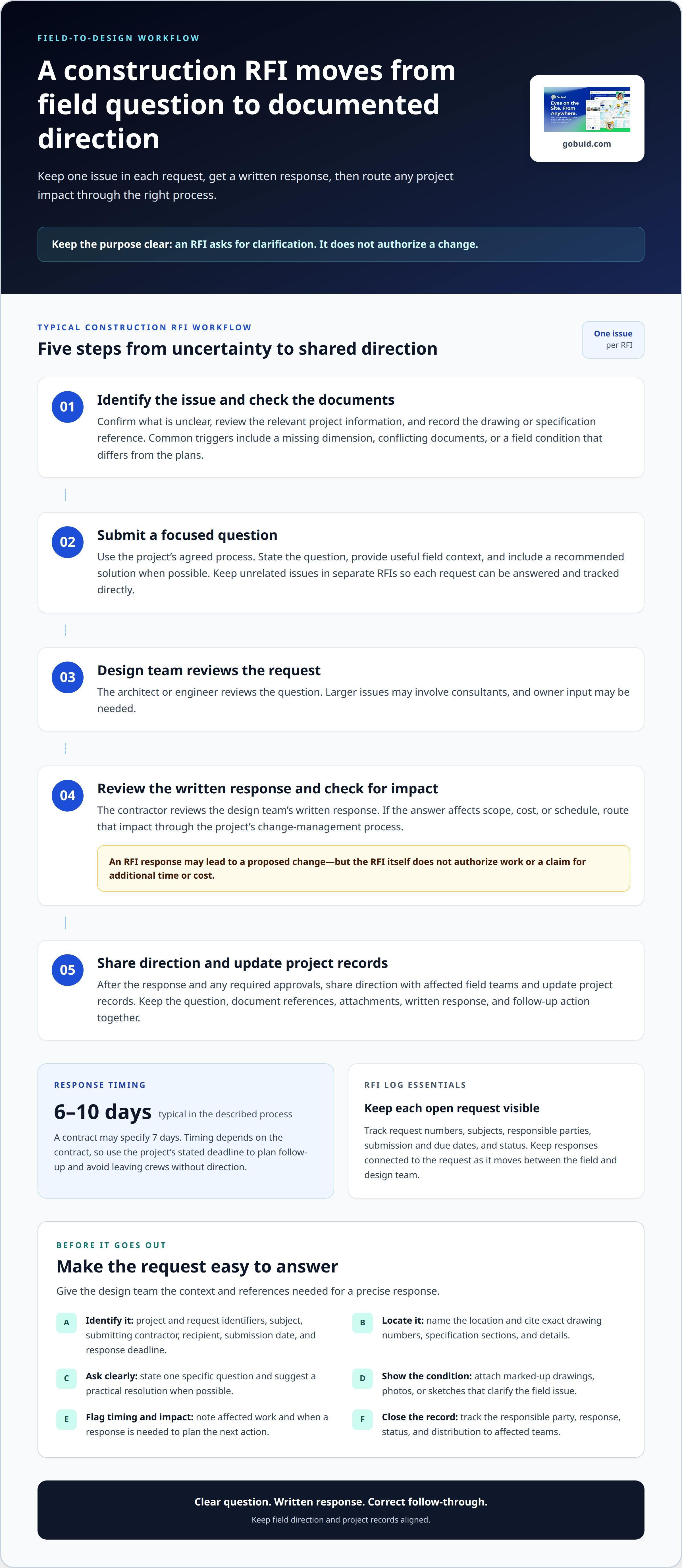
The typical workflow sends the question from the field to the design team and then returns the response to the people doing the work. Keep one issue in each RFI so the response can address it directly.
- The contractor identifies the issue, checks the relevant documents, and records the drawing or specification reference.
- The contractor submits a focused question, context, and recommended solution through the project’s agreed process.
- The architect or engineer reviews the request. Larger issues may involve consultants, and owner input may be needed.
- The design team provides a written response. The contractor reviews it and routes any scope, cost, or schedule impact through change management.
- After the response and any required approvals, the contractor shares direction with affected field teams and updates project records.
Response timing depends on the contract. Architects typically respond within 6 to 10 days in the described process, while a contract may specify 7 days. Use the project’s stated deadline to plan follow-up and avoid leaving crews without direction.
An RFI log can track request numbers, subjects, responsible parties, submission and due dates, and status. Construction software can centralize documents and responses, helping teams see what remains open. Keep project information connected as questions move between the field and design team.
Essential RFI form components
A construction RFI form should give the design team enough context to provide a precise response. Include the project and request identifiers, subject, submitting contractor, recipient, submission date, and response deadline. State one clear question, then cite the exact drawing, specification, and detail that prompted it.
- Issue summary: Name the location and describe the discrepancy or missing information.
- References: Identify relevant drawing numbers, specification sections, and details.
- Question and recommendation: Ask for a specific clarification and suggest a practical resolution when possible.
- Supporting material: Attach marked-up drawings, photos, or sketches that show the field condition.
- Impact and timing: Note affected work and the date a response is needed to plan the next action.
- Tracking details: Record the responsible party, response, status, and distribution to affected teams.
For example, if a wall opening conflicts with a mechanical route, identify the room, cite the architectural and mechanical drawings, attach a marked-up view, and ask which location governs. Put unrelated issues in separate RFIs so each answer can be reviewed and tracked independently.
Procurement RFIs serve a different purpose: they gather supplier information and may request a proposal, deliverables, or evaluation details. Do not copy those fields into a construction form unless the project requires them. A construction RFI should make the project question, its document reference, and the requested response easy to find.
Use GoBuid’s project tools to support clear, consistent field documentation.
GoBuid
GoBuid helps construction teams organise field information and project records. When RFI responses lead to follow-up work, consistent documentation makes it easier to track events and share clear project information. Customised forms support consistent field data collection, while one-click reports bring recorded information together for review.
Use Safety & Quality Inspections to document site observations and Manpower Tracking to record workforce information. These tools support day-to-day project visibility; design clarification and approvals still follow the project’s established process.
For teams looking to make field documentation clearer and easier to review, contact GoBuid.
Make the Next Project Decision Clear
Understanding what an RFI is gives your team a shared starting point. The next step is making project information easy to capture, find, and use as decisions move from the design team to the field. Consistent records connect a clarification to the work it affects and keep project knowledge available beyond a single conversation.
GoBuid supports this process with a Digital Site Diary, customised forms, and one-click report generation. Use these tools to organise field records and bring relevant information together for review. They support clear documentation; design decisions and approvals still follow the project’s established process.
Ready to discuss clearer construction documentation? Contact GoBuid about construction RFIs. Put practical information to work and help your team move forward with confidence.
Frequently Asked Questions
What is an RFI in construction?
An RFI in construction is a formal written query used to resolve uncertainty in project information. For example, a subcontractor installing doors may need clarification when a hardware schedule and a door detail appear inconsistent. The request identifies the affected location and documents, helping the project team provide direction that can be shared with the people doing the work.
Why Are RFIs Important?
RFIs give project teams a documented way to resolve questions before decisions affect field work. A clear response can align the general contractor, trade crews, and design team on the same direction. This matters when an answer affects follow-on tasks such as framing, electrical rough-in, and finishes. The record also helps explain why work proceeded in a particular way.
What Does RFI Stand For?
RFI stands for “request for information.” In construction, it means a formal project query, not a request for a supplier’s price or proposal. The abbreviation may appear in logs, meeting notes, and document workflows. Pair it with a request number and subject so field and office teams can identify the same item quickly.
What Is An RFI?
An RFI is a written request asking the project team to clarify information needed to carry out the work. It is not an instruction to change the design or a substitute for approval. For instance, if a field measurement raises a question about an installation detail, the RFI records the issue and gives the responsible reviewers a clear point to address.
What Is a Request for Information (RFI)?
A request for information can refer to either a construction clarification or a procurement document, depending on context. In procurement, buyers use an RFI to gather information about suppliers or possible solutions before preparing a later request. In construction, it addresses uncertainty in project documents or site conditions. The audience and purpose determine which meaning applies.