Construction Software Implementation Plan: A 5-Phase Deployment Guide
Our 5-phase construction software implementation plan helps you avoid costly failures. Get team buy-in and unify field-to-office data for max profitability.
by Amelia Grant
|
The most expensive software in your stack is the one your field team refuses to use. Most digital upgrades fail because they prioritize office checklists over the physical realities of the job site. Without a structured construction software implementation plan, you'll likely face the fallout of site managers double-handling data and field teams ignoring new tools. This administrative overhead doesn't just create frustration; it actively drains your project’s profitability.
You know that true efficiency requires more than just a new login. You need a strategy that bridges the gap between manual site diaries and high-speed digital project management. This guide provides a proven framework to help you regain control over chaotic workflows through a sophisticated yet accessible interface. We'll show you how to move away from disconnected tools toward a system of intelligence that delivers faster reporting and accurate real-time data.
We’ve broken down the deployment into five logical phases designed for maximum impact and minimal cognitive load. You’ll learn how to unify field-to-office communication and establish a single source of truth for every project. Follow this roadmap to turn your documentation from a daily burden into a high-performance asset.
Key Takeaways
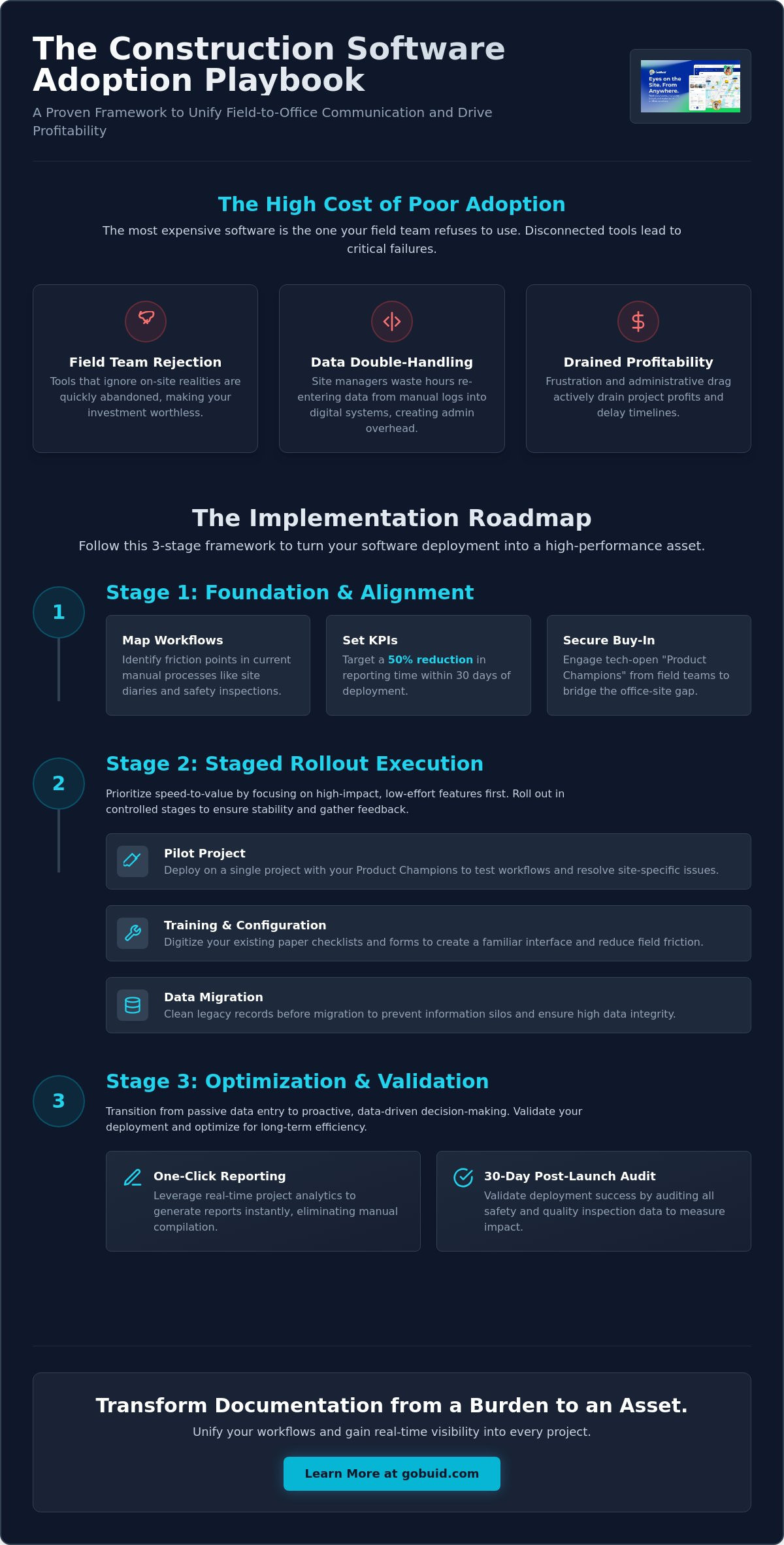
- Treat software deployment as an operational change project rather than a technical IT task to ensure total field-to-office alignment.
- Execute a phased construction software implementation plan that prioritizes high-impact features like progress photos and digital site diaries to secure early team buy-in.
- Eliminate data double-handling by identifying specific friction points in your current manual safety inspections and reporting workflows.
- Transition from passive data entry to proactive decision-making using real-time project analytics and one-click report generation.
- Validate your deployment success with a targeted 30-day post-launch audit of all safety and quality inspection data.
Phase 1 & 2: Workflow Mapping and Stakeholder Alignment
Successful tech deployment is an operational change project, not a technical IT task. It's about how your crews move on-site, not just the code behind the interface. A robust construction software implementation plan starts with mapping these physical movements to digital workflows. You must identify where manual site diaries and safety inspections currently fail. Your construction software implementation plan must account for these specific friction points to avoid double-handling data during the transition.
To better understand the fundamentals of a successful rollout, watch this helpful video:
Defining the Implementation Scope
Set aggressive, measurable KPIs from the start. Target a 50% reduction in reporting time within the first 30 days of deployment. Begin by inventorying your existing documentation, such as site diaries, safety checklists, and equipment logs. This audit prevents information silos and ensures the digital system captures every critical detail of the project. Establish a unified data point strategy early. This ensures that every piece of information recorded in the field is immediately available for Construction Management oversight without manual intervention.
Securing Buy-In Across the Hierarchy
Identify "Product Champions" within your field teams. Look for Foremen who are tech-open and respected by their peers. They act as the bridge between office expectations and site realities. Address the primary objection head-on: site diaries shouldn't be a burden at the end of a shift. Demonstrate how digital tools capture data in real-time, eliminating the need for late-night paperwork. For executives, showcase the Project Analytics Dashboard. It provides the real-time visibility and transparency they need to manage project risks effectively.
Finally, map every existing document to its digital equivalent. Use customized forms that replicate the layout of your current paper checklists. This continuity reduces field friction and ensures that your team doesn't feel lost. When the digital tool feels familiar, adoption rates soar. This alignment transforms your documentation from a static record into a dynamic asset for the entire project team.
The 5-Phase Execution Strategy for Site-Wide Adoption
Heavy ERP rollouts often stall because they demand too much change at once. Your construction software implementation plan should prioritize speed-to-value by focusing on high-impact, low-effort features first. Start with progress photos and documentation. These tools provide immediate visual proof of progress without requiring complex data entry. Integrating equipment management tracking early also demonstrates instant ROI on high-value assets by providing immediate visibility into equipment location and usage.
Maintain an agile mindset throughout this process. Focus on tangible results rather than rigid technical checklists. This approach ensures you stay flexible as project requirements evolve. By connecting disparate operational locations through a unified digital interface, you create the connective tissue necessary for project success. A professional Project Implementation Plan relies on a structured sequence to manage risk and allow for iterative feedback from the field.
Staged Rollout: From Pilot to Full Go-Live
Execute your rollout in stages to ensure stability. This allows you to identify and resolve site-specific issues before a company-wide launch. Follow this sequence for the best results:
- Phase 1: Pilot. Deploy on a single project site with your tech-open Product Champions to test the workflow.
- Phase 2: Training and Configuration. Digitize your specific customised forms to maintain operational continuity and reduce field friction.
- Phase 3: Data Migration. Clean legacy records before moving them to the new system to prevent information silos and ensure data integrity.
Training for High Field Adoption
Field adoption depends on simplicity. Avoid long classroom sessions that pull managers away from the site. Instead, conduct 15-minute "Toolbox Talk" style training on-site. Demonstrate how manpower tracking simplifies daily headcounts for foremen. This immediate utility builds trust. Leverage mobile hardware your team already owns. Using familiar smartphones and tablets reduces technical friction and eliminates the need for expensive new device training. If you want to see how these features work in real-time, explore the full suite of site management tools available to your team.
Optimizing Post-Implementation for One-Click Reporting
Your construction software implementation plan doesn't end at go-live. The real value begins when you shift from manual data entry to data-driven decision making. Conduct a comprehensive audit of safety and quality inspections 30 days post-launch to identify gaps in field compliance. This review ensures your data remains clean and actionable. Iterate on form designs based on direct field feedback to further reduce cognitive load for site managers. Refined tools lead to higher accuracy and more reliable site data.
Site management is evolving quickly. Staying ahead of construction tech adoption trends requires a commitment to continuous improvement. By refining your digital workflows, you bridge the gap between physical site realities and office precision. This results in a leaner, more responsive operational environment where every data point serves a purpose.
Automating Site Documentation
Standardize the digital site diary across all active projects to ensure reporting consistency. Enable automatic progress photo tagging to create an audit-ready record that links visual evidence directly to specific site events. This automation removes the guesswork from project history. Transitioning to full one-click reporting allows your team to reclaim administrative hours previously lost to manual data consolidation. One-click reports eliminate manual data consolidation by instantly pulling field entries into professional, formatted documents.
Scaling the Solution
Review equipment utilization reports to optimize fleet management across multiple sites. Use the analytics dashboard to identify emerging safety trends and proactively prevent site incidents before they occur. Centralize all site communication within the platform to encourage team collaboration and total transparency. This unified approach transforms site data into a strategic asset for the entire business. Follow these steps to scale your solution:
- Analyze equipment logs to reduce idle time and rental costs.
- Monitor safety inspection completion rates to ensure site compliance.
- Review manpower tracking data to optimize labor allocation across projects.
This final phase of your construction software implementation plan secures long-term ROI. It turns raw site data into a powerful tool for project control and business growth.
Take Control of Your Digital Transformation
Transitioning from manual site diaries to digital project management is an operational shift that demands precision. You've learned that success relies on aligning stakeholders early and executing a phased rollout that prioritizes field adoption. By mapping your existing forms to digital equivalents and leveraging real-time analytics, you eliminate the friction of double-handling data. A structured construction software implementation plan ensures your transition is agile, results-focused, and sustainable.
The goal is to move beyond simple record-keeping toward total project transparency. With tools designed for the field, you can generate professional reports in one click and monitor progress via a real-time project analytics dashboard. This level of control allows you to reclaim administrative hours and focus on high-quality execution. Experience the difference of a platform built for operational reality and professional site teams.
Ready to unify your field-to-office communication? Streamline your site reporting with GoBuid today and start making data-driven decisions that drive project profitability.
Frequently Asked Questions
How long does a construction software implementation plan typically take?
A standard construction software implementation plan typically spans four to twelve weeks depending on project complexity. Smaller teams can often achieve full site-wide adoption in under a month by focusing on high-impact features like digital site diaries first. Larger enterprises may require more time to clean legacy data and configure customized forms across multiple departments. Your speed depends on how quickly you move from the pilot phase to full scale deployment.
What is the biggest challenge when rolling out new construction tech?
Resistance to change from field teams is the most significant hurdle. Many site managers view new software as an administrative burden rather than a tool for efficiency. This friction often leads to low adoption rates and the double-handling of data during the transition. Overcoming this requires demonstrating immediate value; such as showing how manpower tracking and one-click reporting reclaim hours of their day by eliminating manual paperwork.
How do I ensure my field crew actually uses the new site diary software?
High field adoption is achieved by prioritizing user-friendliness and immediate utility. Introduce the software through short, 15-minute on-site training sessions that mirror the flow of a standard toolbox talk. Focus on features that solve their immediate pains, like progress photos and documentation. When a foreman realizes they can generate a professional site diary from their mobile device without staying late, the software becomes an essential part of their toolkit.
Do I need to hire a consultant for construction software implementation?
You don't necessarily need an external consultant if you have a clear construction software implementation plan and dedicated internal champions. Modern, cloud-based platforms are designed for intuitive setup without deep technical expertise. Appointing a tech-open foreman as a product champion is often more effective than hiring an outside specialist. This internal lead ensures the digital workflows align with the physical realities of your specific job sites and operational needs.