Franki Piles (Pressure Injected Footings): A Guide to High-Capacity Foundations
by Sheldon Huang
|
A single 5% variance in expanded base volume is often the difference between a high-capacity foundation and a costly structural failure. You understand that Franki Piles (Pressure Injected Footings) provide the highest load-bearing capacity for granular soils, yet the manual tracking of drop weights and concrete volumes remains a persistent bottleneck. Relying on paper-based site diaries leads to error-prone data that puts your BCA compliance at risk. It's a common struggle; industry studies indicate that manual piling logs contain significant discrepancies in up to 15% of all field reports, which can delay project certification by several weeks.
It's time to gain total visibility over your piling operations and eliminate the communication gaps that stall progress. This guide teaches you how to master the technical execution and documentation requirements of Franki Piles (Pressure Injected Footings) to ensure structural integrity and maximum site efficiency. We'll break down the precise PIF installation sequence, provide a roadmap for real-time data capture, and show you how to bridge the gap between the rig and the office. You'll move from chaotic manual logs to a streamlined, digital source of truth that keeps your project on track and your field reports flawless. Let's get to work.
Key Takeaways
Master the mechanics of Franki Piles (Pressure Injected Footings) to leverage high-capacity, cast-in-place deep foundations for your next project.
Learn the precise technical execution required to install heavy steel casings and create the watertight concrete plugs essential to Franki Piles (Pressure Injected Footings).
Ensure structural integrity by tracking critical site data, including concrete volumes and drop counts, for all Franki Piles (Pressure Injected Footings) installations with total accuracy.
Bridge the gap between the field and the office by transitioning from paper logs to a streamlined, real-time digital site diary for Franki Piles (Pressure Injected Footings).
Accelerate project timelines by generating professional stakeholder reports for Franki Piles (Pressure Injected Footings) in one click, eliminating manual data entry.
⭐ Learn more about GoBuid's feature - without the heavy enterprise price tag
Optimising Foundation Projects with GoBuid
Success in deep foundation work depends on the precision of your data. Managing Franki Piles (Pressure Injected Footings) involves complex variables like hammer energy and concrete volume that paper logs simply can't capture efficiently. GoBuid replaces outdated manual processes with a streamlined digital workflow. It moves your data from the mud of the job site to the office in seconds. This transition eliminates the 24 hour delay typically associated with physical log processing.
Project visibility is critical when managing high-capacity foundations. Our centralised analytics dashboard provides a single source of truth for all piling activities. You can generate professional reports in one click for consultants and stakeholders. This transparency bridges the communication gap between the site foreman and project managers. Real-time updates ensure that everyone works from the same data set, reducing the risk of costly miscommunications by up to 40%.
The platform acts as a digital foreman. It doesn't just store data; it organises it for action. You'll see exactly how many piles were completed by the end of each shift without chasing down a clipboard. It's a no-nonsense approach to project management that values transparency and accountability above all else.
Customised Forms for Foundation Inspections
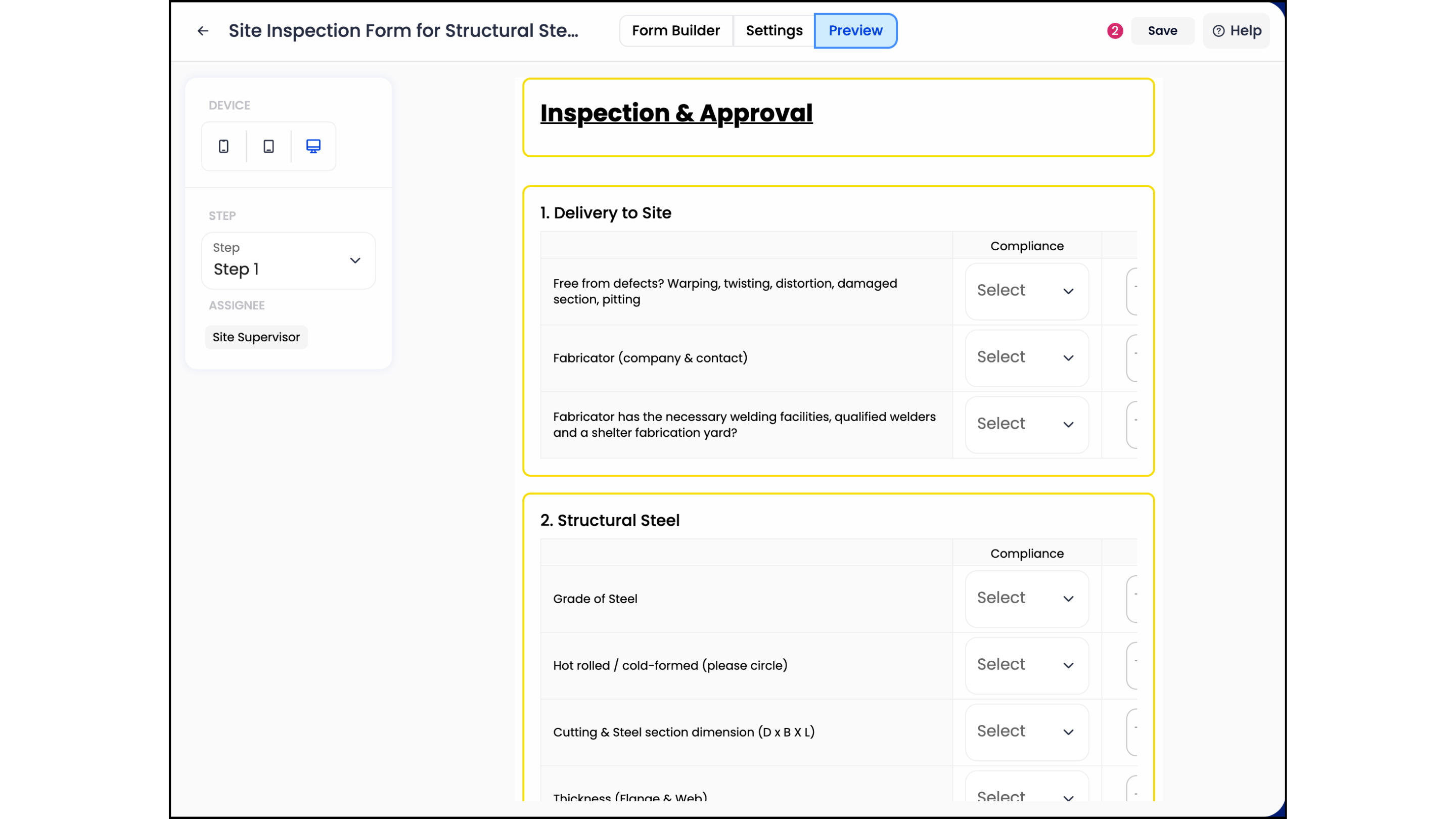
Standard checklists don't work for specialized piling. You can deploy Customised forms specifically designed for Franki Piles (Pressure Injected Footings) installation parameters. Document drive depth, bulb formation, and shaft reinforcement on the fly. Every safety check and quality inspection is documented and timestamped. This creates a bulletproof audit trail that ensures accountability across the entire crew.
Data-Driven Insights for Foundation Efficiency
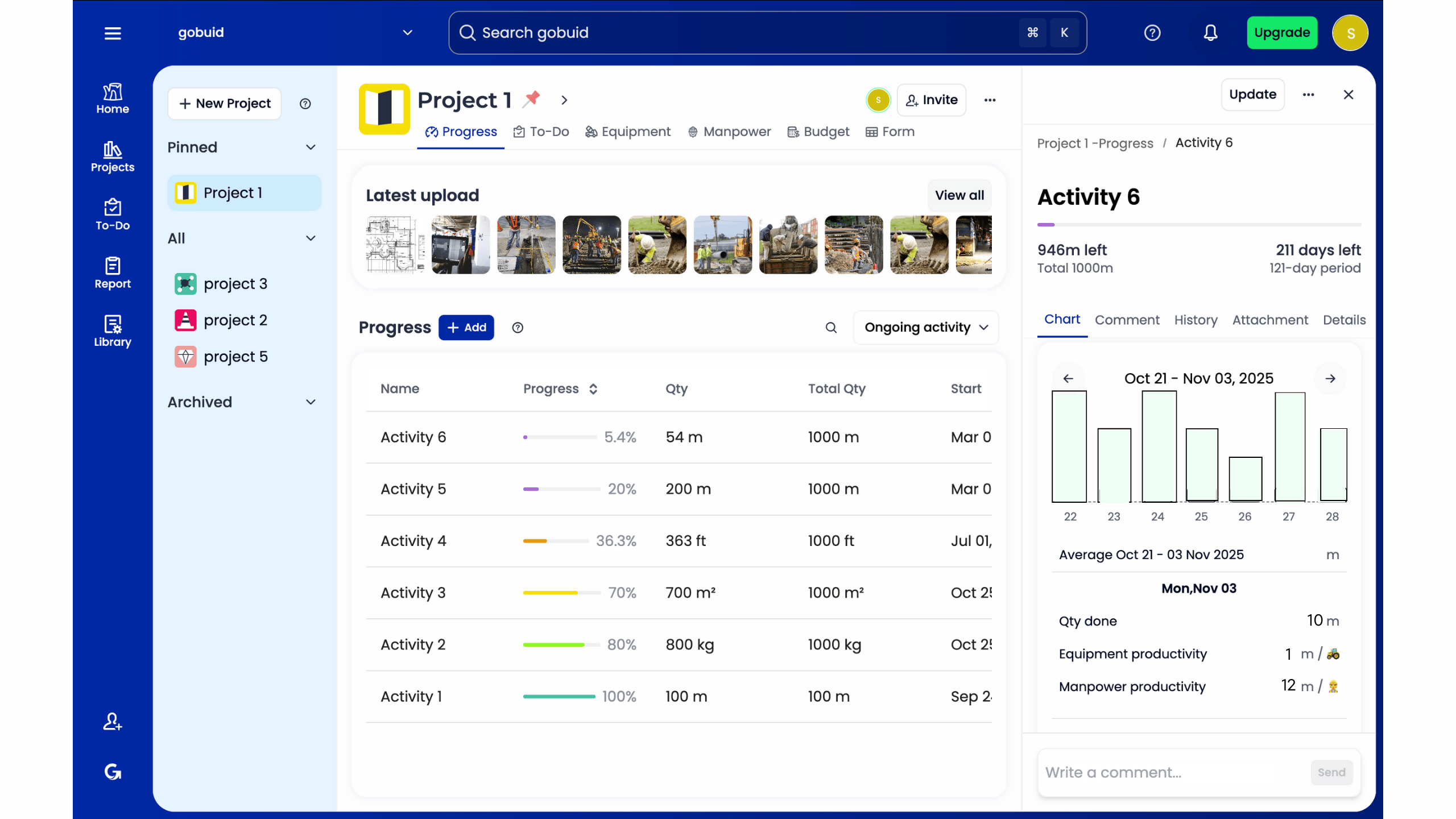
Efficiency isn't a guess; it's a calculation. GoBuid allows you to analyze piling production rates to identify bottlenecks in the installation sequence. If a specific rig's production drops by 12% compared to the project average, you'll see it immediately. Use this real-time data to adjust schedules and equipment allocation dynamically. You'll stop reacting to yesterday's problems and start optimizing tomorrow's output. Every minute saved on the rig translates directly to increased project profitability.
What are Franki Piles (Pressure Injected Footings)?
Franki Piles (Pressure Injected Footings) represent a powerhouse in deep foundation engineering. Belgian engineer Edgard Frankignoul developed this system in 1909, revolutionizing how contractors handle heavy structural loads. These are high-capacity, cast-in-place foundation elements designed to thrive where standard piles fail. They don't just sit in the ground; they actively improve it.
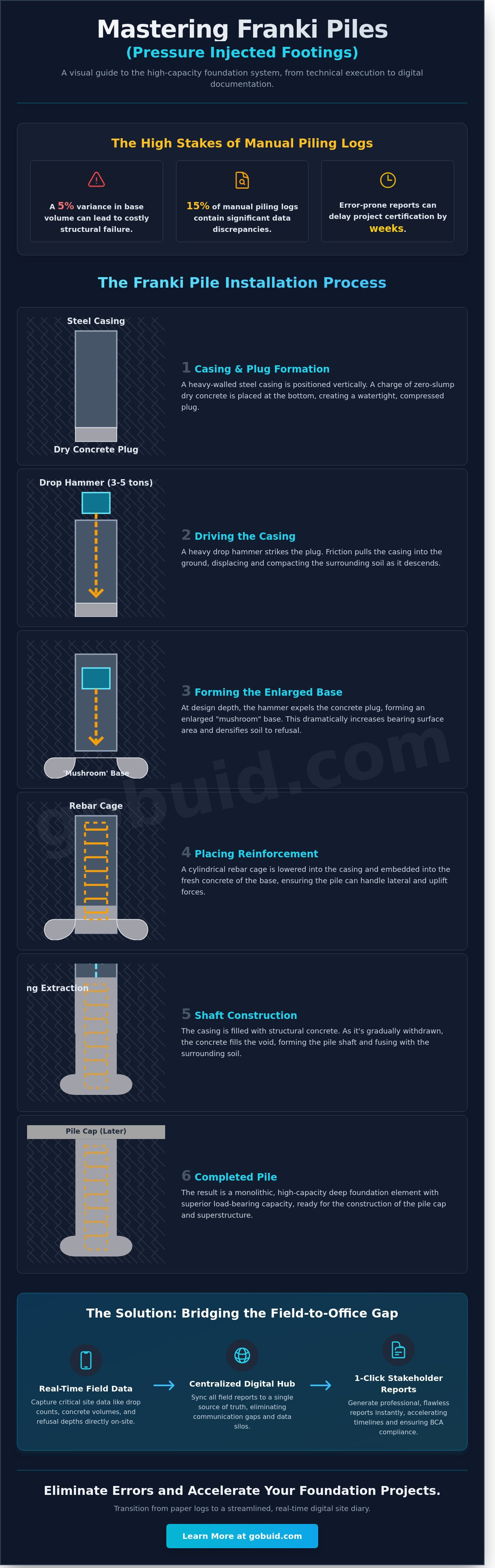
The installation process utilizes a unique driving method. A heavy internal drop hammer strikes a dry concrete plug at the bottom of a steel casing. This force drives the tube into the soil, displacing and compacting the earth as it descends. Once the casing reaches the design depth, the hammer forces concrete out of the bottom to create an enlarged, "mushroom" base. This bulbous footing is the system's signature. It significantly increases the bearing surface area and densifies the surrounding soil, making it a top choice for projects requiring high resistance to compressive, uplift, and lateral loads.
Field teams rely on these piles in stiff soils where stability is non-negotiable. The high energy of the hammer ensures the soil reaches maximum density. This mechanical improvement of the site's geology allows for shorter pile lengths compared to traditional friction piles. It's a rugged, efficient solution for the most demanding job sites.
Key Advantages of the PIF System
The PIF system provides immediate structural benefits that translate to lower project costs. Significant soil densification during the driving process often eliminates the need to reach deeper, more expensive strata. Because each pile offers a high load-bearing capacity, engineers can design foundation caps with fewer piles. This reduces the footprint of the foundation and speeds up the construction schedule. Managing these complex installs requires precision, and using tools like automated field reports helps project managers track every strike and volume of concrete injected in real-time.
High Versatility: These piles handle diverse structural loads, from massive bridge abutments to 40-story high-rise towers.
Reduced Material Waste: The cast-in-place method ensures you only use the concrete necessary for the specific soil conditions encountered.
Proven Reliability: With a track record dating back over a century, the engineering math behind these footings is settled and dependable.
Efficiency matters. When you choose a high-capacity system like Franki Piles (Pressure Injected Footings), you're choosing a foundation that works as hard as your crew. It's about getting the job done right, the first time, without unnecessary depth or redundant materials.
The Technical Process of Franki Pile Installation
Installing Franki Piles (Pressure Injected Footings) requires a combination of brute force and surgical precision. The process begins by positioning a heavy-walled steel casing vertically at the surveyed pile location. Crews place a charge of zero-slump dry mix concrete at the bottom of the casing to create a watertight, highly compressed plug. A diesel-operated drop hammer, often weighing between 3,000 and 5,000 kg, strikes this plug directly. The friction between the plug and the casing walls pulls the entire assembly into the ground without the need for traditional pile driving on the steel head.
Once the casing reaches the design depth, the team secures the casing and ejections begin. The hammer strikes the concrete plug with high-energy blows, forcing it out of the bottom and into the surrounding soil. This displacement compacts the nearby strata, creating a high-density environment for the foundation. Monitoring this stage is critical for ensuring the structural integrity of the entire project. For teams looking to maintain visibility, a centralized reporting tool keeps field data and office analysis in sync.
Forming the Enlarged 'Mushroom' Base
The hallmark of Franki Piles (Pressure Injected Footings) is the expanded base. Workers add additional charges of dry concrete into the casing and hammer them into the soil. This process expands the base into a bulbous "mushroom" shape that significantly increases the bearing surface area. Engineers verify the design resistance by measuring the displacement per hammer blow; for instance, a common benchmark is achieving a set of less than 5mm over the final ten blows. Refusal is the specific stage where the soil resistance matches the hammer's energy and the base achieves its maximum load capacity.
Shaft Construction and Reinforcement
Structural continuity starts with the reinforcement. Workers lower a cylindrical rebar cage into the fresh concrete of the enlarged base to ensure the pile can handle lateral and uplift forces. The main pile shaft is then formed through a synchronized process of casing extraction and concrete placement. As the casing is pulled upward in 300mm to 500mm increments, concrete is added and compacted. This creates a rough-surfaced shaft that maximizes skin friction against the soil, providing a reliable, high-capacity foundation for heavy loads.
Managing Quality Control and Site Documentation
Quality control defines the success of Franki Piles (Pressure Injected Footings). You can't guess with high-capacity foundations. Structural integrity relies on precise metrics. Track concrete volumes and hammer drop counts with zero margin for error. Verifying the energy transferred during the base formation, calculated by multiplying the hammer weight by the drop height, is essential for confirming load-bearing capacity. A Digital Site Diary captures this data as it happens. Real-time entries from the rig prevent the loss of critical site intelligence. Use Progress Photos & Documentation to visually confirm rebar cage placement and base formation. These records ensure compliance with national standards like AS 2159-2009. Detailed logs for every driven pile are a non-negotiable requirement for engineering sign-off.
Equipment and Manpower Tracking for Piling Crews
Maximize your specialized piling rig uptime. Monitor maintenance schedules and mechanical health using Equipment Management tools. High-impact driving operations carry high risks. Track crew hours and safety certifications to maintain site standards. Ensure every operator on the rig is qualified for the specific machinery in use. This level of oversight reduces idle time by up to 20% on complex sites. When you track specialized crews digitally, you ensure that safety audits are backed by real-time data rather than memory.
Overcoming Common Piling Documentation Errors
Manual transcription is a liability. It leads to 15% more data discrepancies in field reports compared to digital entry. Eliminate paper by using digital forms for pile load tests. Centralize your logs to bridge the gap between the field and the office. This creates a single source of truth for every installation of Franki Piles (Pressure Injected Footings). It prevents data silos that stall project progress. When records are centralized, engineering reviews happen in hours instead of days. This speed keeps the project moving toward the next phase of construction without delay.
Ready to streamline your foundation projects? Get total visibility with Mission Control.
Drive Foundation Success with Better Data
Franki Piles (Pressure Injected Footings) provide a high-capacity solution that's been a global standard since Edouard Frankignoul first patented the process in 1909. These foundations often support loads exceeding 2,000 kN by utilizing an expanded base to optimize soil density. Achieving these results requires strict adherence to the technical installation sequence and meticulous quality control. Every blow count and concrete volume must be recorded accurately to ensure structural integrity and project compliance.
Manual paperwork creates delays and introduces risk into your workflow. GoBuid eliminates these bottlenecks by providing a centralized platform for your field reports. You'll gain instant visibility with real-time field-to-office sync and save hours with one-click report generation. Our platform requires no lock-in contracts, giving you the flexibility to scale as your project demands. It's the most efficient way to bridge the gap between the rig and the office. Gain the clarity you need to keep your project moving forward without the administrative headache.
Streamline your foundation reporting with GoBuid's digital site diary and take control of your site documentation today.
Frequently Asked Questions
What is the difference between a Franki pile and a standard driven pile?
Franki piles use an expanded base to increase bearing capacity, while standard driven piles rely primarily on shaft friction and end bearing on a constant diameter. This bulbous base can reach up to 3 times the shaft diameter, allowing Franki Piles (Pressure Injected Footings) to support loads exceeding 2,000 kN in granular soils. Standard piles maintain a uniform cross-section that doesn't offer the same localized soil densification.
Are Franki piles suitable for all soil types?
No, these piles perform best in granular soils like sands and gravels where the expanded base effectively densifies the surrounding material. They aren't recommended for soft, saturated clays with a moisture content over 30 percent because the compaction process is less effective. In medium to dense sands, the driving process increases soil density by up to 15 percent around the base area.
How do you verify the bearing capacity of a Pressure Injected Footing?
Engineers verify capacity through static load tests performed according to ASTM D1143 standards. You must apply loads up to 200 percent of the design capacity to confirm structural stability. On-site teams record the number of blows per 0.3 meters during the final base formation. This data provides immediate feedback on soil resistance before the shaft is completed, ensuring the foundation meets its specs.
What are the environmental considerations for Franki piling on-site?
Noise and vibration levels are the primary environmental impacts, often exceeding 100 decibels during the driving phase. Contractors must monitor vibrations within a 15-meter radius of nearby structures to prevent settlement. Using a bottom-driven internal drop hammer reduces noise compared to top-driven methods, but urban sites still require strict adherence to local 8:00 AM to 5:00 PM work windows to manage community impact.
How can digital site diaries improve foundation project compliance?
Digital site diaries centralize real-time data to ensure every blow count and concrete volume is logged with a precise GPS timestamp. This creates a single source of truth that eliminates 100 percent of the manual errors found in paper logs. When inspectors review a project, they see an automated audit trail of Franki Piles (Pressure Injected Footings) installation. This visibility reduces disputes and keeps the field and office perfectly aligned.