How Does an ITP Improve Safety in Construction Projects?
by Sam Chen
|
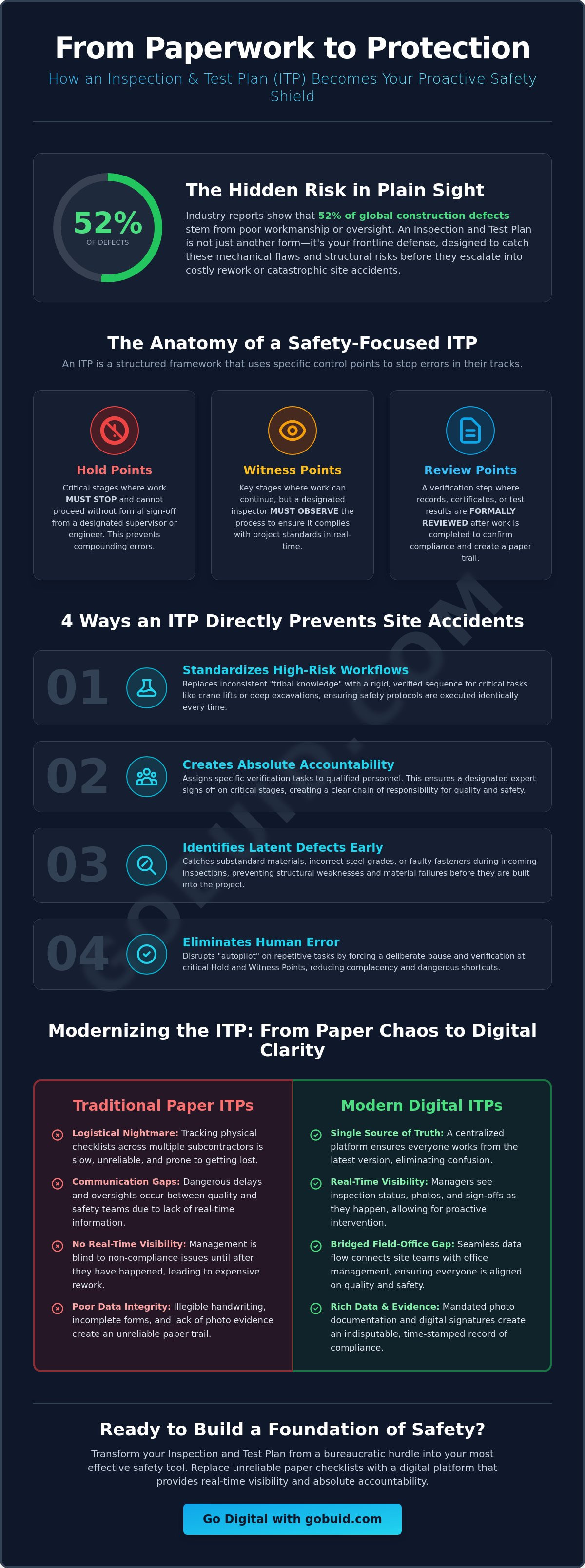
What if your most tedious piece of paperwork was actually the only thing standing between a productive shift and a catastrophic structural failure? Many site managers view the Inspection and Test Plan as a bureaucratic hurdle, but it is actually your most effective frontline defense. You might wonder, how does an itp improve safety in construction projects when it feels like just another form to sign? The reality is that a digital ITP catches mechanical flaws and structural risks before they become site accidents. Industry reports indicate that 52% of global construction defects stem from poor workmanship or oversight, risks that a centralized, real-time inspection process is designed to eliminate.
We understand the pressure of managing a chaotic job site. Tracking whether inspections actually happened across multiple subcontractors is often a logistical nightmare, and communication gaps between quality and safety teams lead to dangerous oversights. This article will show you how to transform your ITP into a proactive safety shield. We'll provide a clear framework for implementing smarter inspection plans that reduce rework and prevent safety-related delays. Discover how to bridge the gap between the field and the office to ensure every project is built on a foundation of visibility and accountability.
Key Takeaways
Identify latent defects early. Learn how an Inspection and Test Plan (ITP) transforms quality control into a proactive safety shield for your job site.
Standardize high-risk workflows to ensure consistency. Create absolute accountability by assigning specific verification tasks to qualified personnel.
Discover how does an itp improve safety in construction projects by neutralizing structural risks and mechanical failures before they escalate.
Master the step-by-step process of building a safety-first ITP that aligns project scope with national engineering specifications.
Bridge the gap between the field and the office. Replace unreliable paper checklists with digital platforms that offer real-time visibility and data integrity.
⭐ Learn more about GoBuid's feature - without the heavy enterprise price tag
Modernising Your ITP: From Paper Checklists to Digital Safety
Paper-based Inspection and Test Plans are a liability. They lead to delayed reporting and "pencil-whipping," where inspections are signed off from a truck instead of on the slab. Digital platforms eliminate this lag. They bridge the gap between the field and the office in real-time, ensuring every safety check is logged the moment it occurs. This shift can reduce administrative overhead by approximately 30%. It frees safety officers to perform actual site supervision rather than chasing signatures. When you examine how does an itp improve safety in construction projects, the answer is found in this immediate accountability.
The Power of One-Click Safety Reporting
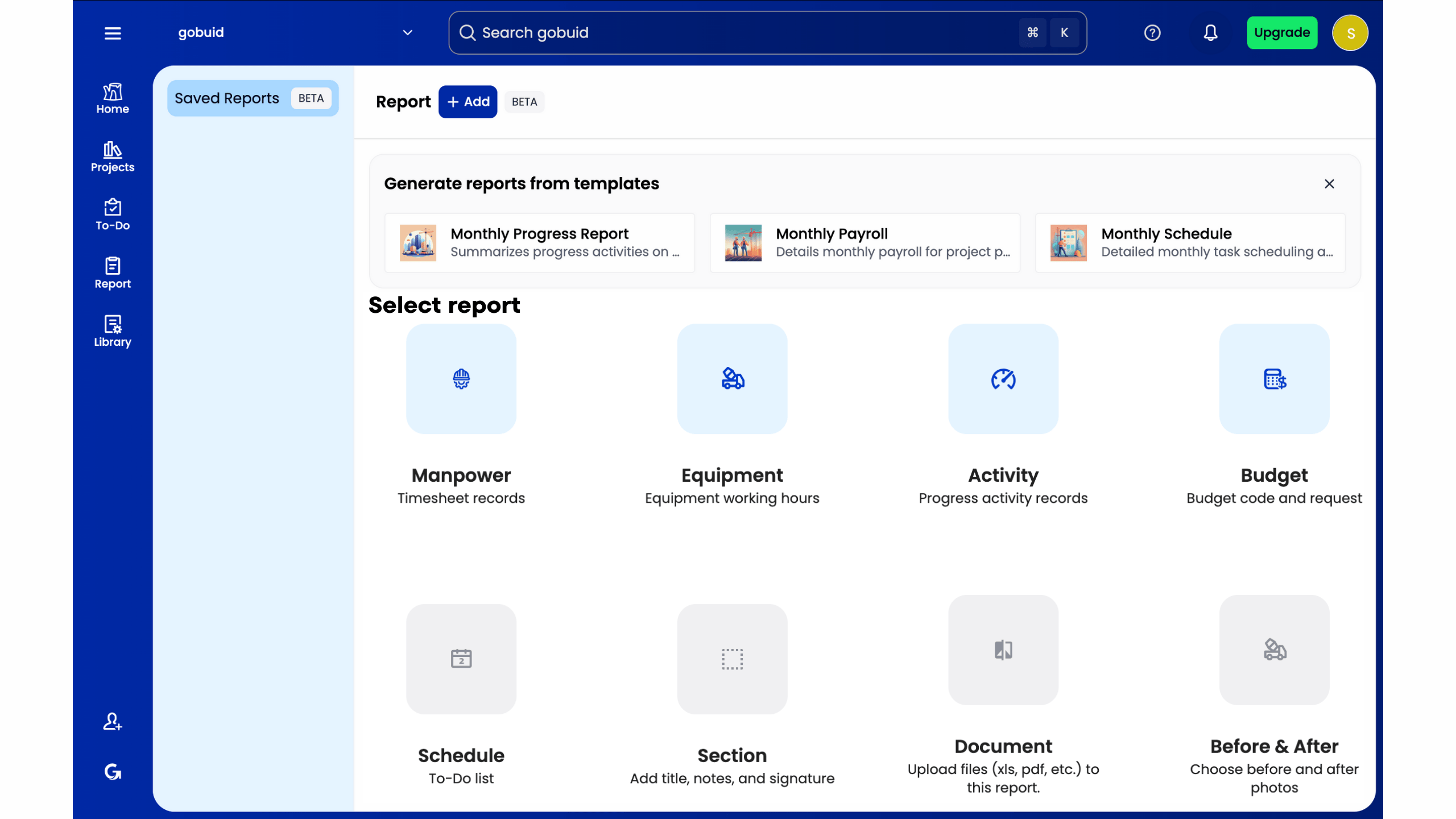
Efficiency drives site compliance. By generating reports in one click, project managers remove the friction between site inspections and office visibility. Real-time progress photos and documentation validate safety claims with visual evidence. You no longer rely on a technician's memory. Instead, you have a timestamped record that proves safety standards were met. This transparency shows exactly how does an itp improve safety in construction projects by creating a culture of verifiable quality.
Centralising Your Safety Truth
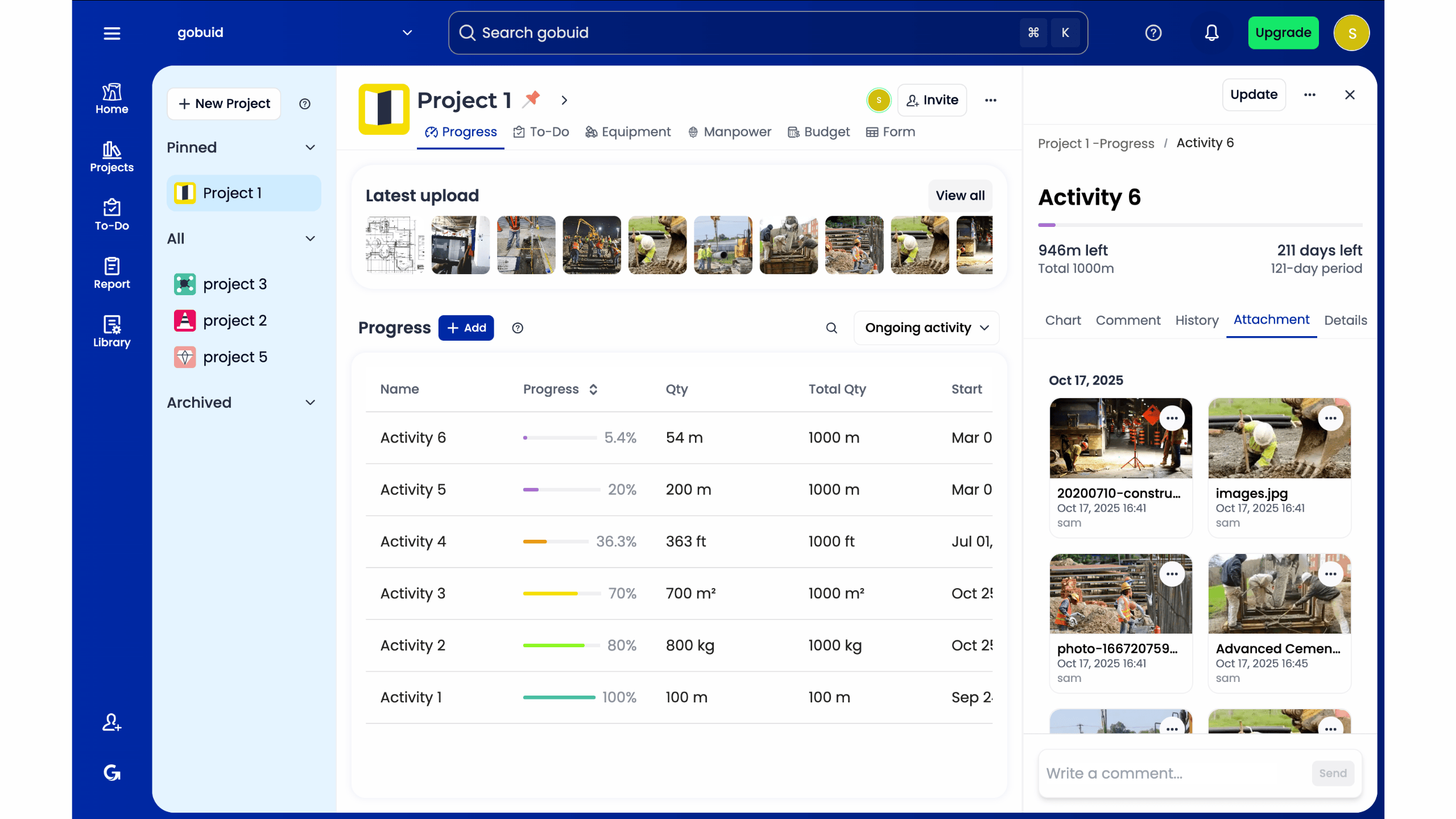
A single source of truth is the foundation of risk management. Using customised forms allows you to tailor inspections to specific hazards like high-voltage work or deep excavations. This data aggregates into a project analytics dashboard for high-level oversight. You can identify which subcontractors or activities represent the highest risk based on actual performance data. This allows for targeted safety meetings that address real problems. Digital ITPs turn safety from a reactive paperwork drill into a proactive project strategy.
What is an ITP and Why is it Essential for Construction Safety?
An Inspection and Test Plan (ITP) is the master document for quality and safety verification on any job site. It isn't just a checklist. It's a structured framework that ensures every phase of work meets specific technical standards. By documenting the Inspection process, teams verify that materials and workmanship align with the project's design requirements. This is exactly how does an itp improve safety in construction projects: it creates a definitive paper trail of accountability.
To better understand this concept, watch this helpful video about the consequences of safety failures:
Poor quality today creates a "Latent Defect" tomorrow. A structural beam that isn't welded to specification might pass a visual safety walk, but it could fail under load in five years. ITPs prevent these ticking time bombs. They ensure compliance with the Building Code of Australia (BCA) and other national standards. While a standard safety audit looks for immediate hazards like trip risks, an ITP-driven technical inspection focuses on the engineering integrity of the build. It's about long-term stability.
The Quality-Safety Connection
Structural integrity is the foundation of site safety. When an ITP mandates a verification of concrete slump or reinforcement placement, it's preventing a future catastrophic collapse. Fire safety works the same way. Verifying material specifications against the approved submittal ensures that non-combustible materials are actually used. This rigorous approach bridges the gap between the field and the office, ensuring how does an itp improve safety in construction projects is understood through every level of the hierarchy.
Key Components of a Safety-Focused ITP
A robust ITP uses specific control points to stop errors in their tracks. These include:
Hold Points: Critical stages where work cannot proceed without formal sign-off from a supervisor or engineer.
Witness Points: Stages where work continues, but a designated person must observe the process to ensure compliance.
Review Points: An evaluation of records, certificates, or test results after the work is completed.
Clear acceptance criteria remove ambiguity for site workers. When every team member knows the exact tolerance for a task, the risk of human error drops. Centralized visibility into these points through mission control ensures that no step is skipped, providing a single source of truth for the entire project team.
4 Ways an ITP Directly Prevents Site Accidents
An Inspection and Test Plan (ITP) acts as a high-performance filter for site hazards. It converts abstract safety policies into a rigid sequence of actionable checks. By standardising high-risk activities like deep excavations or crane lifts, the ITP ensures every safety protocol is executed identically every time. This consistency is exactly how does an itp improve safety in construction projects. It removes the "tribal knowledge" approach and replaces it with a centralized, verified standard of work.
Accountability drives this process. An effective ITP assigns specific verification tasks to qualified personnel, ensuring that a designated expert signs off on critical stages. This prevents the use of non-compliant or hazardous materials. For example, rigorous incoming inspections catch substandard fasteners or incorrect steel grades before they enter the build. Identifying these mechanical and structural weaknesses early in the sequence prevents the 15% of accidents typically caused by material failure or improper installation.
Eliminating Human Error Through Standardisation
Repetitive tasks often lead to complacency and dangerous shortcuts. Checklists within an ITP disrupt this "autopilot" mentality by forcing a deliberate pause at critical hold points. Field teams use photo documentation to provide real-time proof of compliance. This creates a single source of truth that allows project managers to verify safety from the office. You can streamline these field reports to ensure no safety step is bypassed during high-pressure deadlines.
Structural Integrity and Long-Term Site Safety
Site safety doesn't end when the crew clocks out. It depends on foundational integrity. Load-bearing tests and soil compaction checks are vital components of how does an itp improve safety in construction projects. These tests prevent future structural collapses or maintenance-related injuries. Utilizing a rigorous framework for building a safety-first ITP guarantees that these foundational tests are conducted at the correct intervals. This proactive approach identifies structural weaknesses before they become life-threatening failures. Managing these complex sequences is easier when you use centralized construction software to track every inspection in real-time.
How to Build a Safety-First ITP: A Step-by-Step Guide
Building a safety-centric Inspection and Test Plan (ITP) demands precision. It transforms a static document into a live safety shield for your crew. According to 2022 Bureau of Labor Statistics data, construction accounts for 21% of all worker fatalities. A robust ITP targets this statistic by creating a structured environment where errors are caught before they turn into accidents. Follow these four steps to secure your site.
Step 1: Define the scope. Identify every task and pinpoint high-risk zones like scaffolding, deep excavations, or confined spaces.
Step 2: Reference standards. Link every inspection to national safety standards and engineering specifications, such as ISO 45001 or OSHA 1926.
Step 3: Establish Hold Points. Create non-negotiable stops where work halts until a safety verification occurs.
Step 4: Assign competent persons. Designate a Resident Engineer (RE) or Resident Technical Officer (RTO) to sign off on critical stages.
This structured approach clarifies how does an itp improve safety in construction projects. It removes guesswork from high-stakes tasks and ensures accountability is baked into the workflow.
Identifying Critical Safety Hold Points
Hold points act as the site’s circuit breakers. For example, formwork inspections must happen before a concrete pour to prevent structural collapse. Electrical grounding checks are mandatory before powering up site utilities. Pressure tests on gas lines ensure zero leaks before burial. Communicate these points to subcontractors during pre-start meetings. Use a centralized digital tool to ensure they can't bypass these stops without a verified sign-off.
Documenting Evidence and Non-Conformance
Data drives safety. Record "near-miss" quality issues within your ITP to identify patterns before they escalate. If a weld fails a visual check, issue a Non-Conformance Report (NCR) immediately. Use these NCRs as triggers for mandatory safety retraining. This turns a technical mistake into a preventative safety measure. Real-time visibility into these reports ensures the office and the field stay aligned on risk levels.
Regain control of your project risk with centralized mission control.
Master Your Site Safety Standards
An Inspection Test Plan transforms safety from a reactive checklist into a proactive barrier against site risk. By enforcing strict hold points and verifying every critical stage of production, you eliminate the guesswork that leads to structural failures or onsite injuries. Industry research indicates that poor project data contributes to 52% of rework; a centralized ITP solves this by ensuring every team member follows the same protocol. Understanding how does an itp improve safety in construction projects is about more than just checking boxes. It's about creating a single source of truth that bridges the gap between the field and the office.
Transitioning to digital documentation ensures your reporting meets the Building and Construction Authority (BCA) standards for quality and safety. You gain visibility into every submittal and punch list in real-time, allowing for instant intervention before a minor error becomes a major hazard. Streamline your site safety with GoBuid’s digital ITP tools today. GoBuid is used by top contractors for real-time compliance and provides BCA-ready documentation and reporting with no lock-in contracts. Take control of your project workflows and build with total confidence.
Frequently Asked Questions
Does an ITP replace a Safety Management Plan (SMP)?
No, an ITP doesn't replace a Safety Management Plan. The SMP provides the 100 percent overarching safety strategy and risk assessment framework for the entire site. In contrast, the ITP focuses on specific technical inspections and quality verification steps. Using both ensures you address how does an itp improve safety in construction projects by verifying that critical structural components meet safety standards before work continues.
Who is responsible for signing off on an ITP in Singapore construction projects?
Responsibility for ITP sign-offs typically falls on the Resident Technical Officer (RTO) or the Site Supervisor. Under Singapore's Building Control Act, the RTO must verify that works comply with approved plans. For a standard 2024 high-rise project, this involves 3 distinct parties: the contractor's engineer, the consultant's representative, and the client's inspector. Each signature confirms the work meets the 5 mandatory safety criteria defined in project specifications.
What is the difference between a Hold Point and a Witness Point in terms of safety?
A Hold Point is a mandatory stop that requires an inspector's signature before any further work proceeds. This prevents 100 percent of downstream errors in high-risk areas like structural slab casting. A Witness Point only requires notification to the inspector. Work continues if they don't show up within the 24-hour notice period. Both ensure visibility, but Hold Points provide the ultimate safety firewall for critical site activities.
How often should an ITP be updated during a construction project?
Update your ITP whenever there's a change in project scope or a 10 percent shift in construction methodology. It's not a static document. Most successful 2023 projects reviewed their ITPs every 3 months to ensure alignment with current site conditions. Regular updates keep your quality benchmarks relevant. This proactive approach explains how does an itp improve safety in construction projects by adapting to new risks as the site evolves.
Can digital ITP software help with BCA compliance and audits?
Digital ITP software streamlines BCA compliance by providing a single source of truth for every inspection. It eliminates the 30 percent time waste usually spent chasing paper trails during an audit. You get instant access to timestamped photos and electronic signatures required for CORENET e-submissions. This level of transparency ensures your site stays compliant with the latest 2024 Building Control regulations without the manual headache.