Steel H-Piles: A Comprehensive Guide to Specifications, Installation, and Site Management
by Guillermo Sánchez
|
How many hours did your team spend last week manually reconciling paper pile diaries with office spreadsheets? Industry reports indicate that manual data entry errors account for up to 15% of project rework in deep foundation tasks. You know that foundation work is a high-stakes numbers game. Managing hundreds of Steel H-Piles requires absolute precision, yet relying on manual tracking often results in data silos and reporting delays that stall your schedule. It's a chaotic workflow that doesn't have to be the norm on your job site.
This guide helps you master the technical specifications of Steel H-Piles while showing you how to replace inefficient paper logs with automated, digital site documentation. You'll learn how to ensure successful load transfer to bedrock and maintain BCA-compliant records without the administrative burden. We'll examine everything from blow counts and splices to achieving real-time visibility into your piling progress, providing a single source of truth for your entire project team. It's time to bridge the gap between the field and the office with precision and speed.
Key Takeaways
Master point-bearing mechanics to ensure structural stability and efficient load transfer in deep foundation systems.
Identify critical specifications, from HP12 sections to 50 KSI yield strengths, to meet precise engineering requirements.
Optimize the installation of Steel H-Piles by mastering blow count verification and hammer selection for maximum capacity.
Digitize your site diary to replace manual reporting and bridge the gap between the field and the office.
Gain real-time visibility into manpower and equipment costs to keep your piling projects profitable and on schedule.
⭐ Learn more about GoBuid's feature - without the heavy enterprise price tag
Bridging the Gap: Digital Documentation for H-Pile Projects
Traditional paper logs are a liability on foundation sites. Mud, rain, and human error turn critical data into illegible scraps. Transitioning to a digital site diary ensures every detail of your Steel H-Piles installation stays secure and searchable. Real-time tracking of manpower and equipment provides immediate visibility into piling costs. If a rig sits idle for 60 minutes, the dashboard reflects that delay instantly. This transparency eliminates the guesswork that typically leads to 15% budget overruns on large-scale foundation projects.
Capturing progress photos at the exact pile location provides instant verification for engineers. You don't have to wait for a site visit to confirm a pile's position or condition. This direct link between the field and the office creates a high-speed feedback loop. It keeps the project moving and ensures that every driven pile meets the required specifications without delay. Digital records turn a chaotic job site into a structured environment where accountability is the standard.
Streamlining Daily Construction Reports
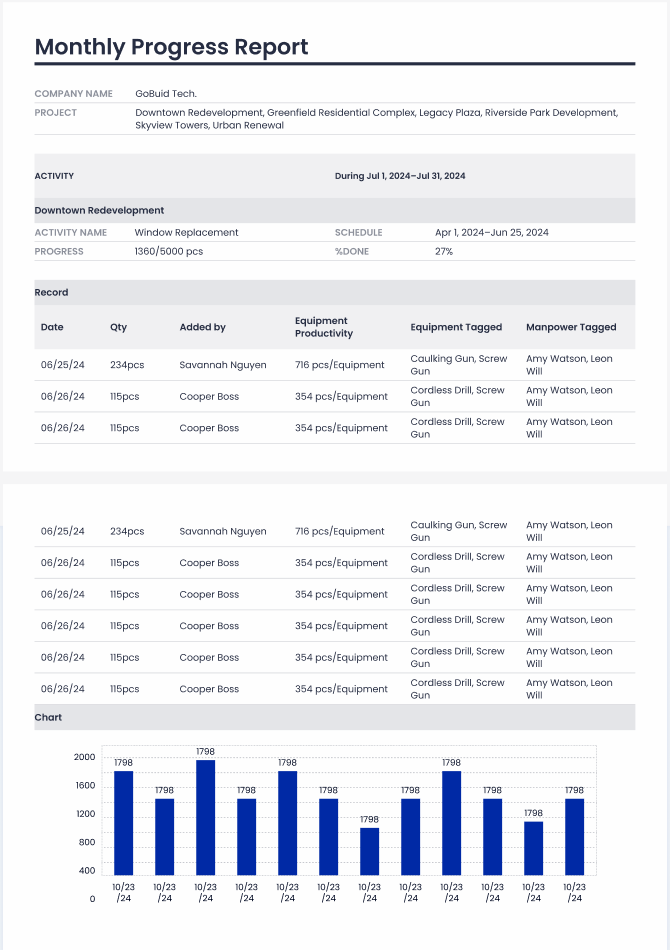
Stop wasting hours on administrative overhead. GoBuid enables foremen to generate reports in one click while they're still on-site. This automation saves project managers an average of 10 hours per week compared to manual entry. All data syncs across the Project Analytics Dashboard, providing a centralized view of production rates versus the original schedule. You get the truth in real-time, not a week later.
Customised Forms for Piling Compliance
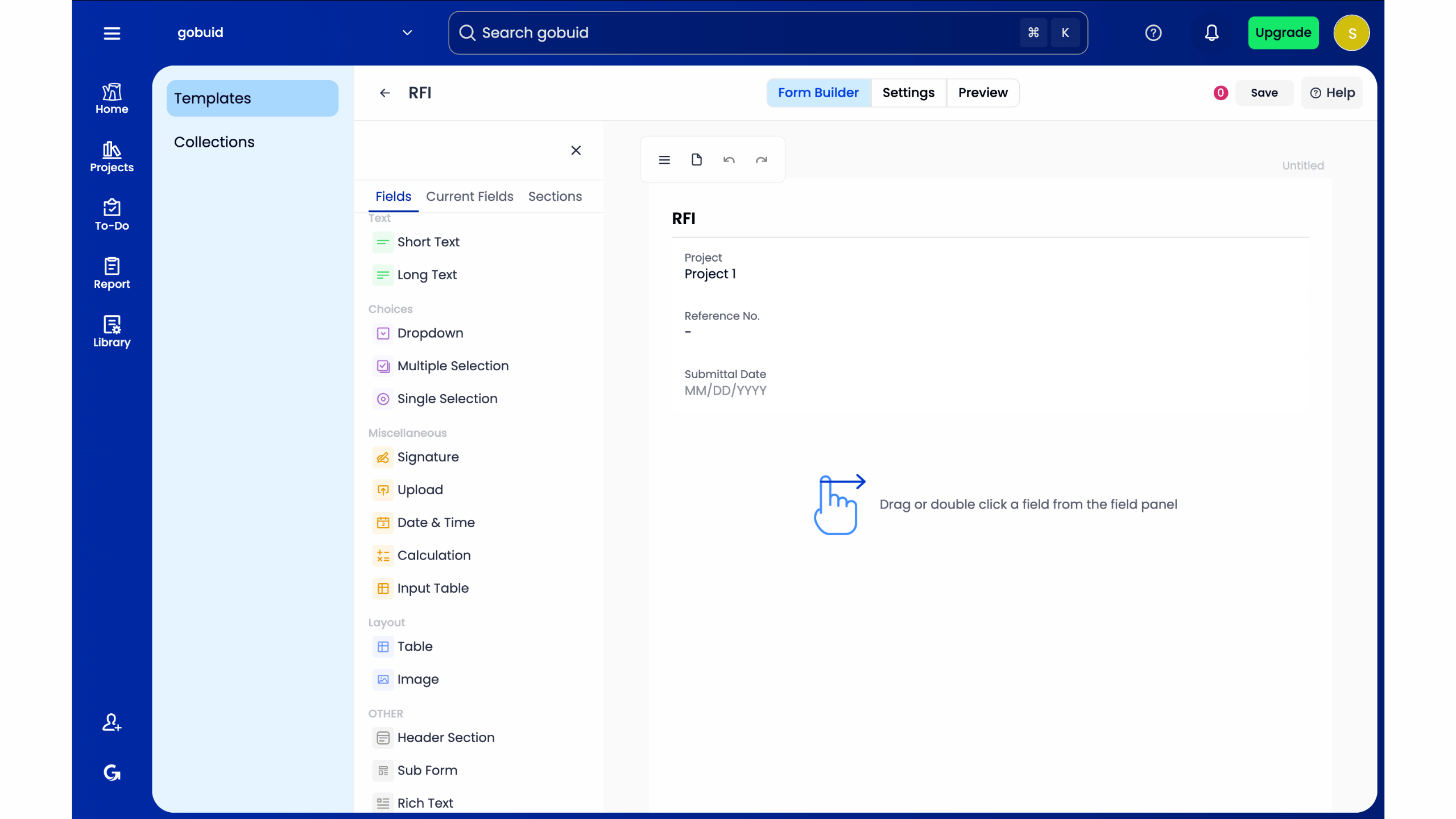
Compliance is the backbone of deep foundation work. Use customised forms to record blow counts, pile heat numbers, and penetration rates. These digital logs create an immutable audit trail for every one of your Steel H-Piles. This documentation protects the firm against future claims and ensures quality control is met at every depth. Book a demo with GoBuid to see how we digitise foundation site management and secure your project data.
Understanding Steel H-Piles in Deep Foundation Systems
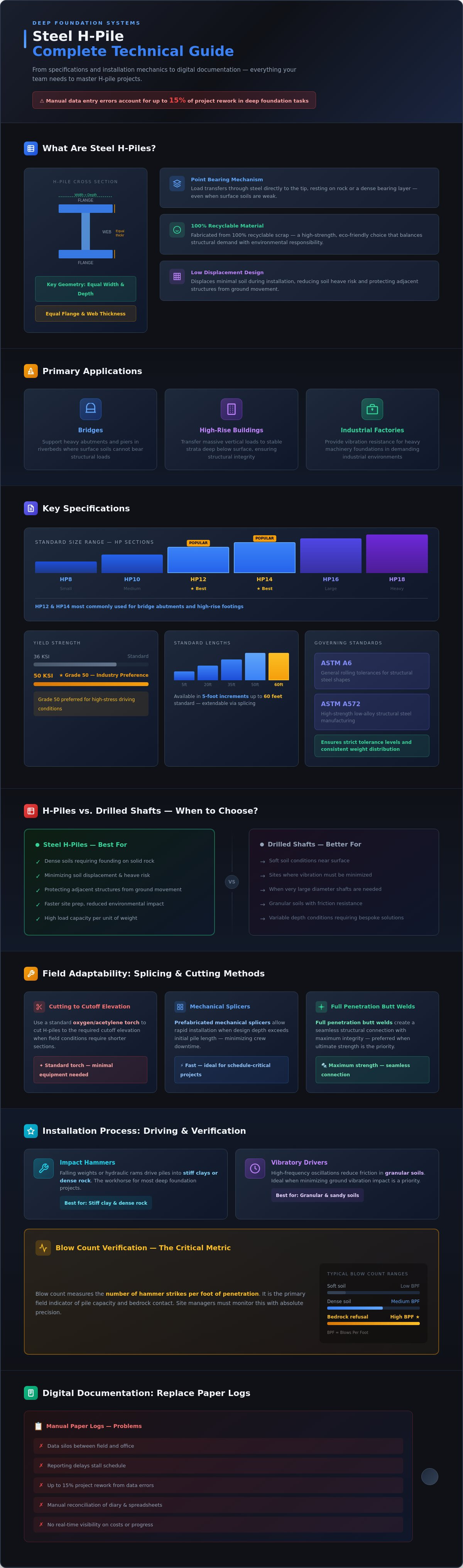
Steel H-Piles are structural square-shaped beams driven deep into the earth to provide permanent stability. They serve as the backbone for complex Deep Foundation Systems. These piles operate primarily through a point bearing mechanism. The load transfers through the steel directly to the tip, which typically rests on rock or a dense bearing layer. This ensures the structure stays put, even when surface soils are weak.
The geometry is unique. H-piles are exactly as wide as they are deep. The flange and web maintain equal thickness to withstand extreme driving forces without buckling. For project managers eyeing sustainability, these piles are often fabricated from 100% recyclable scrap. This makes Steel H-Piles a high-strength, eco-friendly choice for any job site. It's a reliable solution that balances structural demand with environmental responsibility.
To better understand the engineering and bidding principles behind these components, watch this helpful video:
When to Choose H-Piling Over Drilled Shafts
Soil conditions dictate the choice. Steel H-Piles excel in dense soils and when the design requires founding on solid rock. They are classified as low-displacement piles. This is critical because they displace minimal soil during installation. It reduces the risk of soil heave and protects adjacent structures from ground movement. You'll save time on site prep and minimize the impact on the surrounding environment.
The Role of H-Piles in Modern Infrastructure
Bridges: They support heavy abutments and piers in riverbeds.
High-Rise Buildings: They transfer massive vertical loads to stable strata.
Industrial Factories: They provide vibration resistance for heavy machinery.
Engineers prefer H-piles for grander projects because their high load-bearing capacity per unit of weight ensures structural integrity under extreme pressure.
Key Specifications and Material Advantages
Steel H-Piles provide the structural backbone for heavy-duty deep foundations. They're available in standard sizes ranging from HP8 to HP18. Most contractors rely on HP12 and HP14 sections because they offer the best versatility for bridge abutments and high-rise footings. These piles are manufactured in yield strengths of 36 KSI and 50 KSI. Grade 50 is the current industry preference for its superior performance under high-stress driving conditions. You'll find these sections produced in 5-foot increments, with standard lengths reaching 60 feet. This range allows for precise planning before the first hammer strike.
Standard Dimensions and Section Properties
The design of an H-pile is unique. The web and flanges share the same thickness. This symmetry prevents local buckling when the pile hits a tough obstruction. ASTM A6 and ASTM A572 standards govern the manufacturing process to ensure every section meets strict tolerance levels. This consistency is vital for weight distribution across the entire foundation footprint. It allows the pile to displace less soil while maintaining high end-bearing capacity.
Field Adaptability: Splicing and Cutting
Field conditions are rarely perfect. Steel H-Piles are easy to modify on-site. Crew members can cut them to the required cutoff elevation using a standard oxygen/acetylene torch. When the design depth exceeds the initial pile length, you can extend them quickly. Choose between prefabricated mechanical splicers for rapid installation or full penetration butt welds for a seamless connection. Efficiency depends on knowing exactly what materials are on the ground. You can leverage GoBuid features to monitor material consumption and inventory levels from your phone. This keeps your field reports accurate and your supply chain moving without delays.
Managing the Installation Process: Driving and Verification
Installing Steel H-Piles demands heavy-duty equipment and precise data. Impact hammers use falling weights or hydraulic rams to drive piles into stiff clays or dense rock. Vibratory drivers work best in granular soils, using high-frequency oscillations to reduce friction. Site managers must monitor blow counts with absolute precision. This metric measures the number of strikes required for a specific increment of penetration, typically the final foot. It's the primary indicator that the pile has reached its design load capacity.
Geotechnical surprises are a constant reality. A sudden change in soil strata can stop a pile short or force it deeper than the original design. This unpredictability makes real-time communication vital. The site foreman and the engineering office need a single source of truth to make immediate adjustments. When the field and office are disconnected, a 5% deviation in soil density can lead to days of preventable delays.
Documenting the Piling Log
Accuracy in the piling log is mandatory for compliance and structural integrity. Every log must capture the pile ID, start and end times, blow counts, and the final tip elevation. Paper-based logs are a liability on a modern site. Rain ruins them. Messy handwriting leads to data entry errors. Delayed reporting means the office won't see a critical problem until the rig has already moved to the next location.
Quality Control and Safety Inspections
Verification happens during the drive, not after. Teams must check verticality and alignment at every stage. Even a small deviation can compromise the structural integrity of the entire foundation. Use digital Safety & Quality Inspections to ensure every Steel H-Piles installation meets compliance standards before the hammer stops. Centralized data keeps the project moving and eliminates the guesswork that causes budget overruns.
Ready to eliminate paperwork and gain total field visibility? Access your mission control today.
Modernize Your Foundation Management
Success in deep foundation work relies on technical precision and rigorous site management. Steel H-Piles serve as the structural backbone for heavy civil projects, often supporting axial loads exceeding 200 tons per pile when driven to refusal. Adhering to ASTM A572 Grade 50 specifications ensures material integrity, but the real challenge lies in verifying installation data in real time. Accurate blow counts and depth logs are useless if they're trapped in a paper diary at the bottom of a truck seat. You need a system that keeps pace with the hammer.
Efficiency on the job site requires a single source of truth. You've got to bridge the gap between field crews and office managers with real-time data that reflects the rugged reality of the site. GoBuid removes the friction from project tracking. You can generate professional reports in one click, ensuring every pile driven is documented with precision. There are no lock-in contracts; you get maximum flexibility to scale as your project demands. It's time to regain control over your workflow and eliminate the chaos of manual documentation.
Start your digital site diary with GoBuid today and get the job done right.
Frequently Asked Questions
What is the main difference between an H-pile and an I-beam?
Steel H-Piles feature flanges and webs of equal thickness, while I-beams have tapered flanges that are thinner at the edges. This uniform thickness allows the pile to withstand intense driving stresses and carry massive axial loads without buckling. While I-beams work well for horizontal spans, the H-pile’s square cross-section makes it the superior choice for vertical load bearing in deep foundations.
How much load can a single steel H-pile support?
A single steel H-pile typically supports between 200 and 400 tons of axial load depending on the section size and soil density. For instance, an HP14x117 pile driven to refusal on bedrock can reliably carry 250 tons in a standard bridge foundation layout. Engineers determine these capacities using the American Institute of Steel Construction (AISC) manual and site-specific geotechnical reports to ensure structural integrity.
What happens if an H-pile hits an obstruction during driving?
You’ve got to stop driving immediately when the blow count spikes to prevent pile toe deformation or accordioning. Project specifications often require a 5 foot radius inspection if the pile hits a boulder or abandoned utility. The field team then decides to pre-drill through the object, use a reinforced driving shoe, or relocate the pile by 12 inches to maintain the foundation's load path.
Can Steel H-Piles be reused or recycled after a project is finished?
Steel H-Piles are 100% recyclable and often contain over 90% recycled content from the start. If a temporary cofferdam or shoring wall is decommissioned, contractors can extract the piles for reuse on future job sites. This circular economy approach reduces material costs and aligns with LEED v4.1 requirements for construction waste management and life cycle impact reduction. It’s a sustainable choice for heavy civil projects.
How does digital reporting improve the speed of H-pile installation?
Digital reporting cuts the standard 24 hour communication lag to zero by syncing field data instantly. When crews log blow counts on a mobile platform, the office sees the progress in real-time. This visibility prevents costly downtime. Instead of waiting for a paper report, project managers can verify pile capacity immediately and move the rig to the next location, keeping the schedule on track.