Top Construction Management Software List for 2026
Get the definitive 2026 construction management software list. Reclaim hours with tools for one-click reporting, real-time tracking, and streamlined operations.
by Sophia Bennet
|
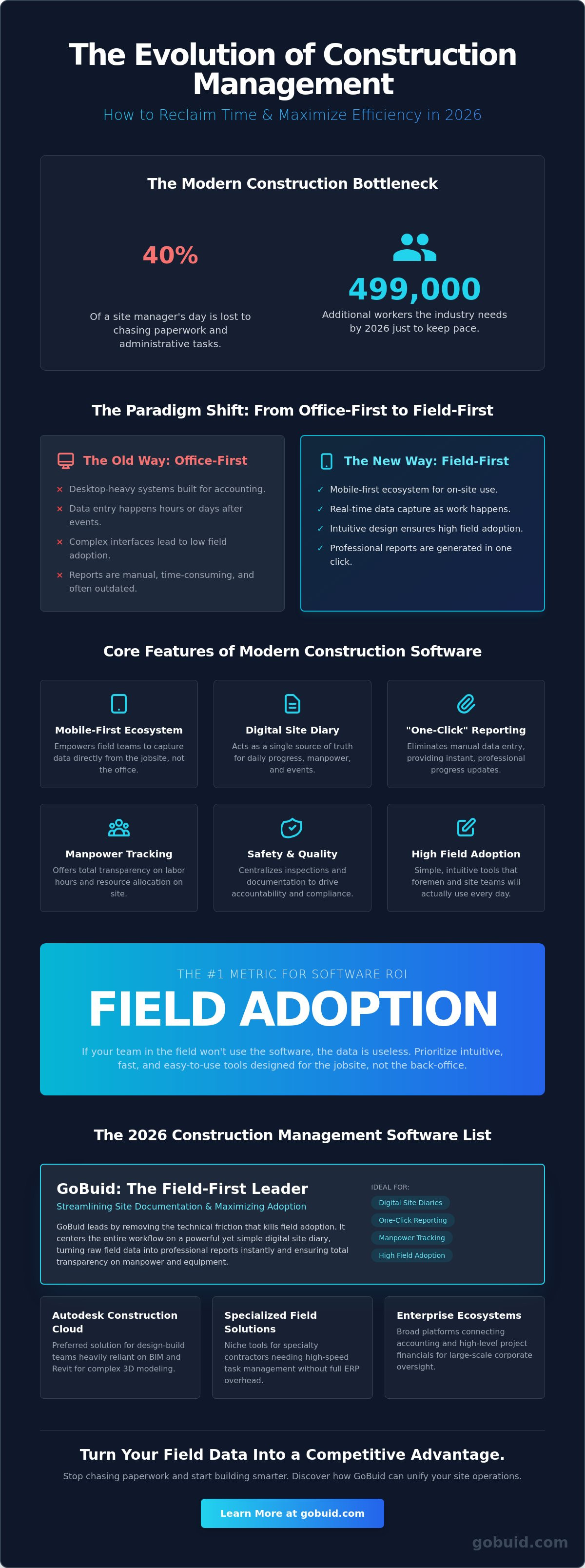
Why are your most skilled site managers spending 40% of their day chasing paperwork instead of overseeing the build? It's a massive drain on resources in an industry that needs 499,000 additional workers just to keep pace in 2026. You know that every hour lost to administrative bloat is an hour stolen from project progress. It's frustrating to manage inaccurate manpower tracking or struggle with stakeholder reports that take half a day to compile.
This guide provides a definitive construction management software list for 2026 to help you reclaim your time and tighten your operations. You'll discover how to move from chaotic, manual workflows to a unified system that generates professional reports in one click. We've analyzed the tools that prioritize real-time site visibility, digital site diaries, and automated safety inspections. Read on to find the technology that transforms your field data into a competitive advantage and keeps your projects on schedule.
Key Takeaways
- Modern construction software has evolved into a mobile-first ecosystem that prioritizes real-time data capture over traditional, desktop-heavy administration.
- Consult our construction management software list to find solutions that bridge the gap between physical site realities and digital project oversight.
- Look for "one-click" reporting capabilities to eliminate manual data entry and provide stakeholders with immediate, professional progress updates.
- Ensure high field adoption by selecting tools that simplify complex tasks like manpower tracking and digital site diary management for your site teams.
- Drive project accountability by centralizing safety and quality inspections within a single, transparent digital platform.
- ⭐ Learn more about GoBuid's feature - without the heavy enterprise price tag
Table of Contents
What is Construction Management Software in 2026?
Construction management software in 2026 isn't just a digital filing cabinet. It's a dynamic ecosystem that bridges the gap between physical operational realities and digital oversight. Construction management software serves as the connective tissue between physical labor and digital precision. It ensures that every hour logged and every task completed is captured instantly. This technology is the basis for modern Construction management, turning chaotic site data into actionable insights.
When exploring any construction management software list, you'll see a clear trend. The 2026 standard prioritizes mobile-first data capture over traditional, desktop-heavy project management. It's about empowering the person with the hard hat. High-quality tools now include automated progress documentation and integrated manpower tracking as core features rather than afterthoughts.
To better understand how these digital ecosystems function on a modern site, watch this helpful overview:
The Shift from Office-First to Field-First Tools
Traditional ERP systems often fail to gain traction with site supervisors and foremen. They're built for back-office accounting, not the fast-paced reality of the field. When software is too difficult to use on-site, data quality suffers. Any modern construction management software list must focus on usability to ensure foremen actually use the tool in the heat and noise of the jobsite.
Real-time data plays a critical role in reducing rework and maintaining safety compliance. If a site manager can't document a hazard instantly, the risk remains unmanaged. Digital site diaries act as the bridge between operational reality and stakeholder reporting. They allow managers to generate reports in one click, ensuring that information is fresh and accurate. This immediacy transforms how teams collaborate and significantly increases productivity across the entire project lifecycle.
The Definitive Construction Management Software List for 2026
The 2026 construction management software list is defined by a clear split between heavy back-office systems and agile field tools. Success on a modern site requires moving away from fragmented spreadsheets toward a centralized data point. High-performing contractors now prioritize platforms that eliminate the lag between site events and office awareness. Efficiency in the field translates directly to profitability in the office, making your software choice a critical operational decision.
GoBuid: Streamlining Site Documentation
GoBuid leads the 2026 construction management software list by removing the technical friction that often prevents field adoption. It centers on a digital site diary that allows foremen to document progress as it happens. The platform’s one-click report generation transforms raw field logs into professional PDFs instantly, reclaiming hours of administrative time every week. For resource-intensive projects, the integrated manpower and equipment tracking ensures total transparency regarding site assets and labor hours. This immediacy turns site data into a strategic asset rather than a paperwork burden.
Other notable categories on the 2026 market include:
-
Autodesk Construction Cloud: The preferred solution for design-build teams heavily reliant on BIM and Revit integration for complex 3D modeling.
-
Specialized Field Solutions: Tools designed specifically for specialty contractors who need high-speed task management without the overhead of a full ERP.
-
Enterprise Ecosystems: Broad platforms that focus on connecting accounting and high-level project financials for large-scale corporate oversight.
Enterprise vs. Specialized Field Tools
Choosing between a massive enterprise ecosystem and a specialized field tool depends on your primary pain point. Enterprise platforms offer immense breadth but often face low field adoption due to their complexity. If your foreman won't use the software, the data is useless. Field adoption is the only metric that truly matters for long-term ROI. Specialized tools win by being intuitive and fast. Utilizing customized forms for safety and quality inspections ensures compliance without adding friction to the workday. To see these field-first features in action, you can explore the GoBuid platform to understand how it fits your specific project needs.
How to Choose the Best Construction Management Software
Narrowing down a construction management software list requires looking past flashy office features. Focus on the users in the dirt. If your foreman needs a week of training to log a site diary, the software has already failed. Priority must go to tools that offer "One-Click" capabilities. This ensures reports are sent while data is still fresh, not hours later when details are forgotten or lost. Site adoption is your only real metric for success.
Demand contract flexibility. Avoid platforms that require excessive long-term commitments before proving their worth on your specific jobsites. A platform should earn its place through increased productivity, not a legal obligation. High-level oversight is equally vital. Ensure the platform provides a project analytics dashboard to turn raw site data into clear, strategic insights. Transparency across all locations is what separates a tool from a total solution.
Essential Features for Site Operations
Visual evidence is your strongest defense against future claims. Your software must handle progress photos and documentation seamlessly. It needs to work where the work happens. Offline functionality is non-negotiable for remote sites or underground projects. When connectivity returns, the data should sync automatically. This creates a real-time collaboration loop that connects the office and field via a single source of truth. Data silos kill projects; unified data points save them.
Implementation and ROI
Transitioning from paper or Excel doesn't have to disrupt current projects. Start by digitizing one workflow, like manpower tracking, and scale from there. Measure ROI by tracking the reduction in administrative hours and the improvement in safety records. When site managers stop chasing paperwork, they start managing quality. Moving to a digital construction management software list is about reclaiming 40% of your day. Ready to ditch the administrative bloat? Contact GoBuid today for a streamlined site management demo.
Master Your Site Operations
Navigating an extensive construction management software list doesn't need to be a source of administrative stress. The goal is simple: find a tool that your site team will actually use. By prioritizing field-first data capture and one-click reporting, you eliminate the 40% of the day currently lost to administrative bloat. You gain a real-time project analytics dashboard that provides total transparency across every jobsite. This visibility ensures that stakeholders receive professional reports while the data is still fresh and actionable.
Transitioning from manual site diaries to digital precision is the only way to remain competitive in 2026. High material costs and severe labor shortages demand maximum efficiency from every member of your professional team. Don't let inaccurate tracking or delayed documentation stall your project progress. You can regain control over chaotic workflows and ensure safety or quality compliance with a platform designed for the operational reality of the build.
Start streamlining your site documentation with GoBuid to experience the power of one-click reporting and professional project oversight. It's time to stop chasing data and start driving results.
Frequently Asked Questions
What is construction management software?
Construction management software is a digital ecosystem that centralizes project data and connects field operations with office oversight. It replaces manual processes like paper diaries and Excel spreadsheets with a unified digital interface. By integrating task tracking, documentation, and resource management, it provides a single source of truth for all stakeholders. This platform ensures that every action on the site is recorded with precision and transparency.
How does construction software improve site productivity?
Software improves site productivity by removing the administrative friction from daily operational tasks. It enables foremen to document progress, track manpower, and manage equipment instantly via mobile devices. This immediacy reduces the time spent on manual data entry back at the office. Real-time visibility allows project managers to identify bottlenecks early, preventing the delays and rework that often occur when using disconnected communication methods.
Is there a free version of construction management software?
Some platforms on a construction management software list offer limited trials, but professional-grade tools usually require a subscription to maintain high standards of security and reliability. Paid models provide access to advanced features like customized forms and comprehensive project analytics dashboards. These tools are designed to handle the scale of commercial projects, offering far more utility and data integrity than basic free versions or generic spreadsheet software.
Can construction management software work offline on remote sites?
Professional construction tools are engineered with offline functionality to ensure data capture never stops in remote or underground locations. Site teams can log photos, site diaries, and safety inspections without a cellular or Wi-Fi connection. The software caches this information locally on the device. Once the user returns to an area with connectivity, the platform automatically syncs the data to ensure the office receives the most current site updates.
What are the benefits of one-click reporting in construction?
One-click reporting saves hours of manual labor by automating the compilation of field data into professional formats. It pulls information directly from digital site diaries and progress photos to create stakeholder-ready documents instantly. This speed ensures that reports are sent while site conditions are still fresh in the manager's mind. It improves project transparency and allows leadership to make informed decisions based on real-time data rather than outdated weekly summaries.