Training Foremen on New Technology: A Strategic Guide to Field Adoption
Boost field adoption with our strategic guide for training foremen on new technology. Turn resistance into efficiency and reclaim hours for your team.
by Sophia Bennet
|
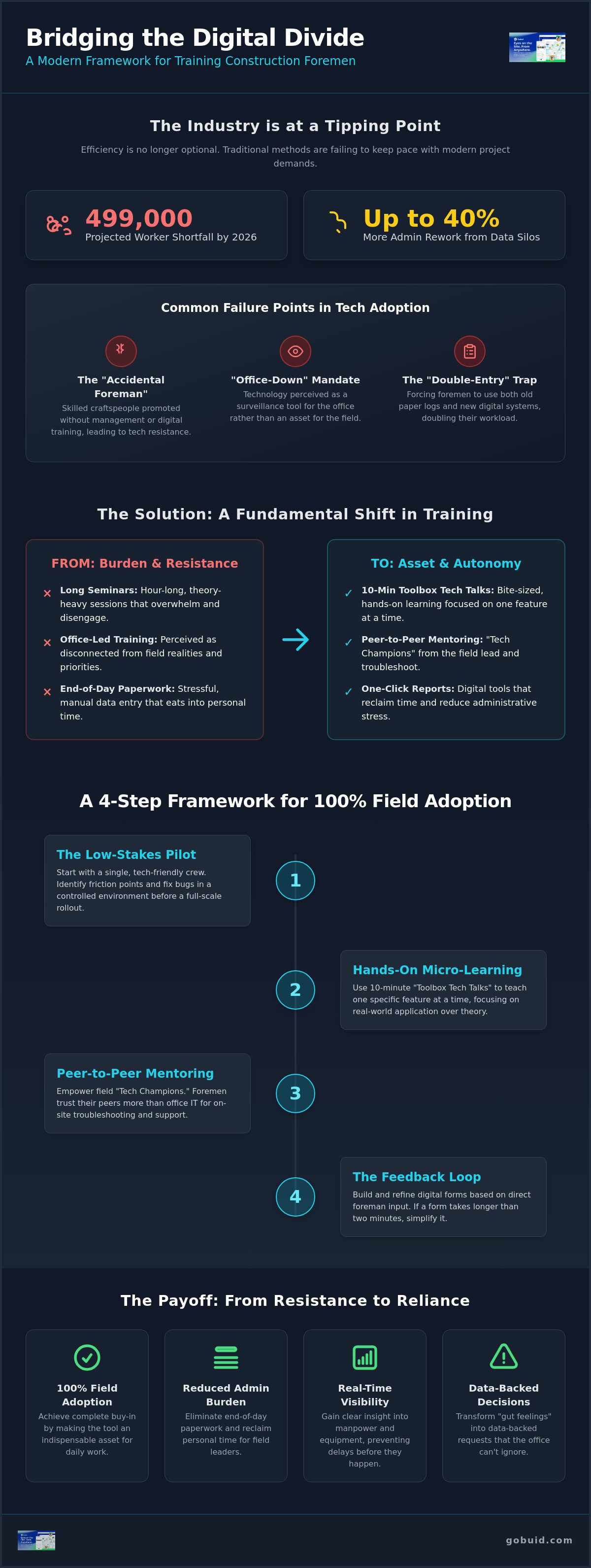
If your veteran foremen view digital tools as "extra work" for the office, your project ROI is already at risk. The construction industry faces a shortfall of 499,000 workers in 2026. Efficiency is no longer optional. Most technology rollouts stall because they're presented as a reporting burden rather than a field asset. Success requires a shift in perspective. Effective training foremen on new technology isn't about teaching buttons; it's about returning hours to their day through autonomous, digital workflows.
You likely recognize the friction of missing site data and slow adoption cycles. It's a common industry challenge that delays progress and creates visibility gaps. This guide shows you how to transition your field leadership from paper-based habits to digital precision without the usual resistance. We'll outline a strategy for achieving 100% field adoption of digital site diaries. You'll learn to reduce administrative burdens while gaining real-time visibility into manpower and equipment. It's time to bridge the gap between the trailer and the office once and for all.
Key Takeaways
- Identify why the "Accidental Foreman" syndrome causes tech resistance and how to pivot toward supportive training models.
- Execute a low-stakes pilot with a single crew to uncover operational bottlenecks before scaling across the organization.
- Shift from long seminars to 10-minute Toolbox Tech Talks when training foremen on new technology to ensure maximum engagement.
- Eliminate end-of-day paperwork stress by leveraging one-click reports to reclaim personal time for your field leaders.
- Transform digital site diaries from office surveillance tools into essential assets for foreman autonomy and field efficiency.
The Digital Gap: Why Traditional Foreman Training Often Fails
Many construction firms struggle with the "Accidental Foreman" syndrome. This occurs when your most skilled tradespeople are promoted into leadership based on their technical craft, yet they're rarely given the management or digital tools they need to succeed. When these leaders are suddenly tasked with training foremen on new technology, the transition often hits a wall. They aren't just learning a new app; they're learning a new way of managing their entire workflow.
Traditional "Office-Down" training models frequently backfire. If the field perceives a new platform as a surveillance tool for the head office, resistance becomes the default. True adoption happens when the software solves a specific site problem first. Without this field-first focus, manual site diaries continue to dominate. This creates fragmented data silos that some industry professionals report can lead to 40% more administrative rework as staff chase missing details.
To better understand the infrastructure needed for this transition, watch this helpful video:
The Friction of Paper-to-Digital Transitions
The most common failure point is the "double-entry" trap. Foremen often feel forced to maintain their familiar paper logs while simultaneously trying to learn a digital system. This doubles their workload and breeds resentment. Addressing the psychological barrier of tech-phobia in veteran staff is critical. Understanding where your team sits on the technology adoption life cycle helps you tailor your approach. Some will be early adopters. Others will need a more practical, results-driven introduction to see the value.
Standardising Field Operations for Digital Success
Software cannot fix a broken process. You must standardise your operational workflows before you begin training foremen on new technology. Clear expectations around data entry and reporting frequency ensure the tool supports the team rather than complicating their day. Centralizing this data through a digital site diary provides the transparency needed to catch errors early. When everyone follows the same digital standard, project visibility improves and the administrative burden on your field leaders actually decreases.
A 4-Step Framework for Training Foremen on New Technology
Adopting new systems fails when the rollout is too broad. Successful training foremen on new technology follows a phased, practical approach that respects the foreman's time. Use this four-step framework to build a sustainable digital culture.
- Step 1: The Low-Stakes Pilot. Start with a single, tech-friendly crew. Identify where the digital workflow hits friction before scaling. This allows you to fix bugs in a controlled environment.
- Step 2: Hands-On Micro-Learning. Stop the hour-long seminars. Use 10-minute "Toolbox Tech Talks" to teach one specific feature at a time. This aligns with the NCCER framework for new technology training, which emphasizes hands-on, real-world application over theory.
- Step 3: Peer-to-Peer Mentoring. Empower "Tech Champions" in the field. Foremen trust their peers more than office IT staff. Let these champions handle the initial on-site troubleshooting.
- Step 4: The Feedback Loop. Build customised forms that reflect actual site conditions. If a form is too complex for a foreman to complete in two minutes, simplify it based on their direct input.
Mastering Real-Time Manpower and Equipment Tracking
Real-time data isn't just for office reporting. It's a tool for foreman leverage. Effective equipment management prevents site delays by identifying shortages before they stop work. Train your leaders to use these metrics to justify resource requests to Project Managers. It transforms a "gut feeling" into a data-backed requirement that the office cannot ignore. You can explore these features to see how they streamline daily site reporting.
Capturing Progress Through Visual Documentation
Digital photos protect your crew's reputation. Establish a specific protocol for capturing progress documentation at daily milestones. This reduces liability during quality disputes and ensures a clear record of work performed under difficult conditions. It's about professional accountability. When a foreman can prove their team's quality with a timestamped photo, they regain control over the narrative of the project.
Scaling Productivity: Incentivising Tech Use Through Efficiency
Technology is a force multiplier, not a chore. When training foremen on new technology, the most powerful incentive is the gift of time. Most field leaders spend their evenings catching up on paperwork that should have been finished on-site. By digitizing these workflows, you end the "After-Hours Admin" cycle. This shift proves to the field that the office values their time as much as their craft.
The ability to generate report in one click is a game changer for site leadership. It replaces thirty minutes of manual data entry and photo sorting with a single tap. This isn't just about office compliance; it's about eliminating the end-of-day stress that leads to burnout. When a foreman sees that the software works for them rather than against them, adoption becomes organic and friction disappears.
Access to a Project Analytics Dashboard provides the field with the same data the office sees. This transparency allows foremen to lead with precision. You can move from tracking simple compliance to celebrating actual performance. Use real-time data to identify and reward high-performing crews, turning training foremen on new technology into a competitive advantage that drives project profitability.
Reducing Administrative Overhead by 40%
Digital systems cut administrative time significantly. Manual safety and quality inspections require physical filing, scanning, and emailing. A digital form is submitted and archived instantly. Industry professionals report that digitizing these recurring tasks can reduce total administrative overhead by 40%. This recovered time allows foremen to focus on their primary objective: managing the build and keeping the crew safe.
Building a Culture of Digital Accountability
Transparent data ends site arguments. When every manpower entry and equipment log is timestamped and centralized, instructions become clearer. Accountability is no longer a matter of opinion; it's a matter of record. This clarity fosters a professional environment where quality and speed are the standard. Ready to empower your field leadership? Book a demo with GoBuid to see how we simplify field adoption and drive project success.
Master Your Digital Field Transition
Moving from paper-based workflows to digital efficiency is a leadership evolution. You've seen how the "Accidental Foreman" syndrome creates friction and why top-down training often fails. By implementing a phased framework, you transform technical resistance into field authority. Successful training foremen on new technology centers on the leader's autonomy. It replaces after-hours administrative stress with real-time visibility and control. When you prioritize the field's time, 100% adoption follows naturally.
Stop chasing missing site data and start leveraging it for project success. With one-click professional reporting and a project analytics dashboard, you can reclaim your day and lead with precision. It's time to bridge the gap between physical operations and digital precision with a partner that understands the realities of the job site. Streamline your site documentation with GoBuid and gain total transparency across every project location today. Your team is ready for the next level of operational excellence.
Frequently Asked Questions
How do I handle foremen who refuse to use mobile devices on-site?
Address the root cause of the refusal by focusing on time recovery. Demonstrate how the device eliminates the burden of end-of-day paperwork. If resistance persists, pair the foreman with a "Tech Champion" peer to show the practical benefits in real-time. Resistance usually fades when they see a peer finishing a site diary in minutes while they're still wrestling with paper. It's about showing value, not just issuing orders.
What is the best way to structure a construction technology training session?
Avoid long seminars and classroom lectures. Structure training foremen on new technology around 10-minute micro-sessions focused on one specific task, like uploading a progress photo or logging manpower. Use a hands-on approach where they perform the action on their own device immediately. This builds muscle memory and confidence without overwhelming your team with unnecessary technical theory. Keep it fast, focused, and practical.
How long does it typically take for a foreman to become proficient in new site software?
Most foremen achieve basic competency within the first week of daily use. Full integration into their daily workflow typically takes 30 days of consistent application. This timeline depends on the simplicity of your customized forms and the frequency of use. Daily entry is the fastest way to turn a new digital tool into a subconscious habit. Don't expect perfection on day one; focus on consistent progress instead.
Should we provide company devices or allow "Bring Your Own Device" (BYOD) for foremen?
Issue company devices to ensure hardware consistency and data security. BYOD creates technical friction because software performance varies across different personal phone models and operating systems. Providing a ruggedized, company-managed tablet signals that training foremen on new technology is a professional investment in their success. It also simplifies troubleshooting and ensures your team uses a unified interface without the distraction of personal apps.