Calculating ROI on Construction Software: A Practical Guide for 2026
Master calculating ROI on construction software with our 2026 guide. Quantify time savings, reduce risk, and prove digital tools are a profit center.
by Sophia Bennet
|
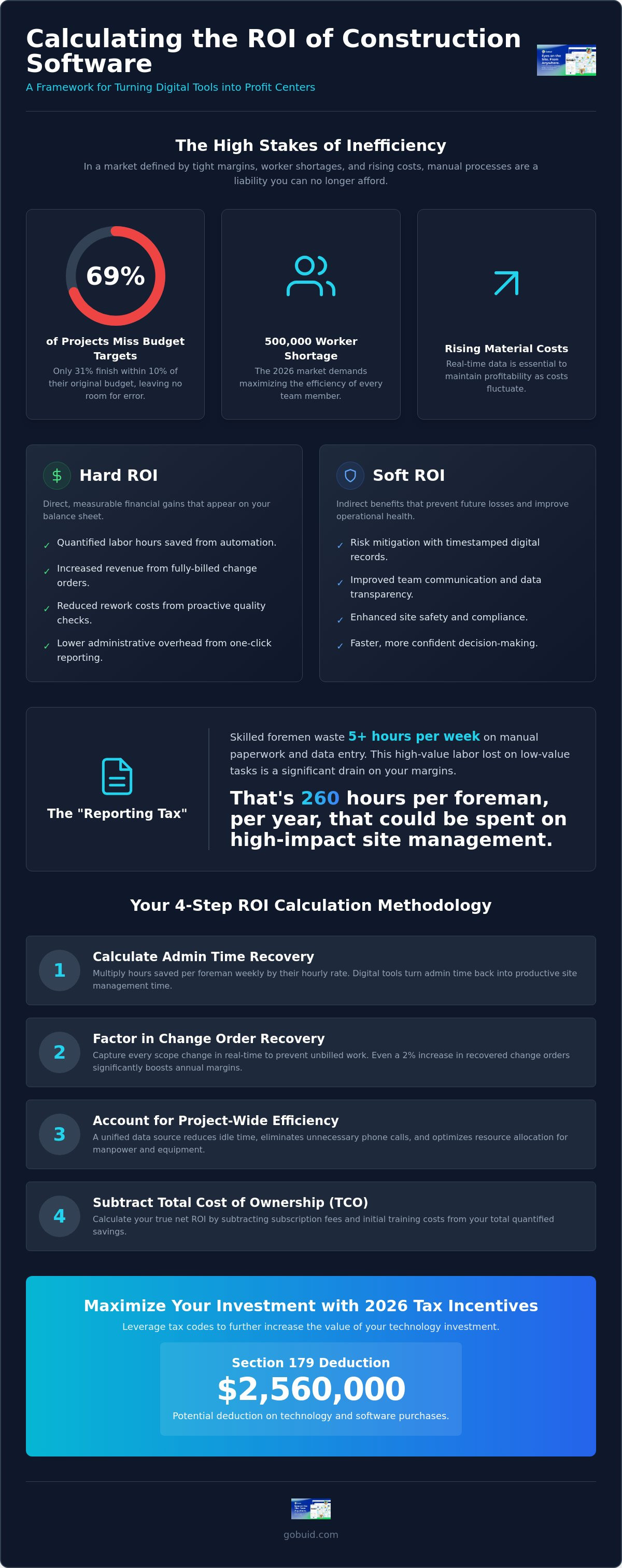
Only 31% of construction projects currently finish within 10% of their original budget. In a 2026 market defined by a 500,000 worker shortage and rising material costs, these thin margins leave no room for error. Calculating ROI on construction software is the only way to prove that digital tools aren't just an expense; they're a profit center. You already feel the weight of manual site diaries and the revenue lost to unbilled change orders. It's time to stop guessing and start measuring.
This article provides a practical framework for quantifying time savings, risk reduction, and direct profitability gains. You'll master the process of turning administrative hours saved into a hard dollar value your stakeholders can't ignore. We'll explore how to bridge the gap between field data and office analytics, leveraging 2026 tax incentives like the $2,560,000 Section 179 deduction to maximize your technology investment. Gain total transparency over your project tracking and eliminate the documentation tax today.
Key Takeaways
- Define the difference between Hard ROI and Soft ROI to build a comprehensive business case for digital tools.
- Use a step-by-step methodology for calculating ROI on construction software by quantifying recovered foreman hours and labor costs.
- Prevent revenue loss by capturing every scope change in real-time to ensure full billing on every project.
- Utilize a Project Analytics Dashboard to identify operational trends and risks before they impact your bottom line.
- Replace manual site diaries with automated reporting to reclaim hours for high-impact site management.
Defining the ROI Framework for Modern Construction Software
ROI isn't just a financial metric; it's a measure of operational survival. In the construction sector, Return on Investment (ROI) represents the ratio between your total operational savings and the total cost of ownership for your tools. Calculating ROI on construction software requires looking past the subscription price. You must account for every dollar saved through efficiency and every cent protected from project overruns.
Hard ROI delivers direct cash savings you can see on a balance sheet immediately. Soft ROI involves improvements in communication and site safety that prevent future losses. One of the most significant drains on your margin is the "Reporting Tax." Skilled foremen often spend five or more hours every week on manual paperwork. This is high-value labor wasted on low-value data entry.
To better understand how these calculations impact your team success, watch this breakdown:
By 2026 standards, retrospective reporting is no longer sufficient. You need real-time data to maintain profitability as material costs fluctuate. Waiting until the end of the month to review site logs means you're already too late to fix a budget leak. Efficiency is the new currency on the jobsite.
The High Cost of Manual Site Documentation
Manual entries are slow and prone to error. Relying on physical notebooks or disparate chat apps creates data silos that increase the risk of information loss. Transitioning to a Digital Site Diary streamlines progress photos and documentation. It eliminates the hours lost to organizing files and ensures a unified data point for the entire team. This centralization prevents the costly search for missing evidence during a dispute.
Quantifying Revenue Protection and Risk Mitigation
Digital records act as a primary insurance policy against liquidated damages. When every action is timestamped, legal disputes become much easier to resolve. Implementing digital Safety & Quality Inspections reduces expensive rework costs by catching errors before they're buried. This proactive approach protects your revenue and ensures project accountability across every site. You aren't just buying software; you're buying a shield for your profit margins.
Calculating Your Returns: A Step-by-Step Methodology
Moving from theory to execution requires a clear mathematical lens. Calculating ROI on construction software is a four-step process that demands precision. You must look at the specific hours reclaimed and the revenue protected from slipping through the cracks. Use this framework to build your justification.
- Step 1: Calculate Admin Time Recovery. Foremen are your most expensive field assets. Multiply the hours saved per foreman per week by their hourly rate. If a digital tool saves five hours weekly, that is 260 hours of high-value labor returned to the project every year.
- Step 2: Factor in Change Order Recovery. Unbilled work is a primary profit killer. Capture every scope change in real-time to ensure every variation is documented and billed. Even a 2% increase in recovered change orders can significantly impact your annual margin.
- Step 3: Account for Efficiency. Visibility reduces idle time. When you have a unified data point, you stop wasting time on phone calls to find out where equipment or teams are located.
- Step 4: Subtract Total Cost of Ownership (TCO). Be honest about the investment. Subtract subscription fees and the initial training time from your total savings to find your net ROI.
The ROI of One-Click Reporting
Manual report compilation is a slow, error-prone process that drains office resources. Compare the labor cost of manual data entry against the ability to generate report in one click. Automated reporting can reduce administrative compilation time by up to 80% per project cycle. This speed allows for faster decision-making and immediate course correction when budgets begin to drift.
Resource Optimization: Manpower and Equipment Tracking
Labor is often your largest variable cost. Implementing Manpower Tracking prevents over-staffing and ensures payroll is based on verified field data. This transparency eliminates disputes and keeps labor costs aligned with the project schedule. Similarly, effective Equipment Management reduces rental overhead by identifying underutilized machinery. You can see how these tools work together by exploring our core operational features to identify where your biggest leaks occur. High visibility leads directly to higher profitability.
Scaling ROI: From Implementation to Long-Term Profitability
Calculating ROI on construction software only works if your field team actually uses the tool. The "Adoption Barrier" is the primary reason digital transitions fail. Software that stays in the office provides no value on the site. GoBuid acts as a catalyst for immediate returns through a site-centric, mobile-first design that foremen actually want to use. When documentation is effortless, your data pool stays clean and your ROI stays high.
Real-time visibility is the connective tissue of a successful project. A Project Analytics Dashboard allows you to stop reacting to yesterday's mistakes and start predicting tomorrow's risks. This high-level overview identifies trends before they hit your bottom line. It turns raw site data into a strategic asset that keeps every stakeholder accountable. Transparency is your greatest defense against margin erosion.
Operational flexibility is essential for reducing the financial risk of software implementation. You need tools that prove their value through utility and results rather than rigid constraints. By prioritizing immediate site impact, you ensure the technology remains an essential member of your professional team. Efficiency shouldn't be a gamble.
Turning Site Data into Actionable Insights
Use integrated analytics to pinpoint exactly where productivity is stalling. When you're calculating ROI on construction software, you must account for the long-term value of identifying underperforming subcontractors or equipment. Bridging the gap between site diaries and budget management ensures that every field event is reflected in your financial forecasting. You can't manage what you don't measure.
Future-Proofing Your Profit Margins
In a competitive 2026 market, digital-first contractors win more bids. They provide the transparency and real-time reporting that owners now demand. The compounding value of a unified data point for all project documentation creates a historical record that improves future estimating. High-quality execution is no longer enough. You need the data to prove your efficiency and protect your reputation on every project.
Drive Profitability Through Operational Transparency
Reclaiming lost time and protecting revenue isn't a luxury in 2026. It's a necessity. You've seen how the "Reporting Tax" drains your most valuable field assets and how unbilled change orders erode your bottom line. By calculating ROI on construction software, you shift from reactive site management to proactive leadership. You stop guessing and start knowing exactly where your resources are allocated.
Efficiency translates directly to increased profitability. Digital tools provide the connective tissue between the site and the office, ensuring every action is documented and every hour is accounted for. It's time to replace manual site diaries with a system designed for the physical realities of the field. Regain control over your chaotic workflows and build with the confidence of a technical innovator.
Ready to eliminate administrative overhead and recover lost revenue? Leverage a real-time Project Analytics Dashboard and the ability to generate report in one click. Calculate your potential savings with a GoBuid demo today. Your team deserves the precision of modern digital tools. Start building your more profitable future now.
Frequently Asked Questions
How long does it take to see a positive ROI on construction software?
Most contractors realize a positive return within the first three to six months of full implementation. The initial gains come from the immediate reduction in administrative labor for foremen and site supervisors. When calculating ROI on construction software, you'll see the fastest results by capturing unbilled change orders that previously slipped through the cracks. Efficiency is cumulative, so the value increases as your team masters the digital workflow.
What is the biggest hidden cost when implementing a new project management platform?
The most significant hidden cost is the temporary drop in productivity during the initial training phase. While subscription fees are predictable, the time your field staff spends learning new Customized forms or documentation workflows is a real investment. Minimize this by choosing site-centric tools that mirror existing physical processes. This reduces the learning curve and ensures the "Reporting Tax" doesn't increase during the transition period.
Can I calculate ROI if I am currently using spreadsheets for my site diaries?
You can calculate ROI by auditing the total time spent manually entering, consolidating, and searching for data across various spreadsheets. Spreadsheets create data silos that require manual reconciliation between the field and the office. When calculating ROI on construction software, compare your current administrative hours against the ability to generate reports in one click. The labor cost difference is your primary hard ROI indicator.
How does digital manpower tracking specifically improve my profit margins?
Digital Manpower Tracking improves margins by ensuring payroll accuracy and preventing over-staffing on site. It provides real-time visibility into labor allocation, allowing you to move teams between locations based on actual progress rather than guesses. This precision reduces idle time and ensures your largest variable cost stays within the project budget. Transparency in labor data eliminates disputes and protects your profit from unverified claims.