The Ripple Effect: Consequences of Poor Quality M&E Craftsmanship and Tracking Faults
by Guillermo Sánchez
|
A single loose conduit buried behind a finished wall can trigger a $15,000 rework order just 48 hours before your scheduled handover. It's the hidden reality of the job site where minor oversights compound into massive legal liabilities. You've likely seen how the consequences poor quality m&e track craftsmanship faults manifest in failed audits and delayed handovers that eat your profit margin. These errors don't just cost money; they damage your professional standing with developers and regulators alike.
We agree that tracking every pipe, wire, and duct in real-time is the only way to protect your reputation and ensure structural integrity. You'll discover how to identify these errors before they're encased in concrete and how to leverage digital field reports to ensure total BCA compliance. This guide breaks down the long-term financial impact of M&E failures and provides a clear roadmap to a faster, fault-free handover that keeps your projects on schedule and your documentation bulletproof.
Key Takeaways
Identify why M&E systems represent the highest risk for latent defects and how these hidden errors compound into massive liabilities.
Master the "1-10-100 Rule" to mitigate the financial consequences poor quality m&e track craftsmanship faults bring to complex projects.
Protect your project from fire safety liabilities and regulatory non-compliance by catching installation errors before they are buried behind walls.
Transition from reactive fixing to proactive tracking using real-time field data and mandatory progress photography.
Leverage digital quality control to create a single source of truth and bridge the gap between site reality and office oversight.
⭐ Learn more about GoBuid's feature- without the heavy enterprise price tag
Digitizing Quality Control: How GoBuid Eliminates Craftsmanship Faults
Construction projects often fail because critical data stays trapped in a foreman's pocket or a dusty binder. GoBuid acts as the digital bridge. It connects the rugged reality of the site to the precision of the office. No more guessing. No more buried errors. Ignoring the consequences poor quality m&e track craftsmanship faults bring to a site is a recipe for litigation. Moving from paper-based chaos to a centralized digital site diary isn't just an upgrade; it's a necessity for project survival.
Real-Time Visibility and Accountability
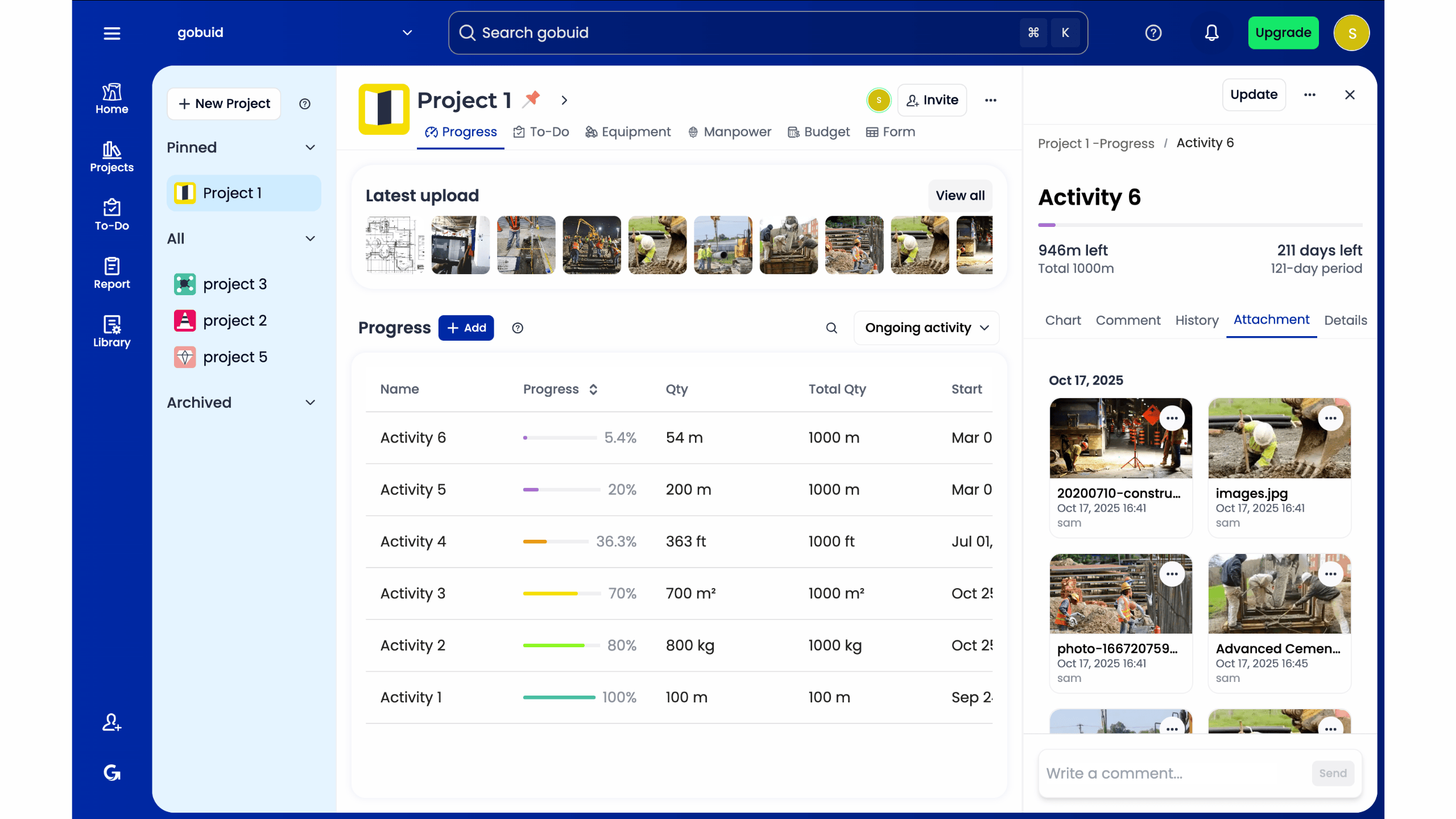
Accountability starts with seeing the problem before it's hidden behind a wall. The Project Analytics Dashboard serves as your mission control. It flags quality issues instantly. When a technician identifies a pipe fitting error or a wiring mismatch, the system tracks it. It doesn't let go. The loop only closes once the fix is verified and documented by the relevant supervisor.
This systematic approach stops small errors from becoming structural disasters. It also saves time. Firms using GoBuid's automated reporting tools reduce administrative overhead by 40%. Instead of spending hours chasing signatures and compiling photos, teams focus on the build. The software handles the data entry. It ensures that the consequences poor quality m&e track craftsmanship faults create are mitigated before they escalate into expensive rework or safety hazards.
Building a Defensible Record
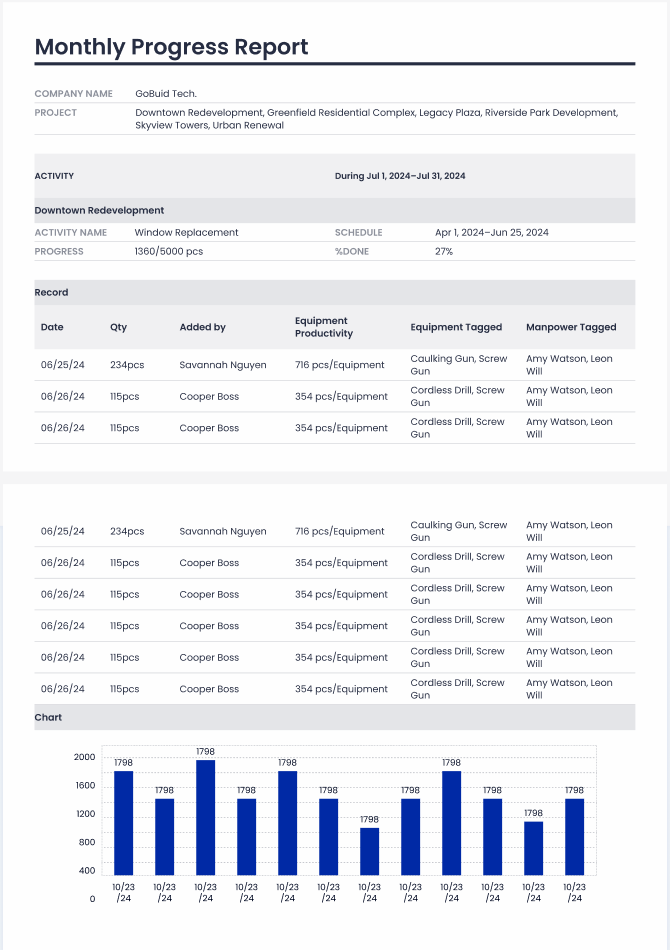
Auditors and clients don't want excuses. They want evidence. GoBuid allows you to generate professional reports with a single click. These aren't just summaries; they are searchable, permanent records of the building's entire lifecycle. Paper gets lost. Memories fade. Digital records endure. If a mechanical failure occurs two years after handover, you have the proof of installation, inspection, and sign-off at your fingertips.
Permanent Traceability: Every entry is timestamped and linked to specific site locations.
Centralized Truth: One version of the truth for the office, the field, and the client.
Lifecycle Management: Data remains valuable for maintenance teams long after the scaffolding comes down.
Transparency is the ultimate tool for trust. By digitizing quality control, you eliminate the ambiguity that leads to disputes. You protect your reputation and your profit margins. Stop managing by accident and start managing by data. Efficiency is the only way forward. Start your free trial with GoBuid today and regain control of your project's quality.
Understanding M&E Craftsmanship: The Nervous System of Construction
M&E craftsmanship is the precision execution of Mechanical, electrical, and plumbing (MEP) systems. These components represent the building's nervous system. They distribute power, data, water, and climate control to every corner of a structure. In modern construction, M&E is the highest-risk phase for latent defects. Unlike structural issues that often show during the build, M&E faults frequently hide behind finished walls and ceilings. They wait for the building to be occupied before failing.
To better understand this concept, watch this helpful video:
The link between track craftsmanship and system longevity is direct. Track systems include the containment, trunking, and routing that house vital cabling and piping. When these are installed poorly, the entire system's integrity is compromised. "Near enough" is never acceptable in high-stakes electrical and HVAC installations. The long-term consequences poor quality m&e track craftsmanship faults manifest as persistent system failures that drain maintenance budgets and frustrate end-users.
The Critical Nature of M&E Track Systems
Cable management and containment aren't just about organization. They're safety requirements. Proper containment prevents electromagnetic interference between power and data lines. It also ensures adequate airflow to prevent overheating in high-voltage runs. Poor layout planning leads to service clashes. According to 2024 industry data, service clashes account for 15% of project delays on complex commercial builds. Accessibility is another non-negotiable factor. If a technician can't reach a junction box without destroying a ceiling, the craftsmanship has failed. You don't just build for the handover; you build for the next 30 years of maintenance.
Craftsmanship vs. Compliance
There's a wide gap between work that passes a basic inspection and work that exhibits true craftsmanship. Compliance is the minimum legal requirement. Craftsmanship is the precision of the installation. It's the difference between a pipe that's "mostly level" and one that's perfectly aligned. High-quality execution ensures that every bracket is secure and every label is accurate. To maintain these standards, teams must utilize a rigorous Inspection Test Plan (ITP). This document acts as a single source of truth, ensuring that the consequences poor quality m&e track craftsmanship faults are caught in the field, not after the client moves in. Precision is the only way to protect the project's bottom line.
The Financial Ripple Effect: Rework, Delays, and Hidden Costs
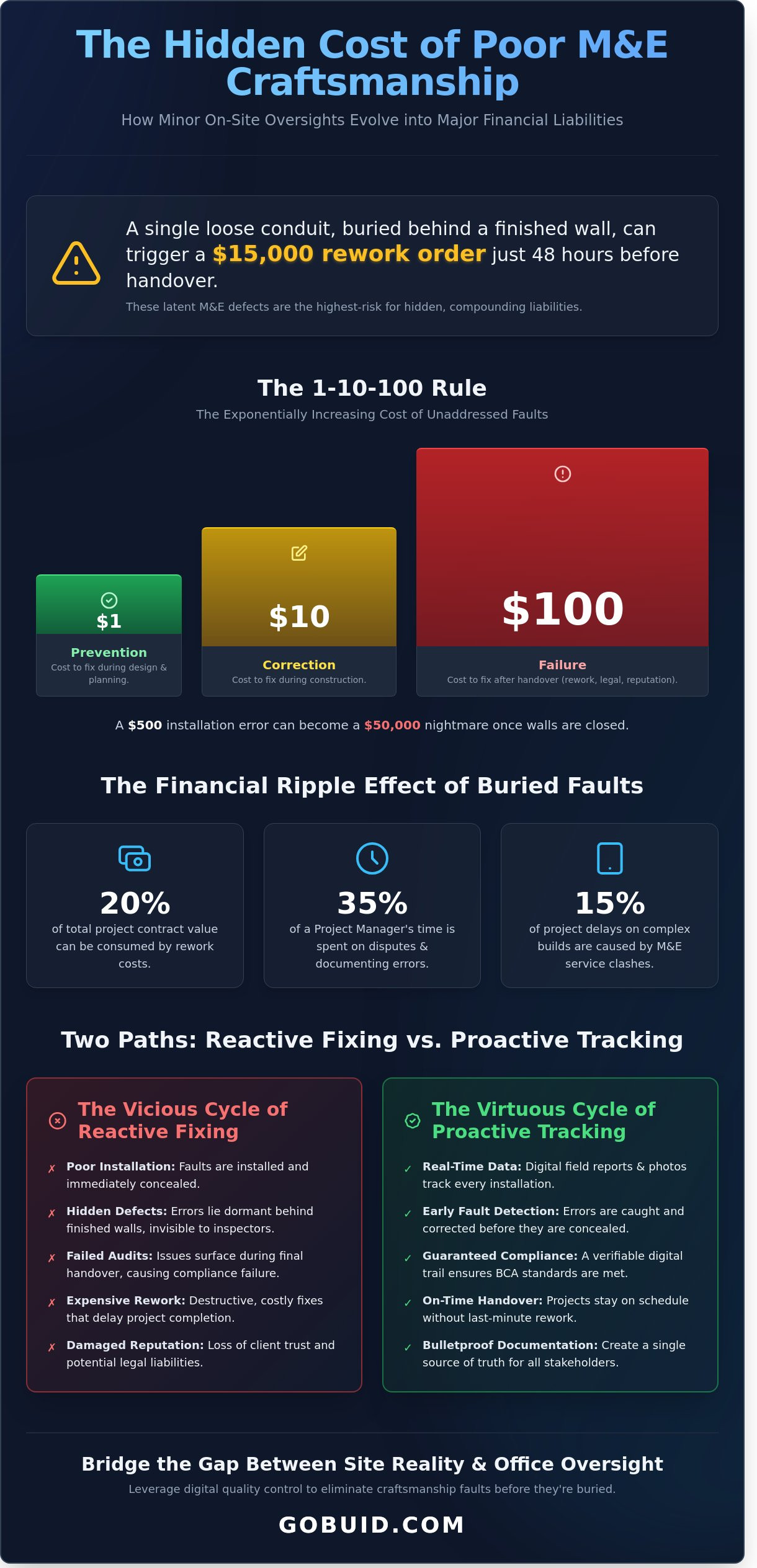
Quality control isn't a luxury; it's a financial survival strategy. In the M&E sector, the 1-10-100 Rule dictates the math of failure. One dollar spent on prevention saves 10 dollars in correction and 100 dollars if the fault reaches the client. When you ignore the consequences poor quality m&e track craftsmanship faults produce, you're essentially gambling with the project's bottom line. A simple $500 installation error, like a misaligned drainage pipe or a faulty junction box, is a minor fix during the rough-in stage. Once the walls are closed and the finishes are applied, that same error morphs into a $50,000 rework nightmare. You aren't just paying for the fix; you're paying to destroy and rebuild everything surrounding it.
The cost of rework often consumes up to 20% of a project's total contract value. Beyond the physical labor, the administrative burden is staggering. Project managers spend 35% of their time managing disputes, processing insurance claims, and documenting errors. This friction stalls momentum and drains resources that should be focused on the next milestone. If you want to stop the bleed, you need to centralize your field data and catch errors before they're buried. High-performing teams use tools like GoBuid to maintain visibility and prevent these financial leaks from turning into floods.
Compounding Costs of Buried Faults
Fixing an M&E error behind a finished partition is a logistical disaster. It requires "opening up" ceilings, which means bringing back the demolition crew, the stud-work team, and the plasterers. Latent defects are faults that appear only after the building is occupied. These are the most expensive failures because they involve tenant disruption and emergency call-out rates. One trade's poor craftsmanship triggers a domino effect. A leaking pipe doesn't just require a plumber; it forces rework for plasterers, painters, and professional cleaners. By the time the dust settles, the original $500 mistake has multiplied across four different subcontractors.
Project Handover and Liquidated Damages
M&E systems are the heartbeat of a building. If the HVAC or fire suppression systems fail final testing, the project cannot reach Practical Completion. M&E delays at the end of a project are the #1 cause of missing handover dates. In high-stakes commercial construction, Liquidated Damages (LDs) can exceed $10,000 per day. These penalties wipe out profit margins in a matter of weeks. Protecting your firm requires a bulletproof record of every installation. Maintaining accurate site diaries is the only way to defend against unfair delay claims and prove that your team met its obligations. When the consequences poor quality m&e track craftsmanship faults lead to the courtroom, your documentation is your only shield.
Safety Risks and Regulatory Non-Compliance Liabilities
The most dangerous phrase on a job site is "we'll fix it later." In M&E, "later" usually means after the drywall is up and the ceilings are closed. Safety cannot wait for a final walkthrough. One of the primary consequences poor quality m&e track craftsmanship faults produce is a fundamental failure in building integrity that remains hidden until a crisis occurs. When safety is treated as a post-production task, the risk of catastrophic failure increases exponentially.
Fire Safety and Electrical Hazards
Poor cable management creates more than just an untidy rack. Overcrowded trays and improper bundling lead to heat accumulation. These hotspots are a primary driver of electrical fires in high-density developments. Adhering to OSHA's electrical standards is the absolute minimum requirement to prevent arc flashes and thermal runaway. Craftsmanship faults in wiring are not just technical errors; they are ignition points.
Fire-stopping is the second critical failure point. In a 2022 fire safety audit of modern commercial builds, nearly 40 percent of failures were linked to improper M&E penetrations. When cables or pipes breach fire-rated walls without certified sealing, the building's fire compartmentalization is compromised. Smoke and flames will bypass these barriers in minutes, rendering expensive safety systems useless and putting occupants at direct risk.
The Legal Burden of Proof
Liability does not vanish at handover. If an M&E fault causes a system failure or injury two years later, the legal burden of proof falls on the project leadership. Directors and project managers are increasingly held personally accountable under updated safety regulations and building acts. Without a "Single Source of Truth" for every inspection, your firm is exposed to massive litigation risks.
Accountability: You must have a verifiable record of every inspection, including who performed the work and who signed off on it.
Insurance Protection: Professional indemnity (PI) insurers are raising premiums for firms with poor tracking. Detailed digital records can prevent these hikes by proving due diligence during the construction phase.
Regulatory Friction: Local authorities or BCA inspectors can halt a project if they find undocumented work. This leads to costly delays and rework that erodes profit margins.
Maintaining a centralized record through digital field reports ensures every penetration and connection is logged in real-time. This level of visibility bridges the gap between the field and the office, protecting your firm from the long-term fallout of craftsmanship faults. If you cannot prove it was done right through documented evidence, the law assumes it was done wrong.
Identifying and Preventing M&E Faults in Real-Time
Stop reacting to disasters after they're buried behind concrete. Reactive fixing burns approximately 30% of project budgets through rework and schedule delays. To maintain control, you must shift from a culture of firefighting to one of proactive tracking. You need total visibility before the ceilings are closed and the walls are finished. Proactive tracking is the only way to mitigate the consequences poor quality m&e track craftsmanship faults. If a pipe joint isn't verified the moment it's installed, it remains a ticking liability for the life of the building.
The Power of Progress Documentation
Establish a photo-first culture on every floor. Every M&E track must be documented before it's covered by secondary finishes. These progress photos serve as a digital X-ray for the building. Maintenance teams in 2027 won't have to guess where a junction box or a valve is located. By using GPS-tagged records and automated timestamps, you create an indisputable record of work. This level of detail reduces search time by 40% during future maintenance cycles. It eliminates "he said, she said" disputes between trades and ensures accountability is baked into the daily workflow.
Standardising Quality with Custom Forms
Generic checklists don't work for complex mechanical and electrical systems. They're too vague to catch critical errors. You need customised inspection forms that mirror your specific project specifications. This ensures every foreman, regardless of their experience level, follows the exact same quality benchmark. Standardised oversight prevents the consequences poor quality m&e track craftsmanship faults inflict on long-term operational costs. Use this data to track performance across your supply chain. If one subcontractor shows a 15% higher failure rate on pressure tests, you have the hard data to intervene before their mistakes compromise the entire floor.
Quality control also extends to the people on the tools. High-risk M&E work requires specific certifications that can't be ignored. Utilize manpower tracking to verify that a licensed technician is handling switchgear or medical gas lines, not an unsupervised apprentice. When you match qualified labor to high-risk tasks, you significantly lower the probability of technical failure. Centralizing this data allows project managers to bridge the gap between the field and the office, ensuring that every wire pulled and every pipe fitted meets the required standard.
Take Control of Your Project’s Nervous System
Poor M&E installation isn't just a minor site snag; it's a massive financial drain. Research from the Navigant Construction Forum indicates that rework often accounts for 5% of a project's total contract value. When teams ignore the consequences poor quality m&e track craftsmanship faults, they invite regulatory fines and safety liabilities that threaten the entire build. These hidden issues don't stay hidden for long. They manifest as blown budgets and missed deadlines that damage your professional reputation. You can't afford to leave these critical systems to chance.
Modern project management demands a single source of truth. GoBuid provides a digital site diary designed by construction experts specifically for the field. You can generate compliance-ready reports in one click, ensuring every wire and pipe meets standard. We don't believe in restrictive barriers. Our platform offers no lock-in contracts and pay-as-you-go flexibility to match your project's pace. It's time to bridge the gap between the office and the dirt. You can eliminate the chaos of manual tracking and start delivering high-quality results with total confidence.
Stop burying your liabilities; start tracking quality with GoBuid today.
Frequently Asked Questions
What are the most common M&E craftsmanship faults in construction?
Incorrect duct sealing, loose electrical terminations, and uninsulated piping are the most frequent M&E issues on modern sites. These errors often result from rushed installation schedules or a lack of supervision. A 2023 industry study found that 35% of all M&E rework stems from these basic installation failures.
How does poor quality M&E work affect long-term building maintenance?
Substandard installation increases building operational costs by 20% over the total lifecycle of the structure. Faulty wiring and leaky valves force facilities managers into a reactive maintenance cycle. This constant state of repair prevents proactive upgrades and drains the annual maintenance budget on emergency fixes.
Can digital site diaries really reduce rework costs?
Digital site diaries reduce rework costs by providing real-time visibility into daily field activities. Capturing data instantly helps teams avoid the consequences poor quality m&e track craftsmanship faults by catching errors before they are hidden behind walls or ceilings. Industry data shows that immediate fault detection can save up to 10% of the total project value.
What is the role of an Inspection Test Plan (ITP) in M&E quality?
An Inspection Test Plan acts as the definitive roadmap for quality assurance during the installation phase. It establishes mandatory checkpoints that ensure every component meets the specific requirements of the project. Following a structured ITP reduces the occurrence of non-compliance reports by 40% compared to projects without standardized digital tracking.
How do I prove a subcontractor is responsible for an M&E fault?
You prove responsibility by maintaining geotagged photos and time-stamped digital logs that link specific tasks to individual subcontractors. When a fault is discovered, you refer to the digital record to see exactly who signed off on that work. This level of transparency eliminates disputes and ensures the responsible party covers the cost of rectification.
What happens if a building fails a fire safety audit due to M&E issues?
Failing a fire safety audit results in immediate stop-work orders or the denial of a Temporary Occupation Permit. In 2022, regulatory bodies increased penalties for non-compliance, often resulting in five-figure fines per violation. Beyond the financial penalty, the project typically suffers a 30% delay in the handover schedule while faults are corrected.
How does GoBuid help with BCA compliance for site documentation?
GoBuid automates the collection of digital records required by the Building and Construction Authority for quality audits. It centralizes all Inspection Test Plans and site diaries into a single source of truth for the entire project team. This system ensures that 100% of the documentation required for compliance is organized and ready for inspection at any time.
Is it difficult to move from paper checklists to digital quality inspections?
Moving to digital inspections takes less than one week when using a platform built for the field. GoBuid replaces paper clipboards with a mobile interface that mirrors existing workflows to ensure high adoption rates. Field teams spend 50% less time on manual paperwork, which allows them to focus on the actual quality of the installation.