Is Construction Management Software Worth It? Analyzing ROI and Efficiency in 2026
Is construction management software worth it? This guide analyzes the ROI, showing how to cut admin drag by 40% and gain control over project costs in 2026.
by Amelia Grant
|
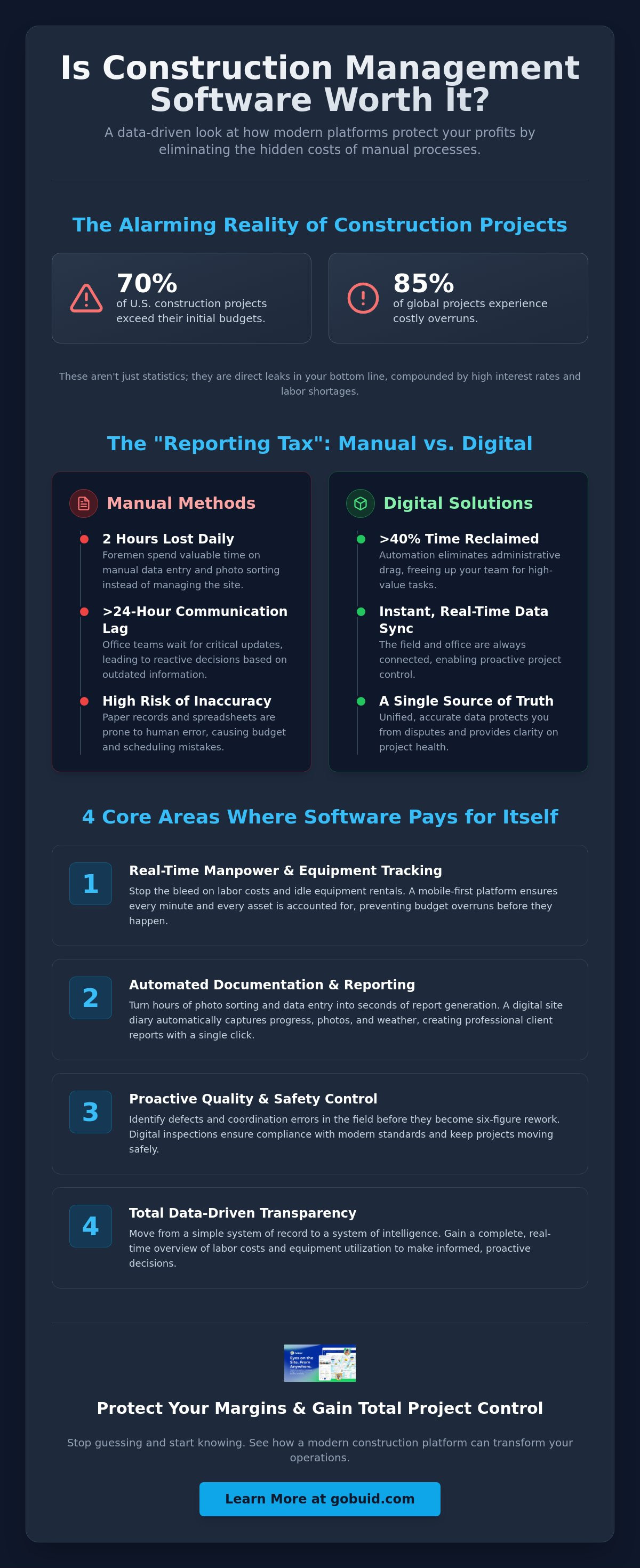
If 70% of construction projects in the United States are currently exceeding their initial budgets, the question isn't just about overhead; it's about survival. You are likely asking, is construction management software worth it when every dollar of profit is squeezed by high interest rates and a relentless labor shortage. Spending two hours every day on manual reports while manpower tracking remains a guessing game isn't just frustrating. It's a direct leak in your bottom line that compounds with every site visit.
You already know that the disconnect between the field and the office is where your project's health begins to fail. We understand that you need tools that work as hard as your crew, not another digital burden that requires a computer science degree to operate. This article proves the tangible ROI of modern construction platforms and shows you how to identify solutions that eliminate administrative drag without the weight of a long-term contract.
We will examine how to reclaim over 40% of your administrative time and achieve total transparency over equipment and labor costs. You'll learn how to generate professional client reports instantly and keep your projects within the guardrails of profitability. This is about moving from a system of record to a system of intelligence that protects your margins.
Key Takeaways
- Eliminate the "reporting tax" by automating site documentation and progress photos to reclaim hours of daily productivity.
- Determine if is construction management software worth it for your firm by analyzing how real-time manpower and equipment tracking prevents budget overruns.
- Reduce administrative drag by over 40% through one-click report generation and centralized project analytics dashboards.
- Ensure a high ROI by prioritizing mobile-first tools that field teams actually use, bridging the gap between site reality and office data.
- Gain total transparency over labor costs and equipment utilization to move from reactive management to proactive project control.
The Invisible Drain: Why Manual Site Documentation Costs More Than Software
Many contractors believe they're saving capital by sticking to traditional methods. This is a misconception. Relying on paper diaries and manual spreadsheets creates a "reporting tax" that drains resources every single day. When evaluating if is construction management software worth it, you must first calculate the cost of doing nothing. The invisible drain of manual processes often exceeds the price of the technology itself.
Manual Construction management often involves site foremen spending up to two hours daily just to compile photos and notes. This isn't just a loss of time; it's a delay in communication. Office teams frequently wait over 24 hours for site updates. These information silos prevent proactive decision-making and leave project managers reacting to problems that happened yesterday rather than preventing them today.
To better understand the value of modern tools over legacy systems, watch this helpful video:
Quantifying Administrative Overhead
The 2-hour daily report trap is a silent profit killer. If a foreman spends 10 hours a week on basic data entry, you're losing significant high-value labor to low-value tasks. This doesn't include the "double entry" friction where office staff re-type handwritten notes into digital spreadsheets. Using a digital site diary eliminates this redundancy. It turns field observations into professional client reports instantly, reclaiming lost productivity.
The Risk of Inaccurate Field Data
Paper records are prone to human error. A single typo in manpower tracking or a missed equipment entry can lead to massive budget overruns. For instance, delayed equipment management often results in unnecessary rental extensions because nobody realized the machine was idle. In 2026, documentation gaps leave you vulnerable during insurance claims or legal disputes. Digital records provide a unified data point that protects your business from the "he said, she said" of project litigation. If you want to know if is construction management software worth it, consider the cost of one lost dispute due to poor documentation.
Calculating the ROI: 4 Areas Where Construction Software Pays for Itself
ROI isn't a vague concept; it's a measurable reduction in waste. Since 85% of construction projects globally experience cost overruns, the question of is construction management software worth it is answered by the bottom line. Real-time manpower and equipment tracking stops the bleed on labor costs immediately. You no longer pay for hours that weren't worked or rental machines that sat idle in a corner of the site. Every minute and every asset is accounted for in a single, unified data point.
Efficiency Through Automation
Documentation should be a byproduct of your work, not a separate chore. A digital site diary ensures your team captures progress photos and weather data with zero manual effort. Nothing gets forgotten at the end of a long shift. This automation feeds directly into one-click reports. You turn hours of photo sorting and data compilation into seconds of generation. It builds professional branding and total client transparency without adding a single minute to your daily workload.
Quality and safety inspections provide a direct return by identifying defects in the field. Catching a coordination error before the concrete pours is the difference between a minor adjustment and a six-figure rework. Digital inspections happen on-site, in real-time, ensuring compliance with the latest 2026 OSHA standards while keeping the project moving. You reduce risk and eliminate the paper trail that usually leads to confusion.
Data-Driven Project Control
Total transparency is your greatest asset. Using a project analytics dashboard allows you to spot budget trends before they become catastrophic losses. You move from guessing to knowing. Decisions are based on today's site reality, not last week's blurred memories or lost notes. This immediacy translates directly to increased profitability. If you want to regain control over your chaotic workflows, explore these integrated features to see how they fit your specific operational reality.
Selecting a Worthy Solution: Avoiding Bloat and Long-Term Contracts
The most sophisticated platform is a liability if your field team refuses to touch it. When determining if is construction management software worth it, the answer hinges entirely on user adoption. If a site foreman finds the interface clunky or time-consuming, they will revert to paper diaries. ROI drops to zero the moment documentation stops being real-time. You need a solution that bridges the gap between site reality and digital precision without requiring a week of training.
The Checklist for High-ROI Software
Documentation must happen where the work happens. Demand a mobile-first design that allows for data entry on the slab, not back in the trailer. Your selection criteria should focus on utility rather than a long list of unused features. A worthy solution must include:
- Rapid Proficiency: A new user should be proficient with the interface in under 30 minutes. Complexity is a cost, not a feature.
- Customizable forms: The software must adapt to your existing workflows, ensuring your team captures the specific data your projects require.
- Scalability: The tool should grow with your project volume without adding layers of administrative friction.
Why Flexibility Wins in 2026
The construction market in 2026 is defined by volatility. With fluctuating interest rates and shifting labor availability, signing a multi-year, high-cost contract is a significant operational risk. Many legacy providers rely on "lock-in" tactics. These contracts keep you paying even if the software fails to gain traction with your crew. This lack of accountability is a primary reason why some contractors feel burned by technology investments.
GoBuid operates on a model that prioritizes ongoing value over contractual obligation. By removing long-term commitments, the burden of proof stays with the software. It has to perform every day to earn its place on your job site. This approach acts as the ultimate de-risking strategy. You gain the technological edge of a project analytics dashboard and automated reporting without the anxiety of permanent overhead. In the end, is construction management software worth it? It is when the provider is as committed to your project's execution as you are.
Protect Your Margins with Digital Precision
Operational excellence is no longer a choice in a market where 70% of projects exceed their budgets. The "reporting tax" of manual data entry is a luxury your firm can't afford. By digitizing your site diary and automating progress documentation, you shift from reactive firefighting to proactive project control. You gain the ability to spot budget leaks in real-time, ensuring labor and equipment costs stay within your specified guardrails.
Deciding if is construction management software worth it for your team depends on the tool's ability to drive immediate value without adding complexity. You need a platform that prioritizes field adoption and provides total transparency through a unified data point. When your foreman can capture site reality in seconds, your office gains the precision required to scale without increasing administrative overhead.
Start optimizing your site operations with GoBuid's no lock-in platform. Benefit from one-click professional reporting and real-time manpower tracking without the burden of long-term contracts. It's time to regain control over your workflows and secure your profitability.
Frequently Asked Questions
How much time can I actually save with construction management software?
You can reduce administrative time by over 40% by eliminating manual data entry. Instead of spending two hours daily on reports, you generate them in one click. This reclaimed time allows site leaders to focus on high-value tasks like site supervision and schedule management. Total transparency over equipment and labor costs further reduces the time spent investigating budget discrepancies or missing paperwork.
Is it difficult to move my team from paper to a digital site diary?
Transitioning is straightforward if you prioritize mobile-first tools designed for field use. The key to answering if is construction management software worth it lies in user adoption. Most teams find that digital site diaries are faster than handwriting notes once they realize they can attach progress photos instantly. Choose a system with a low learning curve to ensure your foreman is proficient in under 30 minutes.
What features are essential for a small to mid-sized construction firm?
Focus on utility over bloat. Essential features include manpower tracking, equipment management, and customized forms that mirror your existing workflows. A centralized project analytics dashboard is critical for spotting cost trends before they impact your margins. Avoid complex enterprise platforms that require long-term commitments. Instead, look for integrated tools that offer one-click reporting and real-time team collaboration.
Can construction software help with safety and quality compliance?
Digital platforms significantly improve compliance by standardizing safety and quality inspections. You can record defects and safety hazards immediately on-site with progress photos and documentation. This creates a permanent, searchable audit trail that protects your business during legal disputes or insurance claims. In 2026, meeting updated OSHA heat and hazard standards is much simpler when your safety plans are accessible via a mobile interface.