Overcoming Construction Tech Adoption Challenges: A Field-First Strategy for 2026
Solve construction tech adoption challenges and stop wasting money on unused tools. Our field-first strategy ensures 100% adoption and real-time site visibil...
by Guillermo Sánchez
|
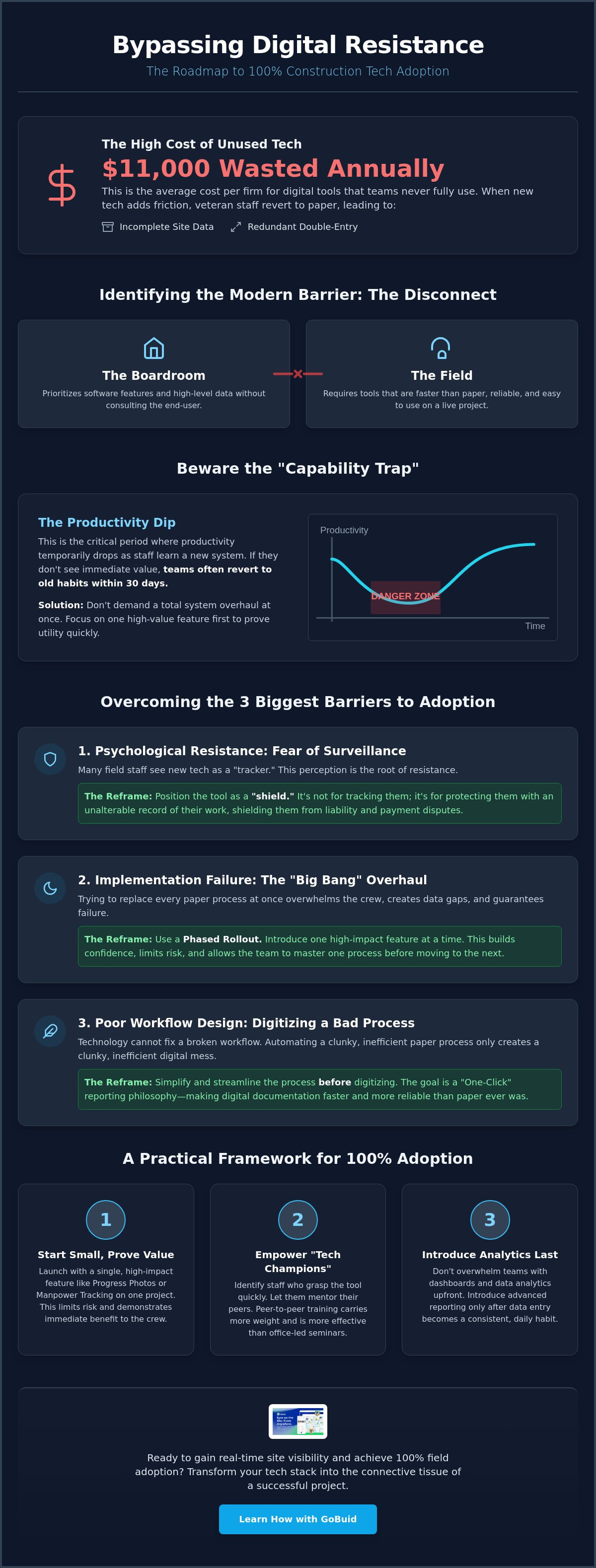
Construction firms waste $11,000 annually on digital tools that their teams never fully use. This isn't a software failure. It's a direct result of construction tech adoption challenges that occur between the site office and the field. When veteran staff feel a tool adds friction, they revert to paper. This leads to incomplete site data and hours of redundant double-entry. It's a cycle that drains profitability and obscures real-time visibility.
Paper-based workflows and fragmented chat threads remain the default because they feel faster during a busy shift. This guide provides a tactical roadmap to bypass digital resistance and ensure 100% field adoption. You'll master the strategies required to implement automated reporting and real-time visibility that site teams actually enjoy using. Learn how to transform your tech stack into the connective tissue of a successful project, ensuring your data is accurate and your workflows remain lean.
Key Takeaways
- Identify the "Capability Trap" to prevent temporary productivity dips during the rollout of new digital tools.
- Solve construction tech adoption challenges by shifting the project narrative from "tracking" to "empowering" your veteran site staff.
- Utilize phased implementation strategies to avoid the common pitfalls and resistance associated with total system overhauls.
- Adopt a "One-Click" reporting philosophy to ensure digital documentation is faster and more reliable than paper-based alternatives.
- Gain real-time site visibility through automated manpower and equipment tracking that removes the administrative burden from field teams.
The Reality of Construction Tech Adoption: Identifying the Modern Barriers
Most digital transformation efforts fail because they prioritize the boardroom over the boots on the ground. This disconnect is the core of most construction tech adoption challenges. When the office buys software without consulting the field, they often buy a burden rather than a solution. If a digital tool doesn't match the speed of a site foreman, it will be ignored. Reliability and ease of use are the only metrics that matter on a live project.
Legacy workflows are a rational response to poorly designed technology. If a paper site diary is faster than a mobile app, the team will choose the paper every time. Fragmented data across email and chat apps creates silos that hide the truth of project progress. This lack of a unified data point is exactly why projects fall behind. Research from June 2026 shows that construction firms waste an average of $11,000 annually on these underutilized digital tools.
To better understand the root causes of these hurdles, watch this analysis:
The Capability Trap and Productivity Dips
The Capability Trap is the period where productivity dips while staff learn a new system. It's the most dangerous phase of any rollout and a major driver of construction tech adoption challenges. Teams often revert to old habits within the first 30 days if they don't see immediate utility. To survive this, don't demand total system overhauls immediately. Manage expectations by focusing on one high-value feature first, like a Digital Site Diary, to prove value quickly.
Software vs. Process: Why Tech Can’t Fix a Broken Workflow
Digitizing a bad process only creates a digital mess. Successful adoption requires an understanding of how Architectural technology bridges the gap between design and physical execution. Identify "analog-first" habits that are redundant. Simplify your forms before you automate them. Using customised forms that mimic the field's natural workflow is the only way to ensure the software sticks. If a task isn't lean on paper, it won't be lean on a tablet.
Overcoming the 3 Biggest Challenges to Digital Transformation
Winning over a site foreman requires a shift in perspective. You aren't installing a tracker; you're providing a shield. Most construction tech adoption challenges stem from the fear that digital tools are purely for surveillance. When a foreman realizes that a digital record protects them from liability and payment disputes, the resistance vanishes. The tool becomes their best defense. It proves exactly what happened on-site, when it happened, and who was there.
Avoid the "Big Bang" failure. Don't try to replace every process on Monday morning. Total system overhauls fail because they overwhelm the crew and create massive data gaps. Phased rollouts allow your team to build confidence without the pressure of a total system collapse. It's about establishing clear ROI for the person using the tool, not just the company owner. If the software doesn't save the worker time, it's not a solution. It's just more work.
Psychological Buy-in: Solving for the "What’s In It For Me?"
Frame the digital site diary as a professional asset. It creates a permanent, unalterable record of work completed. This protects the team when subcontractors underperform or when weather delays occur. By leveraging GoBuid features, site teams can drastically reduce the time spent on repetitive phone calls and status updates. When the office can see progress in real-time, the foreman is left alone to do their actual job. You can start by seeing how one-click reports eliminate the need for end-of-day administrative marathons and replace messy paper logs.
Phased Implementation Framework
- Step 1: Start with a single high-impact feature. Focus on progress photos or manpower tracking on one specific project. This limits risk while proving value.
- Step 2: Identify "Tech Champions" on-site. These are the staff members who grasp the tool quickly. Let them mentor their peers. Peer-to-peer training carries more weight than office-led seminars.
- Step 3: Introduce advanced analytics only after data entry becomes consistent. You can't analyze what you haven't captured. Build the habit of data entry first, then reap the rewards of the project dashboard.
Simplifying Site Documentation: The Path to 100% Adoption
Data fatigue is the silent killer of digital transformation. If a tool requires more effort than a pen and paper, it's destined for the digital graveyard. Speed of reporting is the ultimate driver of success. This is why a "One-Click" philosophy is essential. When you enable automated reporting, site data turns into professional records instantly. It removes the friction that typically fuels construction tech adoption challenges.
Site teams should capture progress photos as a natural part of their site walkthrough, not as a separate administrative task. The goal is to integrate documentation into the physical reality of the job. Real-time manpower and equipment tracking must happen without an added administrative burden. When the process is seamless, the data is accurate. Accurate data is the only way to maintain total transparency across disparate operational locations.
Eliminating the "End-of-Day" Reporting Burden
The "Friday Afternoon Report" is a liability. Memory fades, and delayed data is often inaccurate data. Relying on gut feeling at the end of a week leads to costly errors. Transitioning to digital site diaries allows for real-time updates as events happen. This shift ensures that the office has immediate visibility into site realities. It eliminates the scramble to reconstruct timelines when a dispute arises.
Transparency Through Project Analytics
Stop managing by intuition. High-performing teams move from "gut feeling" to data-driven insights using a Project Analytics Dashboard. This level of transparency fosters accountability among subcontractors and internal crews. When everyone sees the same unified data point, disputes decrease and productivity rises. It's about creating a culture where execution is visible and progress is undeniable. This is the final step in overcoming construction tech adoption challenges and securing a competitive edge for 2026.
Future-Proof Your Site Operations
Success in 2026 depends on your ability to bridge the gap between the office and the field. You've seen that construction tech adoption challenges aren't solved by complex dashboards or executive mandates. They're solved by empowering the foreman with tools that work as fast as they do. By focusing on a one-click philosophy and phased implementation, you eliminate the friction that causes teams to revert to paper. You gain real-time visibility while your crew gains a professional shield against disputes.
It's time to stop fighting legacy workflows and start optimizing them. When documentation becomes a natural part of the walkthrough, data quality improves and administrative burdens vanish. You can regain control over your project timelines and ensure every site event is captured with precision. Reliable data is the foundation of a profitable, transparent project. It's the connective tissue that holds a complex build together from start to finish.
Stop chasing site data; start capturing it with GoBuid’s one-click reporting. Our Digital Site Diary is designed for field-first speed, allowing you to generate professional reports in one click. Build a more resilient, data-driven team today.
Frequently Asked Questions
What is the most common reason construction technology adoption fails?
Adoption fails when software prioritizes executive dashboards over the foreman's operational speed. If a tool feels like an administrative burden rather than a field utility, site teams will revert to paper. This disconnect is the primary cause of most construction tech adoption challenges. Success requires a field-first strategy. The software must match the pace of physical work to ensure it becomes an essential part of the daily routine.
How do you convince older, experienced site workers to use digital tools?
Reframe the technology as a professional shield rather than a surveillance device. Show veteran staff how digital records protect them from liability, payment disputes, and subcontractor errors. When they realize that a mobile app eliminates end-of-day paperwork and redundant phone calls, they'll adopt it. Peer-led mentoring from on-site "Tech Champions" is far more effective than traditional office seminars for building technical confidence.
Does construction management software really improve site safety?
Yes. Digital tools facilitate Safety & Quality Inspections that are captured instantly with photos and timestamps. This creates an unalterable record of compliance. Using customised forms ensures that safety protocols are integrated into the daily workflow instead of treated as a separate task. Real-time visibility allows project managers to identify and mitigate risks before they lead to incidents, fostering a culture of total accountability.
How much time does a digital site diary save compared to paper logs?
Site teams can reduce their daily administrative time by up to 50% by switching to digital logs. Instead of spending an hour transcribing notes at the end of a shift, reports are generated in one click. Transitioning to digital workflows helps firms overcome construction tech adoption challenges by proving immediate value to the user. This eliminates double-entry and ensures data is captured accurately while events are fresh.