What is General Condition of Contract? The Contractor’s Guide to Project Rules
by Sam Chen
|
Your project’s profit isn't usually lost to a broken excavator or a late delivery. It's bled out through the fine print of your contract before the first shovel hits the dirt. Understanding what is general condition of contract isn't just a legal chore for the office; it's the operational playbook for your entire job site. Most contractors treat these 40 plus pages as boilerplate, yet these clauses dictate who pays for the trailers, the site cleanup, and the insurance that keeps you solvent.
You know that administrative documentation can feel like a full time job that pays nothing. It's easy to get buried in paperwork or let a 5% margin slip away because you miscalculated soft costs or confused general conditions with general requirements. This guide changes that. You'll learn to master the legal framework of your contract to protect your bottom line and ensure total site compliance. We'll break down a proven framework for estimating overhead and show you how to use real time data to automate your compliance documentation.
Key Takeaways
Understand what is general condition of contract to establish the "rules of the game" and master the legal framework of your project.
Protect your margins by navigating scope and payment clauses that prevent scope creep and secure consistent cash flow.
Identify and manage "soft costs" or preliminaries to ensure indirect site expenses don't erode project profitability.
Implement rigorous documentation standards to transform your site diary into undeniable contractual evidence for every claim.
Bridge the gap between the field and the office by automating manual workflows for real-time contract visibility and compliance.
Understanding General Conditions: The Foundation of Construction Contracts
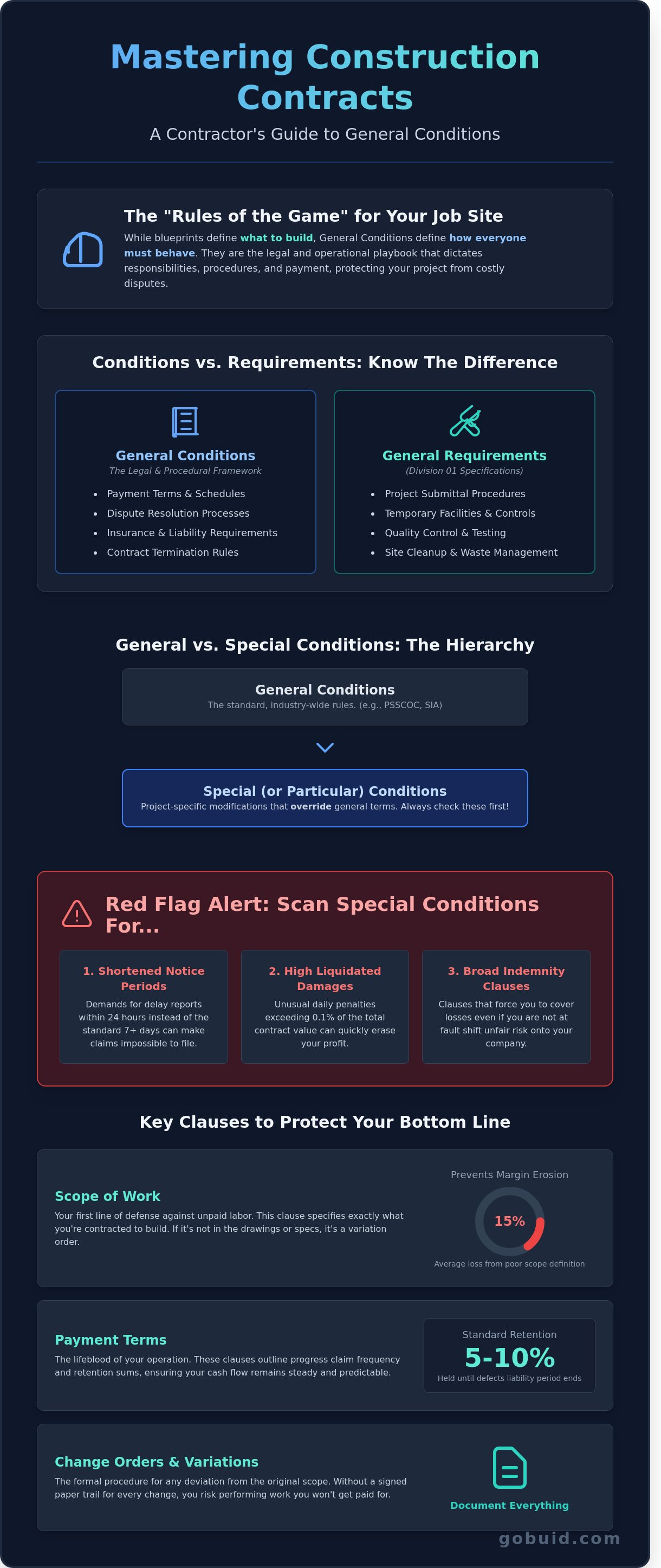
Every successful project relies on a clear playbook. While your blueprints define the physical structure, the general conditions define the legal and operational boundaries. You need to understand what is general condition of contract to protect your margins and manage your team effectively. Think of these conditions as the "Rules of the Game." Your drawings show what to build, but the general conditions dictate how everyone must behave during the process. They establish the framework for a standard Construction contract, ensuring that responsibilities aren't left to chance.
To better understand this concept, watch this helpful video:
Don't confuse General Conditions with General Requirements. General Conditions cover legal and procedural rights, such as payment terms, dispute resolution, and insurance requirements. General Requirements, found in Division 01 of the technical specifications, focus on specific work results like temporary facilities or submittal procedures. In 95% of institutional projects, standardized forms like the PSSCOC 2020 or SIA conditions are used to maintain consistency. These templates provide a reliable baseline for every stakeholder on the site.
The Purpose of Standardized Contract Conditions
Industry standard templates reduce legal friction by using tested language. They allocate risk fairly between the owner and the contractor. For example, they clarify who pays for unexpected site conditions or weather delays. A designated Contract Administrator enforces these rules. This individual acts as the referee, ensuring that field reports and payment claims follow the agreed-upon timeline. Using these standards cuts negotiation time by roughly 30% compared to custom-drafted agreements.
General Conditions vs. Special Conditions
Standard forms can't cover every unique project detail. That's where Special Conditions, or Particular Conditions, come in. These modifications override the general terms to fit specific site needs. If a conflict arises, the Special Conditions usually take precedence in the document hierarchy. Always scan these carefully for "red flags" that shift undue risk onto your shoulders. Look for these three signs in the Special Conditions:
Shortened Notice Periods: Requirements to report delays within 24 hours instead of the standard 7 days.
Liquidated Damages: Unusual daily penalties that exceed 0.1% of the total contract value.
Broad Indemnity: Clauses that force you to cover losses even if you aren't at fault.
Understanding what is general condition of contract allows you to spot these deviations before you sign. This clarity bridges the gap between the office and the field, keeping your project on track and your cash flow predictable.
Key Legal Clauses: Navigating the Rights and Responsibilities
Understanding what is general condition of contract requires a deep dive into the legal guardrails of your project. These clauses define the boundaries of your liability. They dictate how you get paid and how you handle friction. The Scope of Work clause is your first line of defense. It specifies exactly what you're building. If a task isn't in the drawings or technical specifications, it's a variation. Clear scope definitions prevent the 15% margin erosion commonly seen in projects with poorly defined boundaries. Don't let verbal agreements replace written specs.
Payment terms are the lifeblood of your operations. These clauses outline the frequency of progress claims and the percentage of retention sums. Standard contracts often hold 5% or 10% of the contract value until the defects liability period concludes. You must document every milestone to ensure cash flow remains steady. Change orders provide the formal procedure for variations. Without a signed paper trail, you're performing unpaid labor. For a look at how federal standards handle these requirements, review HUD's General Conditions for Construction, which mandates strict documentation for any change in work. Finally, dispute resolution clauses keep you out of expensive courtrooms. Most modern contracts prioritize mediation or arbitration to resolve conflicts in months rather than years.
Time and Schedule Management
Dates aren't suggestions. The Commencement and Practical Completion dates are fixed points that govern your profitability. If you miss the completion deadline, the owner triggers Liquidated Damages (LDs). These penalties often range from $500 to $5,000 per day. Protect your margin by mastering the Extension of Time (EOT) clause. Use it when delays occur due to weather, site access issues, or late approvals from the architect. You can monitor these critical milestones using real-time progress tracking tools to ensure you never miss a deadline.
Indemnity and Insurance Requirements
Construction is inherently risky. Contracts mandate specific insurance coverage to protect all parties. You'll typically see requirements for Work Injury Compensation (WICA) and Public Liability insurance. These policies cover site accidents and third party property damage. The indemnity clause determines who pays when things go wrong. Usually, the contractor bears the risk for onsite incidents. Performance bonds add another layer of security. These bonds, often 5% of the total contract sum, guarantee that you'll fulfill your obligations. They act as a financial promise that the job will reach the finish line regardless of the challenges encountered.
General Condition Costs: Managing the "Soft Costs" of the Site
General Conditions Costs are the non-permanent resources required to maintain a functional job site. While direct costs cover the physical materials like concrete and rebar, these "soft costs" represent the infrastructure of the project. Industry veterans often refer to these as site overheads or preliminaries. They're the indirect expenses that don't end up as a permanent part of the finished building but are essential for its execution. Understanding what is general condition of contract requirements is the difference between a profitable project and a financial drain.
Estimating these costs accurately during the bidding phase is a high-stakes exercise. A 2% error in site overhead calculations can easily erase a contractor's entire net profit. You must account for the duration of the project, as most of these costs are time-dependent. If a project slips by three months, your general condition costs will balloon even if the material prices remain static. Smart contractors treat these as a separate budget category to ensure every dollar spent on site management is visible and recoverable.
Personnel and Site Supervision
Your site's leadership team represents a significant portion of the general conditions budget. This includes the Project Manager, Site Engineer, and Safety Officer. These roles provide the "brain" for the operation, ensuring that field reports are accurate and schedules are met. Recovering these costs requires extreme precision. Utilizing manpower tracking is critical to verify that supervision hours align with the project's progress. Without real-time data, you're guessing at your burn rate.
Administrative staff and security personnel also fall into this category. A 24/7 security presence might cost upwards of $10,000 per month depending on the site's location and risk profile. These roles don't lay bricks, but they prevent theft and manage the flow of subcontractors. Every hour logged by these team members must be tracked against the general conditions budget to maintain financial control.
Temporary Facilities and Mobilization
A job site is a temporary city. You must budget for site offices, portable toilets, and temporary utility connections. These facilities require constant maintenance and "housekeeping" throughout the project lifecycle. A cluttered or poorly maintained site office leads to inefficiency and safety hazards. Budgeting roughly 1% to 3% of the total project value for these facilities is a common industry benchmark, but complex urban sites often demand more.
Mobilization and demobilization are the bookends of your project. Moving heavy machinery like excavators or cranes can cost between $5,000 and $20,000 per trip. You must factor in the transport, setup, and eventual removal of every piece of equipment. When you analyze what is general condition of contract details, look for how these "move-in" costs are reimbursed. Proper documentation of every facility and piece of equipment on-site ensures you aren't left footing the bill for the infrastructure that made the build possible.
Compliance and Documentation: Meeting Contractual Obligations
In construction, the golden rule is simple: if it isn't documented, it didn't happen. Understanding what is general condition of contract requires you to view documentation as a legal shield rather than an administrative chore. Your contract dictates exactly how you must report progress, and if you can't prove your work, you won't get paid for it. This section of the GC isn't about bureaucracy; it's about protecting your cash flow.
Many project managers claim they're too busy building to handle paperwork. This is a costly mistake. A 2023 industry analysis revealed that 70% of disputed claims fail because the contractor lacked contemporary evidence. You aren't just building a structure; you're building a legal case for your payment every single day. Poor record-keeping is the fastest way to see your progress claims and Extensions of Time (EOTs) rejected by the superintendent.
Maintaining the Contemporary Record
A contemporary record is a log created at the time the work occurs. It carries 100% more weight in a legal dispute than a memory-based report written weeks after the fact. You must track daily manpower logs and equipment usage reports every shift. Digital Site Diaries provide an immutable audit trail that proves exactly who was on-site and what they did. This level of detail turns your daily activities into bulletproof contractual evidence. When you define what is general condition of contract in practice, it's the daily discipline of logging every delay, weather event, and site visitor.
Safety and Quality Inspections
General Conditions contain strict Safety and Compliance clauses that you can't ignore. You must document Inspection Test Plans (ITPs) to prove you've met quality standards before moving to the next project phase. Capturing progress photos provides visual proof of work completed. These photos act as a timestamped reality check against the project schedule. Without them, you're defenseless when a client disputes the quality or completion percentage of a specific task. In 2024, 85% of successful EOT claims relied on daily logs and visual evidence to prove site conditions.
Stop leaving your revenue to chance and start documenting your success in real-time. Streamline your site reporting with Buid and ensure every claim you submit is backed by facts.
The Digital Foreman: Streamlining General Conditions with GoBuid
Manual documentation is a bottleneck where project compliance often dies. It's one thing to understand what is general condition of contract, but it's another to prove you followed every rule. Paper-based systems create a gap between the site and the office, leading to lost data and missed deadlines. GoBuid acts as your digital foreman. It bridges that gap by turning raw site activity into organized, contractual proof. This software doesn't just store data; it manages the chaos of the job site with professional precision.
The "one-click report" feature is the core of this efficiency. Instead of spending hours compiling notes at the end of the week, you generate a professional document instantly. This gives you the evidence needed to defend your position during any dispute. GoBuid becomes an essential member of your project team, ensuring that your compliance is as rugged as the structures you build.
Automating Daily Site Records
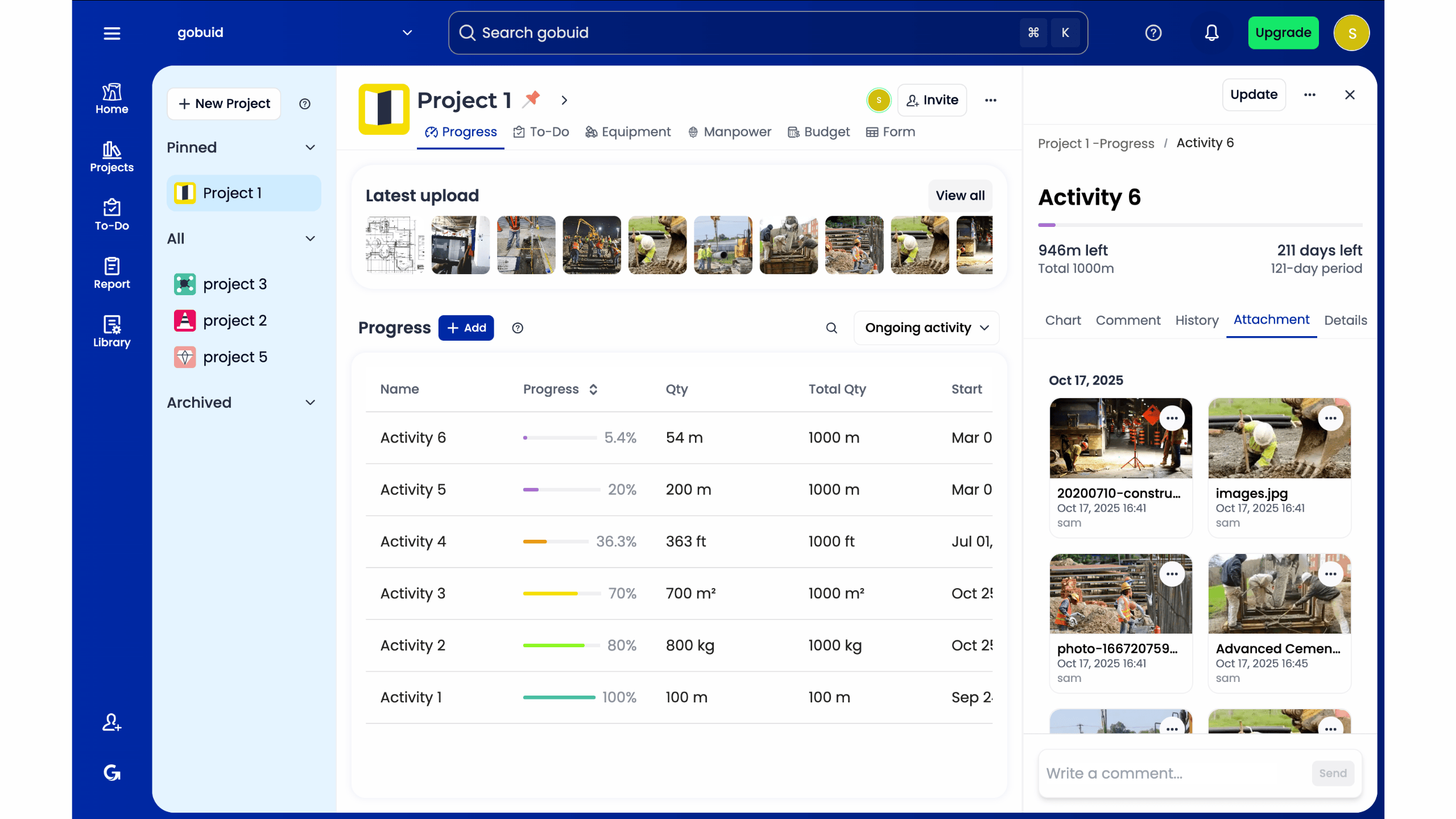
Field teams often view paperwork as a distraction from the real work. GoBuid changes that mindset by putting documentation tools directly onto mobile devices. You can capture manpower and equipment data in seconds while walking the site. This shift to digital automation reduces administrative overhead by 40% for most project managers. By using a customized form, you ensure that every site record meets the specific requirements of your contract. This isn't just about logging hours; it's about building a bulletproof history of the project.
Capture high-resolution site photos linked to specific daily logs.
Track equipment hours to prevent overbilling on rental items.
Sync field data to the office in real-time for immediate review.
Real-Time Visibility and Analytics
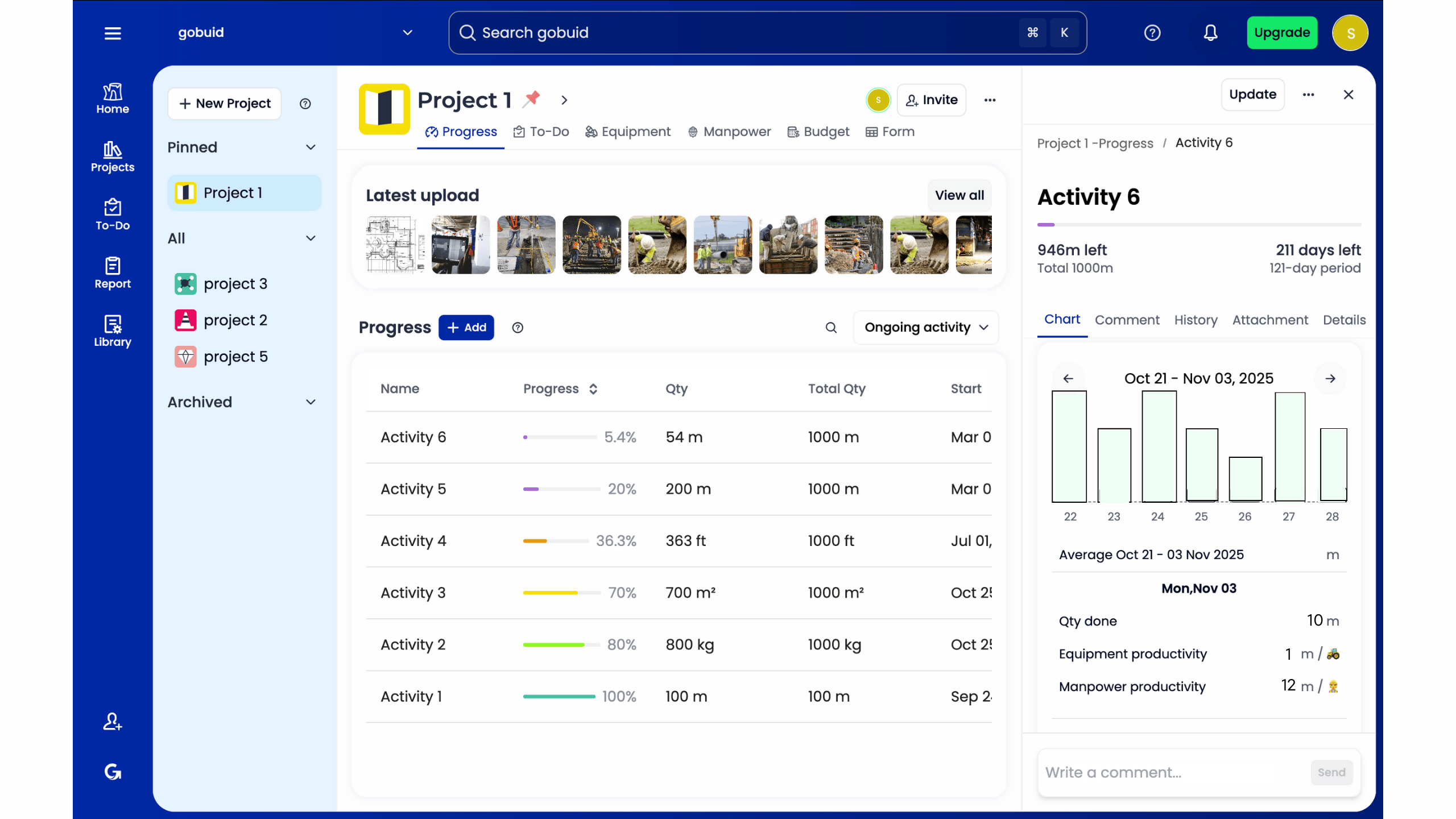
Waiting for month-end reports is a recipe for project failure. You must see how site realities impact your bottom line right now. The Project Analytics Dashboard provides a live view of your general condition costs versus your budget. If you notice a spike in labor costs, you can investigate the cause immediately. This visibility is vital for identifying potential delays before they trigger Liquidated Damages or other financial penalties.
Effective management requires a clear understanding of what is general condition of contract and how those costs are trending. GoBuid provides a single source of truth that keeps everyone accountable. You no longer have to guess about project health. The data is there, it's accurate, and it's ready to be used. This level of transparency builds trust with owners and ensures your project stays on the right side of the contract rules.
Master Your Project Rules for Peak Performance
Understanding what is general condition of contract turns a complex legal document into a clear roadmap for site success. These rules establish the foundation for every task, from managing soft costs to meeting strict regulatory requirements. You've learned that site documentation isn't just a chore; it's a vital record that protects your business and ensures 100% BCA-compliant documentation across every phase. Efficiency on the site depends on having a single source of truth that keeps everyone accountable.
GoBuid serves as your digital foreman, providing the technological edge needed to handle these responsibilities without the manual grind. You can generate professional reports in one click and monitor manpower in real-time, cutting administrative overhead by 40% on average. This visibility allows you to bridge the gap between field operations and office management instantly. Stop letting documentation gaps risk your profitability and start using a tool built for the modern contractor.
Start your no-lock-in trial with GoBuid and simplify your site documentation.
Take control of your workflow and build with absolute confidence today.
Frequently Asked Questions
What is the difference between General Conditions and General Requirements?
General Conditions define the legal relationships, responsibilities, and rights of all parties involved in the project. General Requirements, often found in Division 01 of the specifications, detail the specific administrative and procedural tasks required on-site. Think of General Conditions as the rules of the game and General Requirements as the specific plays you must execute to win.
Are General Conditions costs the same as overhead?
No, General Conditions represent project-specific indirect costs while overhead covers your company's general operating expenses. General Conditions include items like site-specific project manager salaries or temporary fencing for a single job. Overhead includes your 12-month office lease and executive salaries that exist regardless of any specific active project. You must track these separately to maintain accurate job costing.
Can General Conditions be modified during a project?
You can modify General Conditions through Supplementary Conditions before signing or via formal Change Orders during construction. Most standard forms, like the SIA Building Contract, allow for project-specific adjustments to suit unique site constraints. Any change after the contract execution requires a bilateral agreement and a signed amendment to remain legally binding. Never rely on verbal agreements to shift these fundamental rules.
Who pays for General Conditions in a construction contract?
The project owner pays for General Conditions as a line item within the total contract sum. Contractors include these costs in their bid to cover the essential expenses of maintaining a job site. In a typical $5,000,000 commercial project, these costs usually range from 6% to 12% of the total budget. If you under-calculate these figures, you'll end up paying for the site's existence out of your own profit.
What happens if a contractor fails to meet a General Condition?
Failure to meet a General Condition constitutes a breach of contract that can trigger liquidated damages or even contract termination. If you fail to maintain the required $1,000,000 insurance coverage or miss critical submittal deadlines, the owner can legally halt progress payments. This creates a massive bottleneck that threatens your cash flow and ruins your project schedule. Clear visibility into these requirements is your best defense against litigation.
How do I calculate General Conditions costs for a bid?
Calculate these costs by totaling every project-specific indirect expense across your estimated timeline. Use a detailed spreadsheet to track monthly site office rentals, utility fees, and supervision salaries. Understanding what is general condition of contract pricing allows you to protect your 10% net margin from being eroded by overlooked site expenses. Accurate estimation ensures you aren't subsidizing the owner's project with your company's capital.
What are the most common General Conditions in Singapore construction?
The SIA Building Contract and the REDAS Design and Build Contract are the 2 primary standards used across Singapore. These documents define the roles of the Architect and the Superintending Officer while establishing the 28-day window for payment certification. They also provide the specific protocols for Extension of Time claims and the handling of variations. Knowing these standards is essential for anyone asking what is general condition of contract in the local market.
Is a Site Diary a legal requirement under General Conditions?
A Site Diary is a mandatory legal record required by most General Conditions to document daily progress and weather conditions. It serves as the primary evidence during dispute resolutions and Extension of Time claims. Using Buid to digitize your site diary creates a single source of truth that protects your firm from unfair claims. This digital record bridges the gap between field activity and office documentation with 100% accountability.