
Precast Concrete Piles: A Professional Guide to Installation and Management
by Michael R. Henderson
|
A single missing blow count in a piling log can trigger a $15,000 foundation redesign before your team even clears the site. You already know that foundation work is the highest-risk phase of any construction project. Managing Precast Concrete Piles requires more than just heavy machinery; it demands absolute precision in real-time data collection. Manual paper logs and fragmented spreadsheets create a documentation bottleneck that slows down your crew and leaves your firm vulnerable to costly compliance audits.
You don't have to choose between speed and accuracy. This guide shows you how to master the technical essentials of precast piling while slashing your administrative reporting time by 40%. We'll bridge the gap between the field and the office, helping you regain control over your chaotic workflows. We examine pile selection, driving techniques, and the digital tools required to ensure 100% data accuracy for every quality inspection. It's time to build a single source of truth for your deep foundation projects and maximize your site productivity through better management.
Key Takeaways
Master the technical driving sequence and hydraulic hammer techniques to ensure every pile reaches its required design capacity.
Leverage the high-strength reinforcement and structural advantages of Precast Concrete Piles manufactured in controlled factory environments.
Identify and mitigate hidden risks such as internal fractures and spalling to maintain rigorous quality control during installation.
Bridge the gap between the field and the office by implementing digital site diaries that centralize all piling documentation.
Capture real-time progress photos to provide a single source of truth and prove site compliance without manual paperwork.
⭐ Learn more about GoBuid's feature- without the heavy enterprise price tag
What are Precast Concrete Piles: Types and Advantages
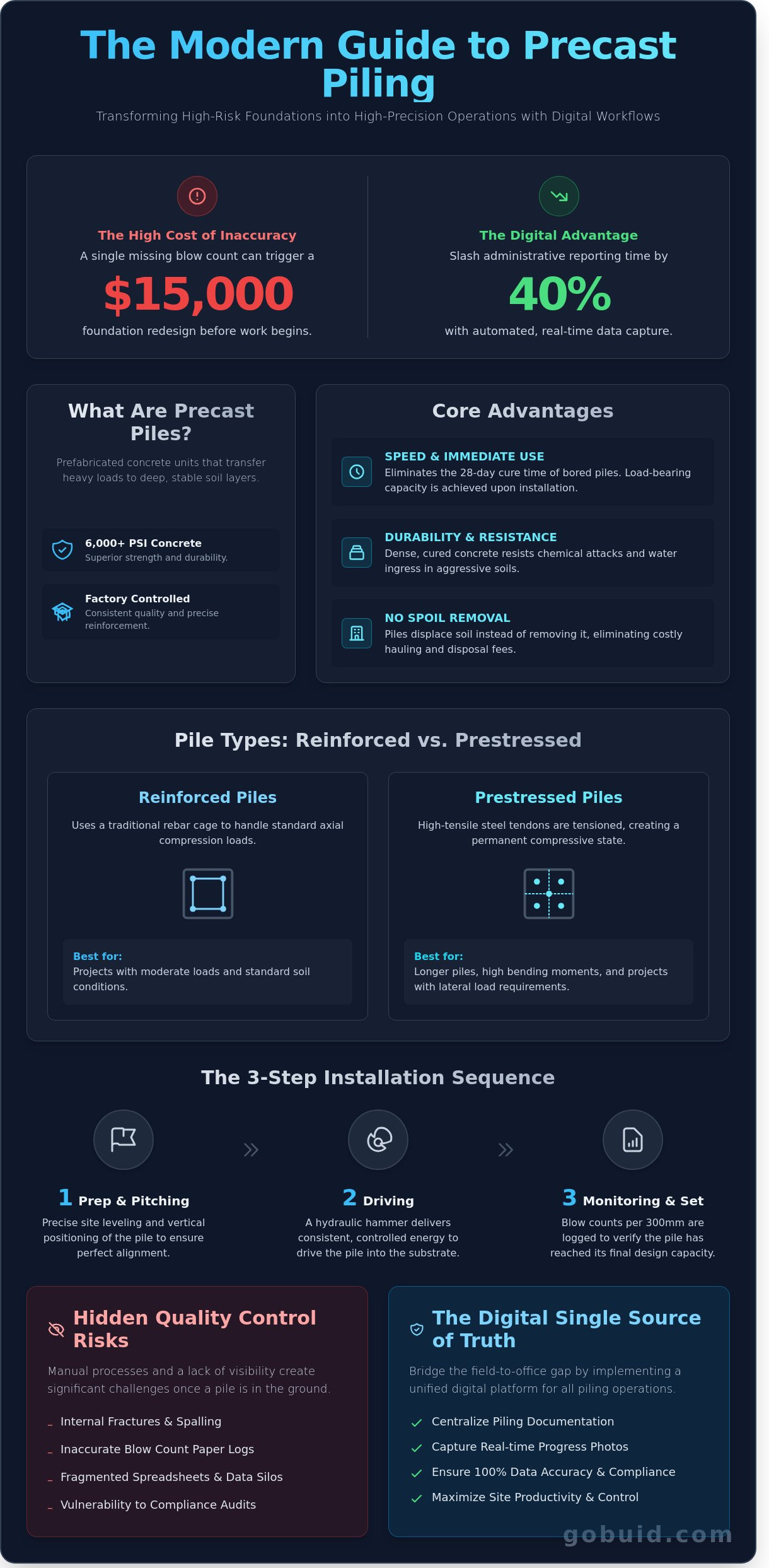
Precast concrete piles are prefabricated structural members designed to transfer heavy loads to deeper, more stable soil layers. These units are a critical component of a Deep foundation system. Unlike cast-in-situ methods, these piles are manufactured in a controlled factory environment. This ensures 6,000 PSI or higher concrete strength and precise reinforcement placement. You get a consistent product that site-poured methods can't match. Every unit meets strict quality standards before it ever reaches the field.
To better understand the physical installation of these units on-site, watch this practical demonstration:
Speed drives profitability on the modern job site. Precast Concrete Piles eliminate the 28-day cure time required for bored piles. You drive them and move to the next task immediately. This efficiency is vital for sites with high water tables or aggressive sulfate-rich soils. Since the concrete is already cured and dense, it resists chemical attacks and water ingress that would compromise wet concrete during a pour.
Reinforced vs. Prestressed Concrete Piles
Standard reinforced piles use traditional rebar cages to handle axial loads. Prestressed variants go further. They utilize high-tensile steel tendons that are tensioned before the concrete is poured. This pre-tensioning process creates a permanent compressive state. It prevents cracking during transport and handles the high bending moments caused by hammer impacts. Choose prestressed piles for longer lengths or projects with high lateral load requirements.
Key Benefits for Modern Construction Projects
Modern projects demand lean operations. Precast piles deliver immediate load-bearing capacity. There's no waiting for chemistry to happen on-site. You also eliminate spoil removal. Bored piles can generate 100% of the hole's volume in waste soil, which requires expensive hauling and disposal. Precast piles displace soil instead of removing it. This reduces logistical costs and keeps your site cleaner. Use real-time reporting to track driving depth and blow counts for every pile to ensure total accountability.
Installation Process: Driving and Splicing Techniques
Precision is the baseline for every drive. Installing Precast Concrete Piles requires a disciplined sequence to ensure structural integrity. It begins with precise site leveling and pile pitching. Once the pile is vertical, the hydraulic hammer delivers consistent energy to drive the unit into the substrate. Monitoring blow counts per 300mm of penetration is mandatory. These metrics provide the data needed to determine when the pile has reached its final set. This "set" confirms the pile has hit the required bearing stratum, a process detailed extensively in the American Concrete Institute (ACI) Guide. Proper Equipment Management ensures that piling rigs operate at peak performance throughout this high-stress phase.
Essential Equipment for Piling Operations
Success on the job site depends on three primary assets: hydraulic piling rigs, service cranes, and specialized impact hammers. Rigs must be calibrated to handle specific pile weights and soil resistance. Tracking equipment uptime in real-time isn't a luxury; it's a necessity. A 12% drop in rig availability can trigger a cascade of schedule delays that inflate project costs. Managers should use centralized dashboards to monitor machine health and hydraulic pressure. You can optimize your fleet visibility to see how real-time data reduces these operational risks.
Splicing Methods for Deep Foundations
When Precast Concrete Piles must reach depths exceeding standard 12-meter or 15-meter lengths, splicing is required. Mechanical joints offer a fast solution that minimizes downtime by locking sections together instantly. Welded plates provide a rigid connection but require certified onsite welders and rigorous cooling periods. Every splice must be inspected and logged. Documenting splice integrity in daily field reports creates a permanent record of the foundation's strength. This level of transparency ensures that the office stays informed of field progress without the need for manual follow-up.
Critical Risks and Quality Control in Piling
The primary objection to using Precast Concrete Piles is simple: how do you verify the integrity of a structure you can't see? Once a pile disappears into the ground, visual confirmation is impossible. This lack of visibility hides critical failures like spalling or internal fractures caused by excessive driving stress. Subsurface obstructions, such as large boulders or varying soil densities, frequently force piles out of vertical alignment. These deviations create eccentric loading, which can lead to structural failure if not identified during the installation phase.
Managing these risks requires a systematic approach to Safety & Quality Inspections. Real-time monitoring allows project managers to identify refusal or alignment issues immediately. Without this oversight, a single damaged pile can compromise the entire foundation, leading to millions in remediation costs. Success depends on catching defects before the pile is capped and integrated into the structure.
Load Testing and Integrity Verification
Verification provides the empirical evidence needed to trust the foundation. Dynamic Load Testing (DLT) uses high-strain sensors to estimate bearing capacity and monitor hammer performance during driving. To assess the physical condition of the shaft, engineers use Pile Integrity Testing. PIT is a low-strain non-destructive test used to detect major cracks or voids. These methods ensure that the Precast Concrete Piles meet the design specifications without requiring destructive excavation.
Maintaining Accurate Piling Logs
Data integrity is the backbone of quality control. Every installation must generate a comprehensive log containing the pile ID, date, installation depth, blow counts per foot, and the final set. Paper-based systems are the weakest link in this chain. Industry data shows that manual transcription from paper to Excel leads to 15% data error rates. These inaccuracies result in miscalculated capacities and rejected submittals. Moving to a digital source of truth eliminates these transcription gaps and connects field data directly to the office.
Stop guessing about your foundation's health. Centralize your piling logs to ensure 100% data accuracy and project transparency.
Streamlining Piling Projects with Digital Site Diaries
Managing the installation of Precast Concrete Piles requires more than just heavy machinery; it demands absolute data integrity. GoBuid acts as your digital foreman, bridging the gap between the mud of the job site and the precision of the back office. By capturing Progress Photos directly on-site, teams prove compliance instantly. Every photo is a timestamped record of quality, ensuring that pile integrity meets structural specifications without the need for manual filing or messy email chains.
Efficiency shouldn't be a luxury. GoBuid allows project managers to generate reports in one click, turning hours of data entry into seconds of output. This centralized source of truth ensures that piling progress is visible to every stakeholder in real time. You get the clarity needed to make decisions based on facts, not guesswork. It's about moving faster without losing control.
Transitioning from Paper to Digital Forms
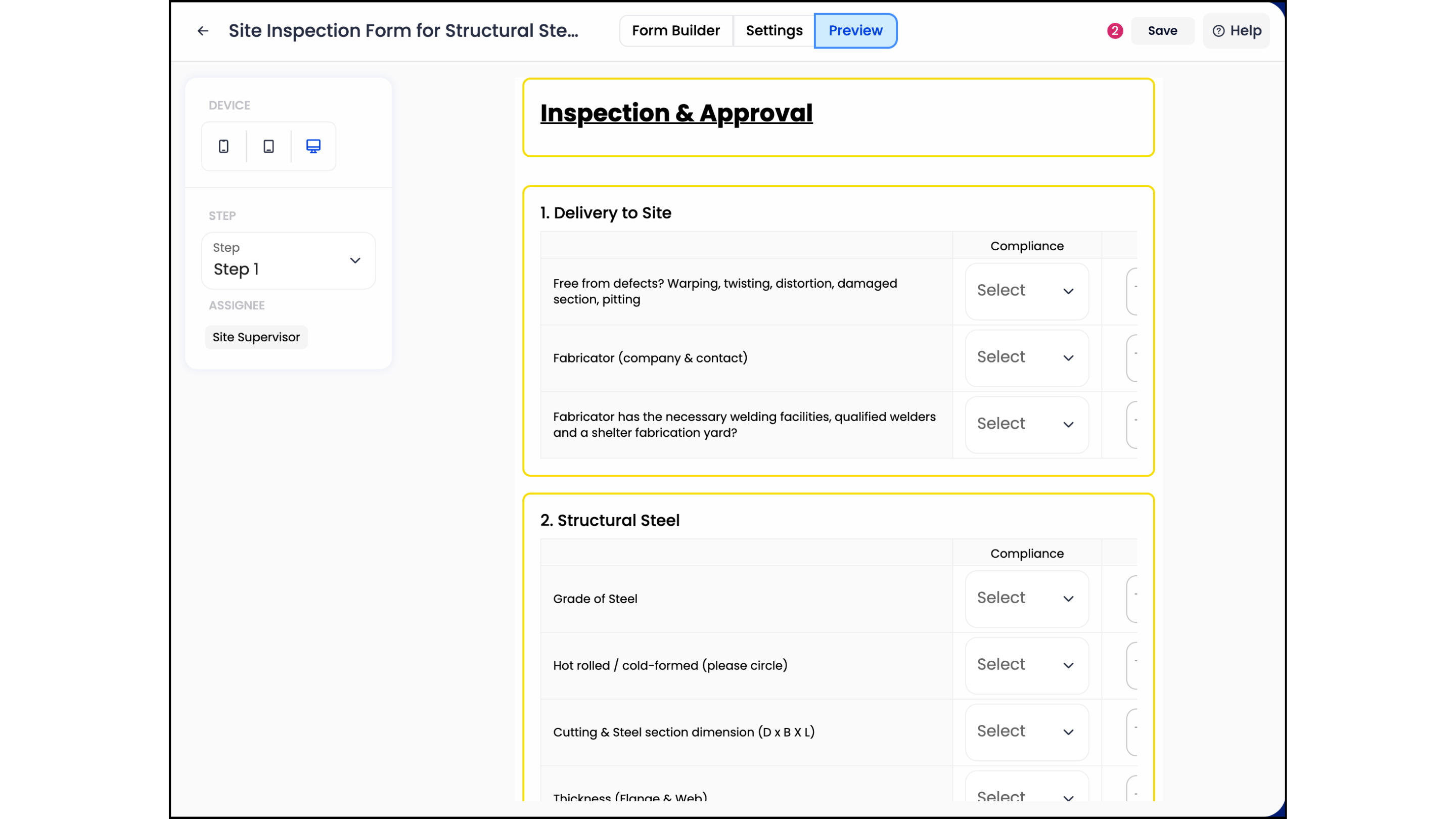
Paper logs are prone to loss and error. Customised forms replicate your existing piling logs while adding GPS and timestamp validation. This ensures every entry is authentic and geographically accurate. You'll also gain real-time manpower tracking. Knowing exactly who is on-site and for how long allows for precise labor cost analysis, which is vital for specialized piling crews working on tight margins. Digital forms don't just save paper; they secure your data.
Project Analytics for Foundation Works
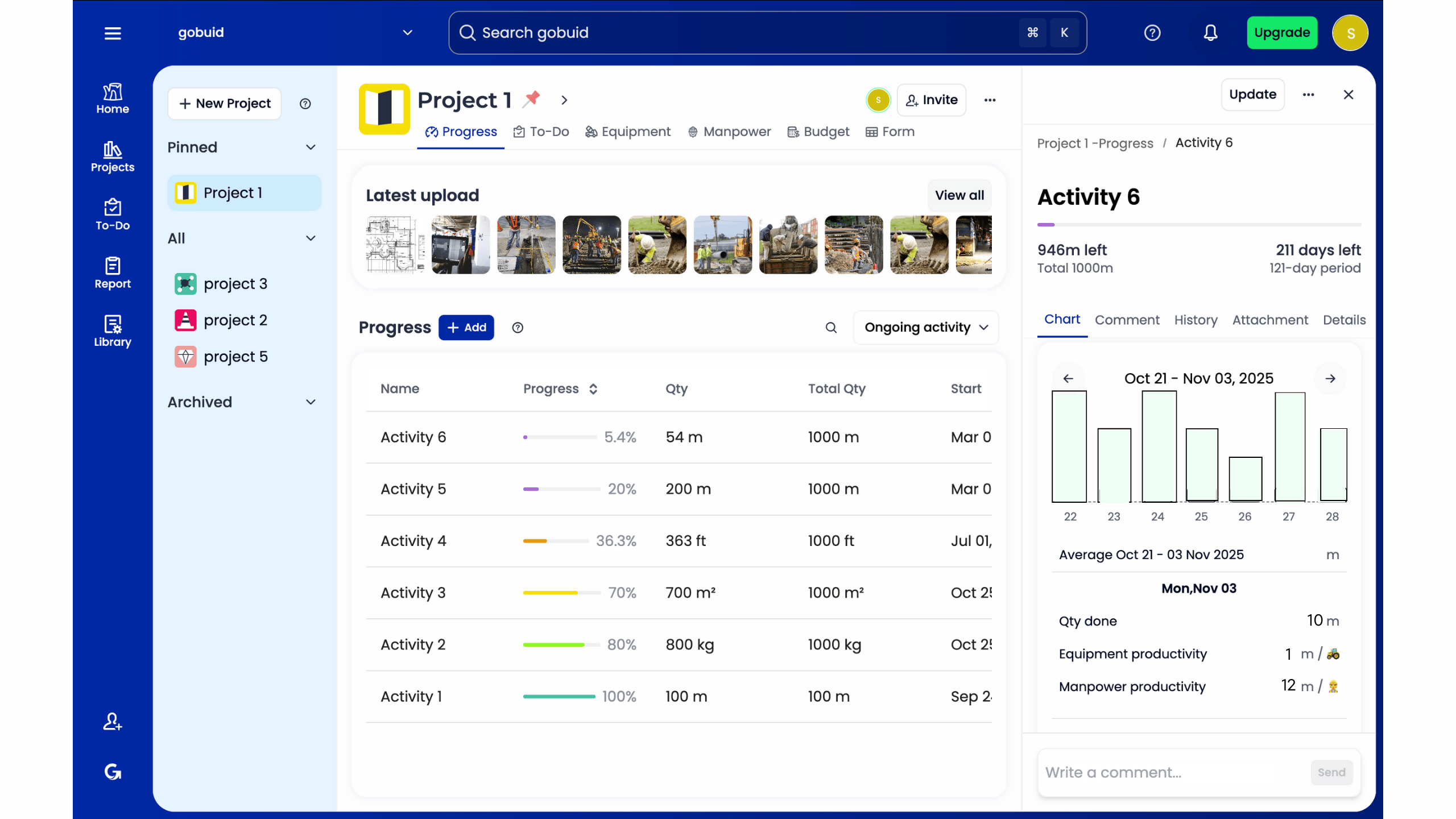
A Project Analytics Dashboard transforms raw numbers into actionable strategy. You can track Precast Concrete Piles installation rates against the master schedule with surgical precision. If production slows by 12%, the system flags it immediately. These data-driven insights help project managers anticipate delays before they hit the critical path. You're not just reacting to problems; you're staying ahead of them to protect your profitability and project timeline.
Master Your Piling Projects with Precision and Speed
Precision defines the success of your foundation. Managing Precast Concrete Piles effectively requires mastering complex driving techniques while maintaining strict quality control across every splice. Top contractors now prioritize BCA compliance through real-time data capture to eliminate costly errors. You can't afford visibility gaps between the field and the office. Digital site diaries transform chaotic field notes into professional submittals instantly. This shift ensures every driven pile meets engineering specifications without the burden of manual paperwork. It's time to replace outdated logs with automated workflows that keep your project moving forward. Centralized reporting provides the single source of truth your team needs to stay accountable and productive.
Take control of your job site documentation today. Book a demo to see how GoBuid generates your piling reports in one click. Our platform is used by industry leaders to reduce reporting time by up to 50% and features no lock-in contracts. Experience the efficiency of a digital foreman on your next project. Let's build a more transparent future together.
Frequently Asked Questions
What is the difference between precast and cast-in-situ piles?
Precast piles are manufactured in controlled factory environments before delivery, while cast-in-situ piles are poured directly into bored holes on-site. Precast units offer higher concrete density and immediate load-bearing capacity upon installation. Cast-in-situ methods require a 28-day curing period before they reach full design strength. Precast Concrete Piles eliminate the risk of soil contamination during the pouring process, ensuring consistent structural integrity across the entire pile length.
How long do precast concrete piles typically last?
Precast concrete piles typically last 75 to 100 years when installed according to ACI 318 or Eurocode 2 standards. Their durability stems from high-strength concrete mixes, often exceeding 50 MPa, which resist chloride penetration and sulfate attack. Most submerged sections remain stable for decades due to the anaerobic environment. Proper project management ensures these foundations outlast a standard building's 50-year design life by a significant margin.
What equipment is essential for driving precast concrete piles?
Driving precast concrete piles requires a dedicated piling rig equipped with a hydraulic or diesel hammer and a set of leaders. You'll also need a crane for handling, a pile helmet to protect the head, and a plywood cushion to distribute impact forces. Modern rigs utilize GPS-integrated sensors to track the verticality and depth of every strike. This hardware setup ensures 100% alignment accuracy during the initial penetration phase.
How do you ensure the quality of a driven pile that is underground?
You ensure quality through High-Strain Dynamic Testing (PDA) and Pile Integrity Testing (PIT) to verify the structural health of the shaft. PDA testing provides real-time data on bearing capacity and hammer efficiency; PIT uses sonic echoes to identify cracks or necking. Engineers analyze the wave equation to confirm the pile reached the required set. Digital field reports capture these metrics instantly, creating a single source of truth for the foundation.
Can precast piles be used in all soil conditions?
Precast piles work in most soil types, but they're most effective in soft clays, silts, and loose sands where they can reach a hard bearing stratum. They struggle in dense rock or soils with large boulders where driving may cause the concrete to shatter. In 90% of soft-soil projects, displacement piles improve the surrounding ground density. If you encounter hard rock at shallow depths, pre-drilling or switching to bored piles is usually necessary.